Showing posts with label working mother. Show all posts

Friday, May 10, 2024

AASWomen Newsletter for May 10, 2024

AAS Committee on the Status of Women
Issue of May 10, 2024
eds: Jeremy Bailin, Nicolle Zellner, Sethanne Howard, and Hannah Jang-Condell

[We hope you all are taking care of yourselves and each other. --eds.]

This week's issues:
Gruber Prize Recipient Marcia Rieke.
Image Credit: NASA

1. Advocating to Change Academia for Mothers 
2. Marcia Rieke Receives $500,000 Gruber Cosmology Prize
3. AIP Launches the Diversity, Equity, Inclusion, Belonging, & Accessibility Strategic Plan
4. 2024 Advancing IDEA in Planetary Science Conference: Save the Date  
5. 4 Amazing Women From History You’ve Probably Never Heard Of
6. Graphic novels can help boost diversity in STEM 
7. How to Submit to the AASWomen Newsletter
8. How to Subscribe or Unsubscribe to the AASWomen Newsletter
9. Access to Past Issues of the AASWomen Newsletter

An online version of this newsletter will be available at http://womeninastronomy.blogspot.com/ at 3:00 PM ET every Friday.

Thursday, April 20, 2023

Requesting Input for Study on Caregiving

By Jeff Gillis-Davs, Washington University


The National Academies of Sciences, Engineering, and Medicine convened a committee on Policies and Practices for Supporting Family Caregivers Working in Science, Engineering, and Medicine. Two of the goals of this committee are:

  • Summarize the published research on the challenges faced by scientists, engineers, and medical professionals who are family caregivers (i.e., parents and those with eldercare responsibilities, or both), including research on the impact of COVID-19 these individuals;
  • Document institutional and governmental efforts to support caregivers and the positive and negative impacts of such efforts (if known), including any unintended consequences of well-intentioned policies and practices;

We seek your input (basically white papers, but we're calling them dear colleague letters) on our study examining policies and programs to support the retention, re-entry, and advancement of students and professionals working in academic science, engineering, and medicine with caregiving responsibilities (e.g., these responsibilities include caregiving for kids, spouses, significant others, dependent adults, parents, etc.). 


To share information, please submit a description and any related publications 

by June 1, 2023, using this link.


Although the primary focus of the study is women caregivers in science, engineering, and medicine, people of all genders, including men, face obstacles as caregivers. Therefore, the study scope will include caregivers of all genders but emphasize women. The study will also take an intersectional approach and place particular emphasis on the experiences of the most marginalized groups in science, engineering, and medicine, such as women of color, who remain particularly underrepresented in these fields.


For questions, please contact j.gillis-davis_at_wustl.edu.


Tuesday, November 16, 2021

Crosspost: The Impacts of Parenthood Are Not Equal

Written By Shelley O’Brien for AWIS

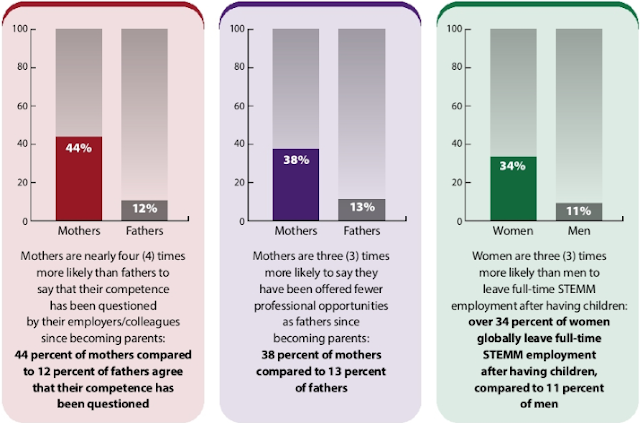
According to research from Mothers in Science's 2020 global survey on the impact of parenthood in STEM careers, mothers are more likely to be perceived as less competent and offered fewer professional development opportunities compared to fathers. 

Research shows that women who become mothers are offered fewer opportunities and earn less over their careers. Men who become fathers do not experience these severe consequences. Consider these data points from the Mothers in Science 2020 pre-COVID-19 global survey* “Impact of Parenthood on Career Progression in STEMM.”

Mothers are perceived as less dedicated employees and less competent due to implicit bias and structural problems that have nothing to do with motherhood. For example, as the COVID-19 pandemic has demonstrated, women carry more of the burden for childcare and eldercare than men. Mothers require support from their partner at home, flexible workplace policies, and affordable and accessible childcare options. However, not everyone has access to these resources.

To be healthy and successful at work, women need to be able to 1) seek medical attention and informed advice and 2) to be able to make decisions about their reproductive health, including the choice about whether to have, and when to have, children. In science-oriented careers, particularly those in higher education where tenure may depend on stepped and timed advancement, the impact of an unplanned pregnancy can be especially significant.

Since men do not experience these challenges, any laws that interfere with women’s reproductive health, including the timing of pregnancy, unfairly target women — especially underprivileged women who do not have access to birth control, proper healthcare, transportation, and/or finances to obtain the care they need. To support women’s careers, we need to support their right to choose.

To learn more about Mothers in Science and ways to support the right to parenthood for all scientists, be sure to check out the Association for Women in Science's What’s Next webinar at 3 PM EST on Thursday, November 18, 2021 featuring Dr. Isabel Torres, CEO and co-founder of Mothers in Science.

*The Mothers in Science survey “Impact of parenthood on career progression in STEMM” was conducted between September 15th and December 31st, 2020. All responses correspond to the participants’ situation prior to COVID-19, and therefore, do not reflect the additional pressures brought on by the pandemic. The answers are based on self-report. A total of 8,930 participants, including mothers, fathers and non-parents, completed the survey. The study brings together survey participants from 128 countries, although the following countries are over-represented: the US, France, UK, Germany and Australia. As expected, women are also over-represented in the survey, which can be common in surveys related to women and caregiving issues. The survey was designed and led by Mothers in Science and conducted in partnership with INWES, Washington University St Louis, Parent in Science, Femmes & Sciences and 500 Women Scientists. Mothers in Science is analyzing the data in collaboration with a team of statisticians from the Universities of Grenoble, France and University of Toulouse, France.

Friday, June 21, 2019

AASWomen Newsletter for June 21, 2019

AAS Committee on the Status of Women AAS Committee on the Status of Women
Issue of June 21, 2019
eds: Nicolle Zellner, Heather Flewelling, Maria Patterson, and JoEllen McBride

[AAS has migrated their email system to Microsoft Exchange, so please check your spam folder if you did not receive the newsletter this week. It is no longer possible to subscribe or unsubscribe to the AASWomen newsletter by means of Google Groups. We have updated our subscribe and unsubscribe instructions below. Please follow us on social media for updates and thank you for bearing with us as we work out all the kinks.
Twitter @AAS_Women Facebook https://bit.ly/2PkU9of

Sally Ride, from item 2
This week's issues:

1. Crosspost: Symposium in Honor of the Legacy of Vera Rubin

2. Sally Ride became the first American woman in space 36 years ago today

3. A Push For More Inclusivity In Science

4. US science agencies report ‘shockingly low’ rates of harassment complaints

5. NIH should ask both institutions and investigators to report sexual harassment findings, advisory group says

6. Unintended consequences of gender-equality plans

7. Psychology Today: It’s Not You, It’s Them

8. Where Are All the Working Mothers in STEM?

9. Making space for female scientists' voices online, in the media and in person

10. Why women in tech are being Photoshopped in instead of hired

11. What it's like to be a trans scientist with imposter syndrome - Lady Science

12. An interview with the CLEAR Lab’s Queer Science Reading Group

13. Job Opportunities

14. How to Submit to the AASWomen Newsletter

15. How to Subscribe or Unsubscribe to the AASWomen Newsletter

16. Access to Past Issues of the AASWomen Newsletter

Monday, July 28, 2014

Please do not disturb: Pumping in progress

This is the sign that adorns my office doorknob every day around noon and again at 3. And this is more or less what I look like as I pump -- yes, quite the fashion statement. Thankfully my officemate is comfortable with my pumping in our office. More importantly, however, is that I have the convenient option to use the new lactation room in my building.

Northwestern University's Tech Building is no exception. The Patient Protection and Affordable Care Act (PPACA) requires employers to allow time for pumping as well as a reasonable space (that's not a bathroom!) to pump. Specifically, the law requires that employers “provide a reasonable break time for an employee to express breast milk for her nursing child for one year after the child’s birth each time such employee has need to express milk.” Moreover, employers must “provide a place, other than a bathroom, that is shielded from view and free from intrusion from co-workers and the public” for nursing employees.