Showing posts with label Why So Few?. Show all posts

Monday, December 21, 2015

Why So Few? Unconscious Bias II


The 2010 report entitled, Why So Few? Women in Science, Technology, Engineering, and Mathematics, by the American Association of University Women (AAUW), finds that women continue to experience more overt discrimination, as well as the more unconscious bias, in science and engineering. Research by Dr. Madeline Heilman at New York University shows that women in so-called masculine jobs or nontraditional fields, which includes science and engineering, often find themselves in a double bind.
 
First, women in these “masculine” jobs are often judged to be less competent than their male peers, unless the women are clearly successful in their work. But when a woman is clearly competent in a “male” job or position, she is often judged to be less likable. Because both likability and competence are needed for success in the workplace, women in STEM fields can find themselves in a double bind. Therefore, the implications of these findings are enormous. Being seen as either less competent or less likable can affect relationships with peers, evaluations, and recommendations for promotion and salary increases.

Wednesday, July 1, 2015

Why So Few? Unconscious Bias I

The 2010 report entitled, Why So Few? Women in Science, Technology, Engineering, and Mathematics, by the American Association of University Women (AAUW), finds that bias, often unconscious, continues to limit women’s progress in scientific and engineering fields. Research by Dr. Mahzarin Banaji, a former AAUW fellow, and her colleagues at Harvard University shows that even individuals who consciously reject negative stereotypes about women in science often still believe that science is better suited to men than women at an unconscious level. These unconscious beliefs or implicit biases may be more powerful than explicitly held beliefs and values simply because we are not aware of them.

Monday, November 24, 2014

Spatial Skills, STEM, and the Gender Gap*

Most engineering faculty have highly developed 3-D spatial skills and may not understand that others can struggle with a topic they find so easy. Furthermore, they may not believe that spatial skills can be improved through practice, falsely believing that this particular skill is one that a person is either “born with” or not. They don’t understand that they probably developed these skills over many years.                             
 —Sheryl Sorby
 
One of the most persistent gender gaps in cognitive skills is found in the area of spatial skills, specifically on measures of mental rotation, where researchers consistently find that men outscore women by a medium to large margin (Linn & Petersen, 1985; Voyer et al., 1995). While no definitive evidence proves that strong spatial abilities are required for achievement in STEM careers (Ceci et al., 2009), many people, including science and engineering professors, view them as important for success in fields like engineering and classes like organic chemistry. The National Academy of Sciences states that “spatial thinking is at the heart of many great discoveries in science, that it underpins many of the activities of the modern workforce, and that it pervades the everyday activities of modern life” (National Research Council, Committee on Support for Thinking Spatially, 2006, p.1).
 
Sheryl Sorby, a professor of mechanical engineering and engineering mechanics at Michigan Technological University, has studied the role of spatial-skills training in the retention of female students in engineering since the early 1990s. She finds that individuals can dramatically improve their 3-D spatial-visualization skills within a short time with training, and female engineering students with poorly developed spatial skills who receive spatial visualization training are more likely to stay in engineering than are their peers who do not receive training.
 

Wednesday, November 19, 2014

Why I think diversity is good, but the wrong target

There have been many posts on this blog and elsewhere calling for increased diversity in astronomy. I've written about it. My student has written about it. Diversity has many benefits, and we're missing out on those benefits by not having a more diverse field of science. However, I'm becoming less and less enamored with diversity as a target or goal in and of itself.
This stock photo shows more diversity than exists in astronomy today, but illustrates
what counts as diversity in most campus discussions. The out-of-focus Black person
is particularly apropos to this discussion.
Short Version

If we only focus on diversity, we'll be like a CEO saying that her goal is to "make money." Ohhh-kay. But how, specifically? By what strategy and mechanisms will the CEO make money? 

It'd be like a coach of a sports team saying, "Our goal is to score more points than our opponents!" By what strategy? What offensive and defensive approach will you use? "Nope, we're just focused on scoring points!"

Diversity is something we should strive for. But how will we get there? I contend that we'll only get to diversity by attacking the power structures that hold us back and stand in the way of diversity. For gender diversity, the roadblock is sexism. For racial diversity, the roadblock is racism

So rather than focusing on diversity as a target, we should instead aim at equal opportunity. Sexism and racism aim to deny equal opportunities to those outside of the white-male power structure. White women have made gains by directly attacking sexist power structures. But this process has left women of color behind. Gains for women (and men) of color will only be made once organizations such as the CSWA start taking an intersectional approach that recognizes that women of color face not only sexism, but racism as well in their daily lives (note how this direct attack on power structures contrasts with "multiculturalism"). 

Long Version

Wednesday, November 5, 2014

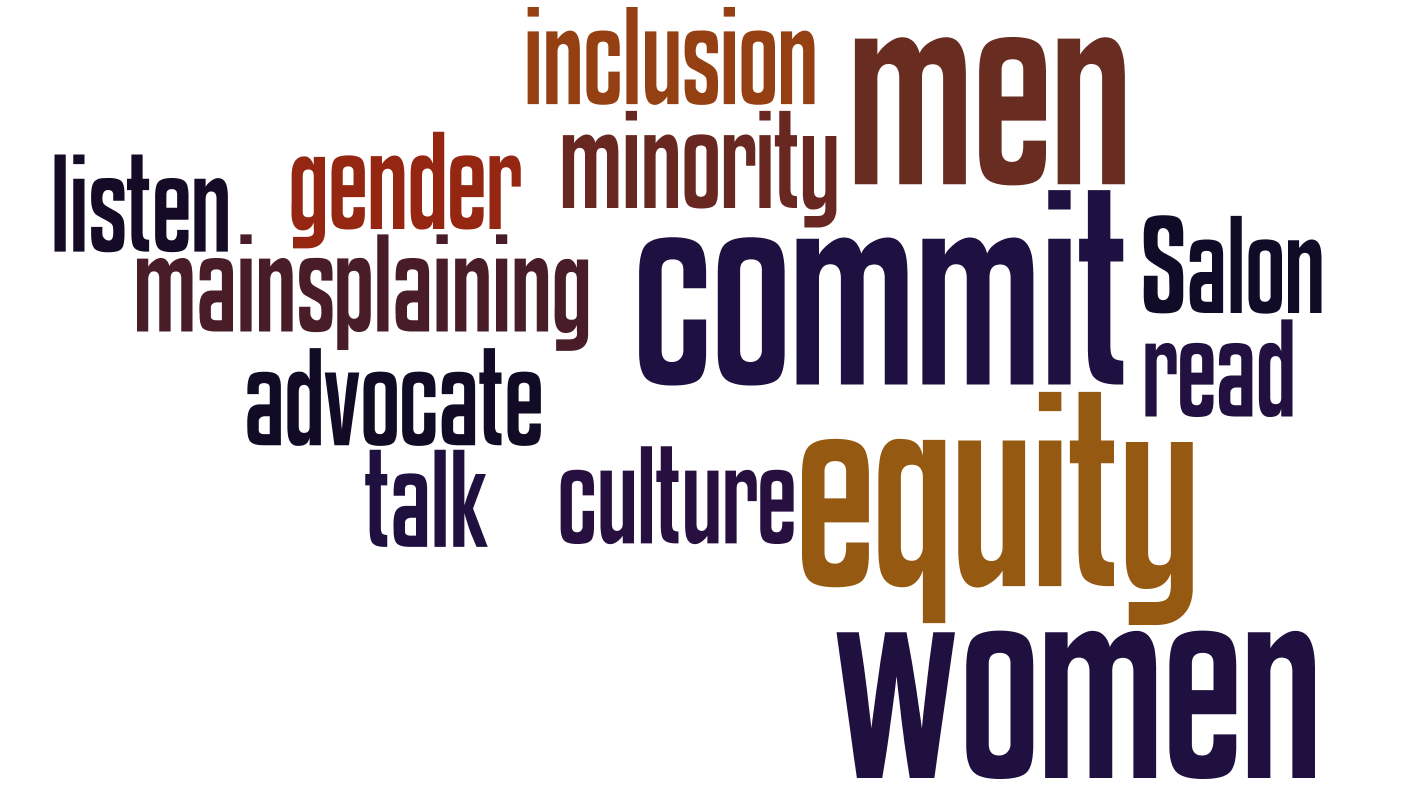
Top Five Tips for Men

www.wordle.net
There's so much to write about this week on the topic of gender equity, I hardly know where to start.  I'll back up two weeks to when a well-known male supporter of women in science wrote me and several others on behalf of a male colleague in the UK who sought advice on how to improve the representation of women and minorities in physics departments.  He was frustrated that his colleagues didn't understand the problem and were resistant to change, and wondered how some US departments had made real progress.  This opened a fascinating small-group email discussion about what works and what doesn't work.  Despite the important efforts to make academic culture change a science, it is still primarily an art, and the conversation arising in the network of practitioners feels to me like the gathering of Impressionist painters whose creativity was rejected by the Salon de Paris.  We share tips and hone arguments in a creative online atelier before presenting our works in exhibitions.  We need our own Salons for mutual support and exchange of ideas - Salons that explicitly welcome men to become full partners in advancing gender equity.

Having been asked many times why and how I became an advocate for diversity, I would like to share a secret: people asked me to do it.  Female graduate students and faculty told me this was important.  But that was not enough; I doubt there are any men in science who have not heard someone say that diversity and inclusion are important.  The real clincher for me was what they said next: "We think you can make a difference, we expect you to make a difference, and we will help you."  I was being held accountable.  If I wanted to succeed as a leader, I had to make this a priority.

To the men in the audience: you can make a difference, your colleagues want you to make a difference, and our new Salons (starting with CSWA) will help you.

With that background, here are my top 5 tips for men advocating real change:
  1. Avoid mansplaining, and speak up when you see others doing it.  If this is the first time you're reading the word, see this or this.  (I have another secret to share: I've mansplained, much to my embarrassment.  Someone called me out on it.  Thank you!)
  2.  Listen to women, to minorities, and to others unlike you. Recognize that their experiences are as varied as the experiences of white men, so don't overgeneralize.  And certainly don't conclude that gender equity has been achieved just because some people think Academic Science isn't Sexist.  Others (including us at CSWA) disagree for good reasons.
  3. Read.  Good starting points are Why So Slow? by Virginia Valian and Why So Few? by the American Association of University Women.
  4. Talk with other men and women committed to equity and inclusion.  You'll find some of them at this blog.  It's important that we realize that gender equity is not a women's issue, and racial equity is not a minority issue.  It's an issue for those in leadership positions, who in most of our fields are overwhelmingly white male.
  5. Commit to making a difference.  Join one of our Salons, for example the Association for Women in Science.  Several years ago I timidly asked the AWIS Executive Director if I could join despite being a man.  The AWIS President replied, "We are an association FOR women in science not OF women in science and we welcome all members who want to support our mission."  I couldn't agree more, and have long since dropped my timidity.  AWIS has helped me enormously to learn and grow as a leader.
Never doubt that a small group of thoughtful, committed citizens can change the world. (r) Indeed, it's the only thing that ever has.
-- Margaret Mead, with permission

Monday, October 6, 2014

Perspectives from computer science: Silent Technical Privilege

On Friday, October 3 MIT hosted a symposium addressing the well-known story told by Virginia Valian in Why So Slow?  It was a big hit with the audience of more than 200 students, staff and faculty who came to hear an outstanding panel talk about the problems and solutions. Why did we hold this symposium and what did we learn?

Two years ago, computer scientist Tess Rinearson wrote a blog On Technical Entitlement in which she poignantly discussed the challenges of being a female student in a male-dominated field.  This is a familiar, distressing story, with a twist: namely, her story inspired a male computer science student to reflect on his own technical privilege - on how being an Asian male gave him unearned privilege that helped him to compensate for deficiencies.  As Philip Guo said, "Nobody every says you only got into MIT because you're an Asian man."  He spoke up about micro-inequities, stereotype threat, and silent technical privilege.  Man bites dog is news, so Guo was interviewed on NPR.

Philip Guo's story resonated with many of us at MIT (where he earned his bachelors degree), so we organized a symposium to bring visibility to the topic.  This was an interdisciplinary effort involving Women's and Gender Studies, the Institute Community and Equity Office, the Office of Minority Education, and Computer Science.  It was well attended, with more than 200 people present, to understand how bias and other factors lead to the marginalization and underrepresentation of women and minorities in STEM fields.  I was the moderator and there were 5 panelists.

Jane Stout, Director of the Center for Evaluating the Research Pipeline of the Computing Research Association (CERP/CRA), is a social psychologist who presented her research on factors explaining the underrepresentation of women in some STEM fields.  Her analysis was powerfully supported by two MIT students, Jean Yang and Tami Forrester.  They shared examples of explicit and implicit bias and how they coped with the challenges.  Every faculty member in a STEM field should hear stories like theirs, along with the advice offered by the rest of the panel on how to prepare our students to face social as well as intellectual challenges.  Intel's Gabriela Gonzalez shared with us how important it is to go beyond data to tell personal stories.  In Mexico, she noted, engineering is not regarded as a man's field; engineers solve problems, and this is a desirable profession for women and men.  In the US, engineering culture is different.  Donna Milgram, Executive Director of the National Institute for Women in Trades, Technology and Science (IWITTS), cited examples of schools that significantly increased the percentage of women in STEM, and noted the elements of their success: having gender-balanced outreach efforts, making STEM appealing to those who want to improve the world, and using an inclusive curriculum.

For me, the main lesson was this: our students have compelling stories of how to cope with the continuing challenges of inequity and exclusion.  Giving them voice, and supporting them with mentoring and sponsorship, is a great way to advance equality.  Speaking of which, Jean Yang has produced a wonderful annotated bibliography for those who would like more information.  You can also follow the conversations on twitter at #techprivMIT and read a news report of the symposium at Boston.com.

Wednesday, September 3, 2014

Why So Few? Department Climate and Culture II

The 2010 report entitled, Why So Few? Women in Science, Technology, Engineering, and Mathematics, by the American Association of University Women (AAUW), investigates the effects of college climate on female faculty in STEM fields. This chart shows the percentage of tenured and nontenured faculty who are women in selected STEM fields. First, we see that women make up a smaller share of faculty in engineering, the physical sciences, and computer and information sciences compared to the biological/life sciences (which is shown on the bottom of the graph). Second, we see that women make up a far smaller share of the tenured faculty in all these fields. This is significant because tenured positions are the more secure, higher-paying, and higher-status positions in higher education. Overall, there are fewer women in tenured positions in STEM fields than one would expect given the number of women earning Ph.D.s in these fields.

Wednesday, August 20, 2014

Why So Few? Department Climate and Culture I

The 2010 report entitled, Why So Few? Women in Science, Technology, Engineering, and Mathematics, by the American Association of University Women (AAUW), investigates climate and culture in science and engineering departments at colleges and universities. These areas are especially important for women - both students and faculty.

The graph shows that among first-year college students, women are less likely than men to say that they are interested in majoring in a STEM field. The difference is most pronounced in engineering (shown in green) and computer science (shown in red). However, women are more likely to major in the biological/agricultural sciences.

Monday, July 21, 2014

Why So Few? Spatial Skills

The 2010 report entitled, Why So Few? Women in Science, Technology, Engineering, and Mathematics, by the American Association of University Women (AAUW), investigates the area of spatial skills learning. One of the largest and most persistent gender gaps in cognitive skills is found in the area of spatial skills, where boys and men consistently outperform girls and women on average. Spatial skills are thought to be critically important for success in fields such as engineering, and many people believe that they are innate and, therefore, some believe that the gender difference in spatial skills explains why there are so few women in engineering, for example.

Research highlighted in the report, however, shows that spatial skills are not fixed and can improve dramatically in a short time with training. This picture shows a sample question on mental rotation, one example of spatial skills. Do you know the right answer? It is D.

Wednesday, June 25, 2014

Why So Few? Contrast-Sensitivity Ability

The 2010 report entitled, Why So Few? Women in Science, Technology, Engineering, and Mathematics, by the American Association of University Women (AAUW), profiles research by Dr. Shelley Correll on gender differences in self-assessment, or how good you think you are at a particular activity or subject. Dr. Correll is a sociologist at Stanford University and finds that “boys do not pursue mathematical activities at a higher rate than girls do because they are better at math. They do so, at least partially, because they think they are better.”

Dr. Correll first became interested in gender differences in self-assessment when she taught chemistry to high school students. She realized that no matter how well the girls in her classes did, she had trouble convincing them that they had any scientific ability. At the same time, she found that no matter how poorly the boys in her classes did, they continued to believe that they were very good at chemistry.

Tuesday, February 4, 2014

Why So Few? Stereotype Threat


The 2010 report entitled, Why So Few? Women in Science, Technology, Engineering, and Mathematicsby the American Association of University Women (AAUW), profiles the research of Dr. Joshua Aronson, a psychologist at New York University, who shows that negative stereotypes about girls’ and women’s abilities in math and science persist and can adversely affect their performance in these fields through a phenomenon known as stereotype threat. Stereotype threat arises in situations where a person fears that her or his performance will be evaluated based on a negative stereotype.

For example, a female student taking a difficult math test might experience an extra cognitive and emotional burden of worry that if she performed poorly, her performance would reinforce and confirm the stereotype that women are not good at math. This added burden of worry can have a negative effect on her performance. In one experiment, researchers gave a math test to two groups of female and male college students with similar math abilities. One group was told that men perform better than women do on the test (the “stereotype threat” group), and the other group was told that there were no gender differences (the “no stereotype threat” group).

Tuesday, January 7, 2014

Why So Few? Growth Mindset

The 2010 report entitled, Why So Few? Women in Science, Technology, Engineering, and Mathematicsby the American Association of University Women (AAUW), finds that girls’ interests in math and science are shaped by social and environmental factors. The first finding comes from the research of Dr. Carol Dweck, a psychologist at Stanford University, who studies beliefs about intelligence. She finds that believing in the potential for intellectual growth, in and of itself, improves outcomes.

Dr. Dweck’s research provides evidence that a “growth mindset” as opposed to a “fixed mindset” benefits girls in math and science. The table lays out the differences between a fixed mindset and a growth mindset. Individuals with a “fixed mindset” believe that intelligence is static. Because of this, they want to always “look smart” and therefore, tend to avoid challenges, give up easily when they encounter an obstacle, see effort as fruitless, ignore feedback, and can be threatened by others’ success. In contrast, individuals with a “growth mindset” believe that intelligence can be developed. Because of this they want to learn more and, therefore, tend to embrace challenges, persist when they encounter obstacles, see effort as a path to mastery, learn from criticism, and be inspired by the success of others.

Tuesday, December 3, 2013

Why So Few? Scientific Workforce

The 2010 report entitled, Why So Few? Women in Science, Technology, Engineering, and Mathematics, by the American Association of University Women (AAUW), finds that women’s representation in the STEM workforce is uneven. This graph shows the percentage of women in selected STEM occupations between 1960 and 2000. In general, women’s overall representation has increased in all these occupations since the 1960s; however, in 2000, although women were well represented among biological scientists, for instance, they made up a small minority of engineers. These data come from the census, so the most recent data available are from 2000. Also, the definitions of the different occupations have changed slightly with each census.

Tuesday, November 5, 2013

Why So Few? Transition to College

The 2010 report entitled, Why So Few? Women in Science, Technology, Engineering, and Mathematics, by the American Association of University Women (AAUW), finds that despite the overall positive trends in high school, the transition to college is a critical time for young women in STEM. Women are less likely than men are to plan to declare a STEM major in college. In 2006 (the most recent data available), only about 15% of first-year female college students compared with more than a quarter (25%) of first-year male college students planned to declare a major in the physical sciences, mathematics or statistics, engineering, computer science, or the biological/agricultural sciences. If, for a moment, we did not consider the biological/agricultural sciences - indicated here in blue and the STEM area women are most likely to major in - only about 5% of first-year female students intend to major in a STEM area in college.

Tuesday, October 8, 2013

Why So Few? High School Foundation II

The 2010 report entitled, Why So Few? Women in Science, Technology, Engineering, and Mathematics, by the American Association of University Women (AAUW), reviews GPAs and high-stakes testing. The graph above shows students’ average GPA in high school math and science combined over time, by gender. High school girls now also earn higher GPAs in math and science, on average, than their male peers do. It is also important to note that average GPAs in math and science for all students are improving over time.

Wednesday, October 2, 2013

Why are there so few female physics faculty?

Analysis by the American Institute of Physics Statistical Research Center this summer by Susan White & Rachel Ivie questions whether the low percentage of women faculty in physics departments, and their absence from many departments, is evidence of a lack of equity for women.  The authors point out that the main factor is the small percentage of women in physics overall.  Given the small fraction of women overall, the argument goes, departments may be equitable in appointing women despite their small representation on the faculty.

In a later report on Women among Physics & Astronomy Faculty, the authors point out that in Physics, women are hired as assistant professors at rates well above their availability rate among doctoral recipients.  In 2007, 18% of PhDs in physics were awarded to women.  In 2010, 29% of newly hired assistant professors of physics were women (based on a survey with 93% response rate from departments).  One possible conclusion is that physics departments are working hard to improve gender equity, and we should be pleased with the results.  I've even heard some argue that departments are going out of their way to recruit women.

Tuesday, September 10, 2013

Why So Few? High School Foundation I

The 2010 report entitled, Why So Few? Women in Science, Technology, Engineering, and Mathematics, by the American Association of University Women (AAUW), describes how girls’ and women’s performance and participation in STEM fields have changed over time. Women have made tremendous progress in education and the workplace during the past 50 years, including progress in scientific and engineering fields.

Although, historically, boys outperformed girls in math and science, the gender gap has narrowed over time, and today girls are doing as well as boys in math in school by most measures. For example, in high school, girls’ average performance and participation in math and science has improved over time and, in some cases, has surpassed that of boys.

The graph above shows the average number of high school credits earned in math and science combined, by gender, between 1990 and 2005 (the most recent year for which data were available). Girls are in green and boys are in purple. Over time all students, both boys and girls, are taking more math and science credits - both lines are going up - and girls now earn more credits in math and science than boys do.

Tuesday, August 20, 2013

Why So Few? An Introduction


The 2010 report entitled, Why So Few? Women in Science, Technology, Engineering, and Mathematics, by the American Association of University Women (AAUW) is based on interviews with top researchers and a review of the large body of academic research literature on gender and science. It presents eight separate research findings on the nurture side of the nature-nurture debate.  Each of these findings demonstrates that social and environmental factors clearly contribute to the underrepresentation of women in science and engineering.

The research findings are organized into three areas: (1) how social and environmental factors shape girls’ achievements and interest in math and science; (2) how the climate of university science and engineering departments affect women’s - both students and faculty - experience in STEM fields; and (3) the continuing role of bias in limiting women’s success in STEM in education and the workplace.