Showing posts with label gender stereotyping. Show all posts

Tuesday, November 16, 2021

Crosspost: The Impacts of Parenthood Are Not Equal

Written By Shelley O’Brien for AWIS
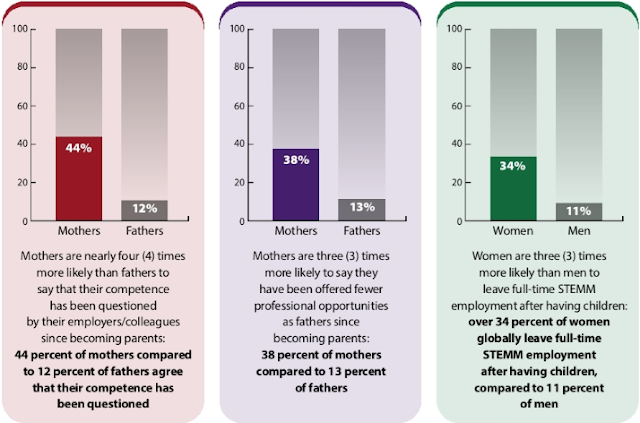
According to research from Mothers in Science's 2020 global survey on the impact of parenthood in STEM careers, mothers are more likely to be perceived as less competent and offered fewer professional development opportunities compared to fathers. 

Research shows that women who become mothers are offered fewer opportunities and earn less over their careers. Men who become fathers do not experience these severe consequences. Consider these data points from the Mothers in Science 2020 pre-COVID-19 global survey* “Impact of Parenthood on Career Progression in STEMM.”

Mothers are perceived as less dedicated employees and less competent due to implicit bias and structural problems that have nothing to do with motherhood. For example, as the COVID-19 pandemic has demonstrated, women carry more of the burden for childcare and eldercare than men. Mothers require support from their partner at home, flexible workplace policies, and affordable and accessible childcare options. However, not everyone has access to these resources.

To be healthy and successful at work, women need to be able to 1) seek medical attention and informed advice and 2) to be able to make decisions about their reproductive health, including the choice about whether to have, and when to have, children. In science-oriented careers, particularly those in higher education where tenure may depend on stepped and timed advancement, the impact of an unplanned pregnancy can be especially significant.

Since men do not experience these challenges, any laws that interfere with women’s reproductive health, including the timing of pregnancy, unfairly target women — especially underprivileged women who do not have access to birth control, proper healthcare, transportation, and/or finances to obtain the care they need. To support women’s careers, we need to support their right to choose.

To learn more about Mothers in Science and ways to support the right to parenthood for all scientists, be sure to check out the Association for Women in Science's What’s Next webinar at 3 PM EST on Thursday, November 18, 2021 featuring Dr. Isabel Torres, CEO and co-founder of Mothers in Science.

*The Mothers in Science survey “Impact of parenthood on career progression in STEMM” was conducted between September 15th and December 31st, 2020. All responses correspond to the participants’ situation prior to COVID-19, and therefore, do not reflect the additional pressures brought on by the pandemic. The answers are based on self-report. A total of 8,930 participants, including mothers, fathers and non-parents, completed the survey. The study brings together survey participants from 128 countries, although the following countries are over-represented: the US, France, UK, Germany and Australia. As expected, women are also over-represented in the survey, which can be common in surveys related to women and caregiving issues. The survey was designed and led by Mothers in Science and conducted in partnership with INWES, Washington University St Louis, Parent in Science, Femmes & Sciences and 500 Women Scientists. Mothers in Science is analyzing the data in collaboration with a team of statisticians from the Universities of Grenoble, France and University of Toulouse, France.

Wednesday, December 14, 2016

Gender Identity Policies Affecting Astronomers

By Jessica Mink, AAS CSWA+SGMA
When people think about the integration of transgender people into an academic environment, they tend to stop at the use of public facilities. That is the focus of people and groups who are in fact opposed to our identities and in the end, by denying us access, to our very existence. But we need other kinds of support. In my September Women In Astronomy post, I asked readers to help the American Astronomical Society Committee on Sexual orientation and Gender identity Minorities in Astronomy (SGMA) assess institutional gender identity and expression policies in their institutions. In one of the responses to a Facebook post of it, I learned that Campus Pride had conducted a much larger survey, though I found that it did not differentiate between identity and expression. It provides links to anti-discrimination policies at 998 institutions of higher education which include at least one, usually gender identity, but I don't have the time to ferret out specific wording from all of these. We also wanted to include some of the other institutions which employ astronomers in our survey, and a few of those came in.

Since November 8, local anti-discrimination rules have become more important as at least one member of the newly-elected U.S. administration has vowed to remove LGBT protections from Federal Regulations: In May, Vice President-Elect Mike Pence released this statement, the significant sentence of which I have underlined:
I have long believed that education is a state and local function. Policies regarding the security and privacy of students in our schools should be in the hands of Hoosier parents and local schools, not bureaucrats in Washington, DC. The federal government has no business getting involved in issues of this nature. I am confident that parents, teachers and administrators will continue to resolve these matters without federal mandates and in a manner that reflects the common sense and compassion of our state.
Many of my transgender friends are worrying that our Federal protections will disappear. Those protections have been mostly instituted by regulation and court interpretation since Congress has failed to pass an explicitly inclusive anti-discrimination law. Possible changes in regulators and judges could change our available rights. We are hurrying to correct the gender in our Social Security records and to get passports with the correct gender, things which have been made possible by changes in regulations during the Obama administration. Those of us who work for the Federal government or its contractors fear the loss of coverage of gender corrective medical care in our health insurance plans, which has only recently been required.

In that context, the results of our small survey are given here:

Institution                         Date          Gender_Protection
Wesleyan University                 9/30/2016     identity,expression
American Museum of Natural History  9/29/2016     identity,expression
NASA Goddard Space Flight Center    9/27/2016     identity,perceived_gender
University of Michigan              9/23/2016     identity,expression
University of Delaware              9/23/2016     identity,expression
University of Pittsburgh            9/22/2016     identity,expression
University of California            9/22/2016     identity,expression
Arizona State University            9/22/2016     identity,expression
Penn State                          9/22/2016     identity,sex_stereotyping
University of Colorado              9/21/2016     identity,expression
American Astronomical Society       9/21/2016     identity,expression
Smithsonian Institution             9/29/2016     identity,gender_stereotyping
Harvard University                  10/3/2016     identity
Johns Hopkins University            10/11/2016    identity,expression

The on-line version of the policy of each institution is linked from its name. The date is that on which the policy was checked. Policies change: my employer, the Smithsonian Institution added "gender stereotyping" between the time I wrote the original survey post and the time I started putting together the responses a week later.  Because this survey is the beginning of SGMA's effort to get employers of AAS members to meet the same standard, I wondered how "stereotyping" differed from "expression" and asked the National Center for Transgender Equality. They responded:
"Sex stereotyping" or "gender stereotyping" is something some federal agencies are using for some nuanced reasons having to do with the Justice Department's equivocal position on whether federal sex discrimination laws cover sexual orientation. So, you often see it used in this way: "race, color, national origin, religion, sex (including gender identity and gender stereotyping), sexual orientation, or disability." It's a somewhat confusing legal term and we don't recommend it as a substitute for gender expression. Similarly, "perceived gender" is not the same as gender expression. We believe nondiscrimination policies always cover a perception of someone's characteristics (like if your boss harasses you based on assuming you're Muslim but you're not actually Muslim), and that if "actual or perceived" language is used it should be applies to all covered characteristics. 
For private businesses and state and local policies, we still recommend "gender identity and expression" or "gender identity and gender expression."
10 out of 14 compliant employers is a good start, and we'll be fortunate if we can hold on to the partial protection of the two federal installations in the survey. We still have to work to move every institution toward the simple standard of forbidding discrimination based on either gender identity or gender expression. Then we'll be on to insurance coverage, the details of which are much harder to ferret out unless the institution is in a state which requires coverage of transgender-related services.

[This press release from GLAD, GLBT Legal Advocates and Defenders (of which I am on the Board) came out while I was writing this post. Covering an agreement on accommodation of transgender students in Massachusetts' community college system, it gives us some further goals.]