Showing posts with label working parents. Show all posts

Thursday, October 30, 2025

Career Profile: April Russell, Founder and Entrepreneur, and Creative Pathways in Astronomy Careers

The AAS Committee on the Status of Women in Astronomy has compiled dozens of interviews highlighting the diversity of career trajectories available to astronomers, planetary scientists, etc. The interviews share advice and lessons learned from individuals on those paths.

By Kimberly Mitchell

April Russell has navigated a unique career path in astronomy and physics. Russell graduated from MIT in 2002 with a B.S. in Astrophysics and an M.S. in Planetary Science. Once she finished her degrees, she worked in the private sector for Raytheon, but she didn’t like working in defense technology. Not certain she wanted to pursue a path in teaching, she decided to go to law school. It only took a semester for Russell to realize law wasn’t the right path, either. She took a career break and began her family.

April Russell wearing glasses and standing outside with snow in the background.
Photo: April Russell
Educational and Teaching Opportunities

Getting back to work after a break to raise children can be challenging. Russell was able to find a pathway back to astronomy by working at a local observatory and astronomy center, where she worked in education and public outreach. She enjoyed that enough that she also did some teaching locally. Khan Academy was hiring subject matter experts to create its online courses. Russell was hired as an SME in physics. She created the coursework for Khan Academy learners, but more importantly, she made valuable connections with other SMEs as they worked to create high-quality educational content.

These connections have served Russell well. She still keeps in touch, checking in with other experts, and occasionally recommending jobs or reaching out to her network to see what might be available.
Russell enjoyed the educational aspect of these jobs and obtained a Master’s in Education. She also did contract work for the Department of Education, focusing on K-12th-grade content in the physical sciences. She also took on visiting professor positions at Vassar College and Siena College, where she taught astrophysics, astronomy, and earth science. 

Writing and Publishing

Russell’s depth and breadth of work in education, as well as her background in physics and astronomy, made her the perfect candidate to write textbooks and educational material. She is a prolific writer, contributing to textbooks published through John Wiley & Sons, 5 Ponds Press, and Pearson. Her focus remains on the physical sciences, physics, and astronomy. Russell has also published many articles on astronomy, featured in Icarus and Astronomy.

Entrepreneurship

In 2017, Russell took the experience gained from teaching, designing coursework, and writing to create Take Space Consulting. Through her business, Russell guides physical science educators and researchers through curriculum development, including planning, design, and strategy. 

In 2023, Russell also became the CEO of Astronomers Without Borders. This non-profit organization works to build and cultivate community through astronomy. Through a partnership with Celestron, she helped develop an AI telescope coach to get people comfortable with astronomy at home as they work with their new telescopes. 

On the Challenge of a Non-Traditional Career Path

Russell acknowledges her career path has been unique, cobbled together through a necessity to both work and be at-home/available for her children. Much of her work has been contract work, finding that is what allowed her the flexibility to raise children, especially when one was diagnosed with a rare disease. The family has also moved twice during the pandemic, and Russell lost her mother around the time her contract with Khan Academy ended. 

“Honestly, 2018 through 2024 are such a blur,” she says. “I needed something to do as a distraction, but it couldn’t be full-time. I was trying to take care of my own mental health by having something outside of these high-stress situations at home.”

Russell knows her situation isn’t unique. Many mid-career women face the same choices. How do they have children and keep working? Can they stay at home and still work part-time? Russell says she has found that even companies that claim they are supportive of these conflicts have proven difficult. “A lot of environments aren’t fully supportive even when they claim to be. It’s a common and disappointing aspect of the current climate.”

“I’ve learned to pay attention to my gut when I’m talking to people around me. Before, I was a pretty analytical person and took things at face value. You want to trust other people, but really, you have to trust yourself first. It’s scary to jump into the unknown. It’s been really important to me to lean on my network. Keeping in touch, seeing what they’re working on, letting them know what I’m working on or looking for. That’s how most of the work I’ve gotten has shown up.”

What’s Next and Untapped Talent At Home

Russell has recently taken a break to reset from the last seven years, which were peppered with difficult circumstances. She’s found her focus through long walks, which allow her body to move and her mind to focus on the future. She’s contemplating a deep dive into astronomy education research. “The main textbook hasn’t been rewritten since 2000,” she notes. She’s also interested in focusing those thoughts into a Substack newsletter and YouTube channel—a niche she’s well prepared to take on. 

A colorful maple tree and photo of April Russell with a coat
Long walks to ponder next steps. Photos courtesy of April Russell.

Russell points out that in the K-12 educational sphere, there is currently no AP Astronomy exam, and in the Next Generation Science Standards, there are no spatial reasoning/awareness guidelines. “Spatial reasoning is one of the most basic things you need to be successful in astronomy.”

Finally, she’s pondering the depth of “untapped talent at home” that could be working on interesting and valuable projects if they had the time and financial support to do so. “There’s this group of untapped talent of women who are in the middle of their lives, unaffiliated, part-time, at home for their kids (or whatever the reason). It would be great to have some small grants to support their work. Grants don’t have to be for full-time work.” 

Russell’s wheels are turning on how to fund other women like her who have chosen non-traditional career paths and have much to offer the astronomy (and other) communities on a part-time basis. It’s a perspective likely to resonate with many, and Russell has the lived experience to understand just how important unique career paths are.

To keep up with April Russell, follow her Substack newsletter at https://aprilrussell.substack.com/ and on LinkedIn https://www.linkedin.com/in/april-russell-consulting/.




Thursday, August 8, 2024

Researcher Parents Pay EXTRA When Attending Conferences


"...as academics with caring responsibilities for young families, we face inequitable hurdles to fully attend and participate in activities that require us to spend time away from home."


In an opinion piece for Nature, Laura Carter, Laura Wolz and Laura Pallett, all research scientists in the United Kingdom, share experiences and advice for caregiving research scientists. In particular, they lament that while funding agencies recognize that "costs for dependants should not be parents’ financial liability", they still need to rely on the employing research organization to dictate what exactly can be claimed as an expense. They argue that, instead, carers need organizations to update and align internal financial reimbursement policies.

Caregiving
Image Credit: https://earlylearningnation.com

To do this, science policy must change to deliver initiatives that genuinely support those in need and that do not further burden an already overworked community. Opportunities need to be 

  • flexible
  • adaptable
  • comprehensive and 
  • transparent.

Read more at

https://www.nature.com/articles/d41586-024-01571-x


In this country, the National Academies has published multiple documents that describe policies and best practices for supporting family caregivers working in science, engineering, and medicine. You can find them here.

As a reminder, our professional societies provide grants to support caregiving activities. For example, the AAS' Division for Planetary Science offers a Dependent Care Grant, as does the American Geophysical Union (AGU) for specific AGU meetings.


See also:

Tuesday, November 16, 2021

Crosspost: The Impacts of Parenthood Are Not Equal

Written By Shelley O’Brien for AWIS

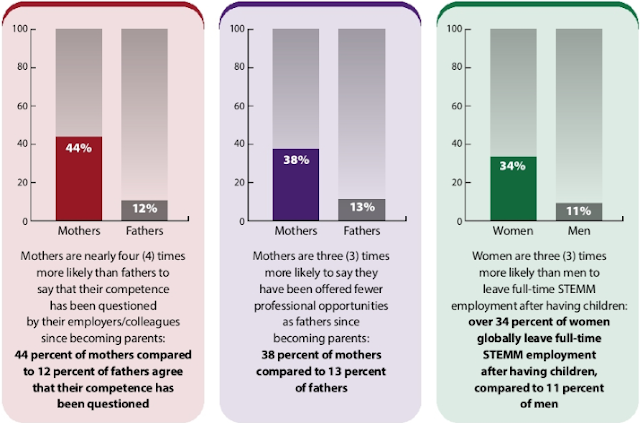
According to research from Mothers in Science's 2020 global survey on the impact of parenthood in STEM careers, mothers are more likely to be perceived as less competent and offered fewer professional development opportunities compared to fathers. 

Research shows that women who become mothers are offered fewer opportunities and earn less over their careers. Men who become fathers do not experience these severe consequences. Consider these data points from the Mothers in Science 2020 pre-COVID-19 global survey* “Impact of Parenthood on Career Progression in STEMM.”

Mothers are perceived as less dedicated employees and less competent due to implicit bias and structural problems that have nothing to do with motherhood. For example, as the COVID-19 pandemic has demonstrated, women carry more of the burden for childcare and eldercare than men. Mothers require support from their partner at home, flexible workplace policies, and affordable and accessible childcare options. However, not everyone has access to these resources.

To be healthy and successful at work, women need to be able to 1) seek medical attention and informed advice and 2) to be able to make decisions about their reproductive health, including the choice about whether to have, and when to have, children. In science-oriented careers, particularly those in higher education where tenure may depend on stepped and timed advancement, the impact of an unplanned pregnancy can be especially significant.

Since men do not experience these challenges, any laws that interfere with women’s reproductive health, including the timing of pregnancy, unfairly target women — especially underprivileged women who do not have access to birth control, proper healthcare, transportation, and/or finances to obtain the care they need. To support women’s careers, we need to support their right to choose.

To learn more about Mothers in Science and ways to support the right to parenthood for all scientists, be sure to check out the Association for Women in Science's What’s Next webinar at 3 PM EST on Thursday, November 18, 2021 featuring Dr. Isabel Torres, CEO and co-founder of Mothers in Science.

*The Mothers in Science survey “Impact of parenthood on career progression in STEMM” was conducted between September 15th and December 31st, 2020. All responses correspond to the participants’ situation prior to COVID-19, and therefore, do not reflect the additional pressures brought on by the pandemic. The answers are based on self-report. A total of 8,930 participants, including mothers, fathers and non-parents, completed the survey. The study brings together survey participants from 128 countries, although the following countries are over-represented: the US, France, UK, Germany and Australia. As expected, women are also over-represented in the survey, which can be common in surveys related to women and caregiving issues. The survey was designed and led by Mothers in Science and conducted in partnership with INWES, Washington University St Louis, Parent in Science, Femmes & Sciences and 500 Women Scientists. Mothers in Science is analyzing the data in collaboration with a team of statisticians from the Universities of Grenoble, France and University of Toulouse, France.

Monday, November 10, 2014

Queer Eye for the Straight Marriage


The Women in Astronomy blog is committed to representing diverse perspectives on women in astronomy.  The below post is a response from the AAS Committee on the Status for Women in Astronomy (CSWA) reaching out to AAS Working Group for LGBTIQ Equality (WGLE) for guest contributions, specifically contributions from the LBGQTI perspective.  If you are interested in contributing a guest post to this blog, please contact Jessica Kirkpatrick

Today's guest post is by Dr. Jane Rigby. Jane Rigby is an astrophysicist at the NASA Goddard Space Flight Center, a contributor to Astrobetter, and a member of the AAS’s Working Group for LGBTIQ Equality (WGLE).

The other day after work, my wife and I were sprawled on the playroom floor, watching our toddler run in circles. I picked a strewn section of the paper and scanned this article.

Confused, I read it more carefully. Was this news? I could have titled the article “Man gets chores, work done”? Why was it leading the local section? To me, the most interesting facet of the article was that the attorney had deliberately chosen a lower-paying job with reasonable hours and a short commute. The rest -- “He cooks! He does laundry!” seemed so quotidian. I was boiling water for pasta, and planned to do laundry after the kid’s bedtime. Is it still newsworthy to profile a straight couple that shares household duties?

Monday, July 28, 2014

Please do not disturb: Pumping in progress

This is the sign that adorns my office doorknob every day around noon and again at 3. And this is more or less what I look like as I pump -- yes, quite the fashion statement. Thankfully my officemate is comfortable with my pumping in our office. More importantly, however, is that I have the convenient option to use the new lactation room in my building.

Northwestern University's Tech Building is no exception. The Patient Protection and Affordable Care Act (PPACA) requires employers to allow time for pumping as well as a reasonable space (that's not a bathroom!) to pump. Specifically, the law requires that employers “provide a reasonable break time for an employee to express breast milk for her nursing child for one year after the child’s birth each time such employee has need to express milk.” Moreover, employers must “provide a place, other than a bathroom, that is shielded from view and free from intrusion from co-workers and the public” for nursing employees.