Showing posts with label childcare. Show all posts

Thursday, April 20, 2023

Requesting Input for Study on Caregiving

By Jeff Gillis-Davs, Washington University


The National Academies of Sciences, Engineering, and Medicine convened a committee on Policies and Practices for Supporting Family Caregivers Working in Science, Engineering, and Medicine. Two of the goals of this committee are:

  • Summarize the published research on the challenges faced by scientists, engineers, and medical professionals who are family caregivers (i.e., parents and those with eldercare responsibilities, or both), including research on the impact of COVID-19 these individuals;
  • Document institutional and governmental efforts to support caregivers and the positive and negative impacts of such efforts (if known), including any unintended consequences of well-intentioned policies and practices;

We seek your input (basically white papers, but we're calling them dear colleague letters) on our study examining policies and programs to support the retention, re-entry, and advancement of students and professionals working in academic science, engineering, and medicine with caregiving responsibilities (e.g., these responsibilities include caregiving for kids, spouses, significant others, dependent adults, parents, etc.). 


To share information, please submit a description and any related publications 

by June 1, 2023, using this link.


Although the primary focus of the study is women caregivers in science, engineering, and medicine, people of all genders, including men, face obstacles as caregivers. Therefore, the study scope will include caregivers of all genders but emphasize women. The study will also take an intersectional approach and place particular emphasis on the experiences of the most marginalized groups in science, engineering, and medicine, such as women of color, who remain particularly underrepresented in these fields.


For questions, please contact j.gillis-davis_at_wustl.edu.


Tuesday, November 16, 2021

Crosspost: The Impacts of Parenthood Are Not Equal

Written By Shelley O’Brien for AWIS

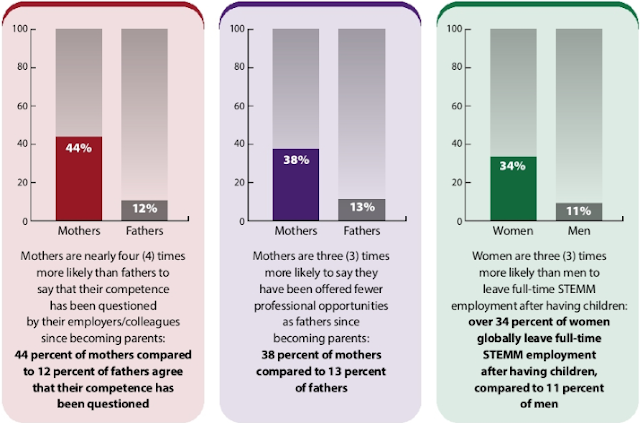
According to research from Mothers in Science's 2020 global survey on the impact of parenthood in STEM careers, mothers are more likely to be perceived as less competent and offered fewer professional development opportunities compared to fathers. 

Research shows that women who become mothers are offered fewer opportunities and earn less over their careers. Men who become fathers do not experience these severe consequences. Consider these data points from the Mothers in Science 2020 pre-COVID-19 global survey* “Impact of Parenthood on Career Progression in STEMM.”

Mothers are perceived as less dedicated employees and less competent due to implicit bias and structural problems that have nothing to do with motherhood. For example, as the COVID-19 pandemic has demonstrated, women carry more of the burden for childcare and eldercare than men. Mothers require support from their partner at home, flexible workplace policies, and affordable and accessible childcare options. However, not everyone has access to these resources.

To be healthy and successful at work, women need to be able to 1) seek medical attention and informed advice and 2) to be able to make decisions about their reproductive health, including the choice about whether to have, and when to have, children. In science-oriented careers, particularly those in higher education where tenure may depend on stepped and timed advancement, the impact of an unplanned pregnancy can be especially significant.

Since men do not experience these challenges, any laws that interfere with women’s reproductive health, including the timing of pregnancy, unfairly target women — especially underprivileged women who do not have access to birth control, proper healthcare, transportation, and/or finances to obtain the care they need. To support women’s careers, we need to support their right to choose.

To learn more about Mothers in Science and ways to support the right to parenthood for all scientists, be sure to check out the Association for Women in Science's What’s Next webinar at 3 PM EST on Thursday, November 18, 2021 featuring Dr. Isabel Torres, CEO and co-founder of Mothers in Science.

*The Mothers in Science survey “Impact of parenthood on career progression in STEMM” was conducted between September 15th and December 31st, 2020. All responses correspond to the participants’ situation prior to COVID-19, and therefore, do not reflect the additional pressures brought on by the pandemic. The answers are based on self-report. A total of 8,930 participants, including mothers, fathers and non-parents, completed the survey. The study brings together survey participants from 128 countries, although the following countries are over-represented: the US, France, UK, Germany and Australia. As expected, women are also over-represented in the survey, which can be common in surveys related to women and caregiving issues. The survey was designed and led by Mothers in Science and conducted in partnership with INWES, Washington University St Louis, Parent in Science, Femmes & Sciences and 500 Women Scientists. Mothers in Science is analyzing the data in collaboration with a team of statisticians from the Universities of Grenoble, France and University of Toulouse, France.

Friday, March 16, 2018

AASWomen Newsletter for March 16, 2018


AAS Committee on the Status of Women
Issue of March 16, 2018
eds: Nicolle Zellner, Heather Flewelling, Christina Thomas, and Maria Patterson

This week's issues:

1. Autism Isn't the Problem              
2. Science — without the mansplaining
3. Same Course, Different Ratings
4. Female researchers publish childcare recommendations for conference organizers
5. Watch: Female Astronauts Speak About Women in STEM
6. Senior female scientist dropout rate causing concern
7. How to Submit to the AASWomen Newsletter
8. How to Subscribe or Unsubscribe to the AASWomen Newsletter
9. Access to Past Issues of the AASWomen Newsletter

Friday, May 19, 2017

AASWomen Newsletter for May 19, 2017

AAS Committee on the Status of Women
Issue of May 19, 2017
eds: Nicolle Zellner, Heather Flewelling, Christina Thomas, and Maria Patterson

This week's issues:

1. Women in Leadership: It’s Not Just About Confidence    
2. Astronomers Elected to National Academy of Sciences
3. Childcare Opportunity at MetSoc
4. Caltech Students Protest Return of Professor From Suspension
5. Five Ways to Move Beyond the March: A Guide for Scientists Seeking Strong, Inclusive Science
6. We Recorded VCs’ Conversations and Analyzed How Differently They Talk About Female Entrepreneurs
7. How to Submit to the AASWomen Newsletter
8. How to Subscribe or Unsubscribe to the AASWomen Newsletter
9. Access to Past Issues of the AASWomen Newsletter

Friday, November 20, 2015

AASWOMEN Newsletter for November 20, 2015

AAS Committee on the Status of Women
Issue of November 20, 2015
eds: Daryl Haggard, Nicolle Zellner, Meredith Hughes, & Elysse Voyer

This week's issues:

1. On Becoming a Woman Astronomer   
2. Accessible Astronomy   
3. Childcare and Dependent Care at the AAS Meeting in Florida
4. Dr. Beatrice Mueller: Find a great advisor, a great support system, and passions outside of science
5. L'Oreal USA For Women in Science Fellowship
6. When women are missing from peer review 
7. Distractingly Sexist      
8. FACT SHEET: Advancing Equity for Women and Girls of Color
9. Job Opportunities
10. How to Submit to the AASWomen Newsletter
11. How to Subscribe or Unsubscribe to the AASWomen Newsletter
12. Access to Past Issues of the AASWomen Newsletter


Wednesday, February 11, 2015

Postdoc Parenting Work-Life Balance

There's a koan in academia for when is the best time to have a kid:
No time is the right time, all times are equally good (bad?)
My husband is also a postdoc. We have a 9 month old. This is a glass half full kind of post, about how we've taken advantage of the flexible hours, the autonomy, and a few supportive policies to pursue parenting and work on our own(-ish) terms. 

The short of it is that at least one of us was home with our daughter full time until she turned 4 months old and at least one of us continues to be home with her four days a week. Here's how we do it:

Friday, March 7, 2014

AASWomen for March 7, 2014

AAS Committee on the Status of Women
Issue of March 7, 2014
eds: Michele M. Montgomery, Daryl Haggard, Nick Murphy, & Nicolle Zellner

This week's issues:

1. Sometimes Being Good Isn’t Enough
2. Part II Nail Salons: Appropriate Astronomy Women’s Group Venue? Survey Results
3. The 2013 CSWA Demographics Survey: Portrait of a Generation of Women in Astronomy
4. Childcare Available at Boston AAS Meeting
5. Career Profile: Astronomer to Director for the Centre of Excellence for All-Sky Astrophysics
6. L’Oréal-UNESCO Women in Science Fellowships: UK and Ireland
7. How to Level the Playing Field for Women in Science
8. In Academia, Women Collaborate Less With Their Same-Sex Juniors
9. Sexism plagues major chemistry conference: Boycott emerges amid growing outrage
10. A Mighty Girl: Mighty Careers
11. Change sought in women's depiction in text books
12. How to Submit to the AASWomen Newsletter
13. How to Subscribe or Unsubscribe to the AASWomen Newsletter
14. Access to Past Issues of the AASWomen Newsletter

Monday, August 27, 2012

Paid Parental Leave for Graduate Students

For my first post to the Women in Astronomy Blog, I would like to describe some activities that the Committee on the Status of Women in Astronomy is undertaking with regard to parental leave policies for graduate students.

When I joined the CSWA last year, I jumped at the chance to move this issue forward. Of course the entire topic of paid parental leave for employees in the US is enormous and perhaps baffling to our colleagues in any of the 178 other countries that have national laws guaranteeing some form of paid leave for new mothers (50 of these also guarantee paid leave for new fathers). While the US Family and Medical Leave Act of 1993 does mandate up to 12 weeks of (potentially unpaid) leave for workers, many students are not considered employees and hence it isn't even clear if the FMLA applies. And besides, one might ask, aren't leave policies at a University the purview of the upper administration (in discussion with the various funding agencies), and thus the desires of the relatively small pool of astronomers students a modest consideration?

Well, I would like to make the case that there is good reason to think that we are going to see some rather interesting developments on this question over the next few years.  At the start of 2012, I mailed a letter to the chair of each of the 28 departments of astronomy and/or astrophysics that offer the degree of PhD, asking for the details of their parental leave and childcare policies for graduate student parents.  And, I was delighted when fully 100% of these recipients sent me a reply! My first pass at the data indicates that we are in a time of rapid change and the current policies vary tremendously between institutions: A number of universities have recently adopted a paid leave policy for all graduate student parents, while others offer no paid leave but do allow students to retain benefits such as health care and students housing; some do not even have an official policy. I also learned that solutions needn't be University wide: The Department of Astronomy at the University Wisconsin Madison has recently implemented a paid family and medical leave policy that is entirely home grown. Way to go Badgers!

My own university could surely do much better, and I point you to the excellent article by two former Harvard graduate students of astronomy, Sarah Ballard (now a Sagan fellow at the University of Washington) and Gurtina Besla (now a Hubble fellow at Columbia University), which was definitely an inspiration to me on this topic both here at Harvard and nationwide.

I do think we need to shift this discussion from one in which the students and postdocs advocate for their own needs to one in which senior faculty, department chairs, and deans advocate on their behalf. With that in mind, Laura Trouille (CIERA fellow at Northwestern University) and I will host a Special Session on Family Leave Policies and Childcare for Graduate Students and Postdocs at the upcoming AAS meeting in Long Beach (this blog post addresses only graduate student leave, but the special session will include leave for postdocs).  The speakers will include AAS President David Helfand, Ed Ajhar (Program Director for the the NSF Astronomy and Astrophysics Postdoctoral fellowships, as well as the Extragalactic Astronomy and Cosmology Research Grants), Chas Beichman (Executive Director of the NASA Exoplanet Science Institute, and director of the Sagan fellowships program), as well as Natalie Gosnell (graduate student) and Bob Mathieu (Department chair) from the University Wisconsin (who will tell us how they put their plan into action). I will also present the results from my national survey. The session will be Monday, January 7th from 2:00-3:30pm.

While I hope that many graduate students and postdocs will attend, it is essential that the more senior individuals who are in a position to change policy at their respective institutions participate as well.  So, if you are such a person, please consider attending. If you are a student or postdoc, might I suggest you ask your department chair to identify the faculty member who will represent your department? The goal will be both to inform about current practices, and to discuss specific means by which departments and funding agencies can adopt more supportive policies.

I hope to see you in Long Beach!


Tuesday, January 25, 2011

Women in STEM Organizations- Getting Started

Post by guest-blogger Meredith Danowski*, PhD student in Astronomy at Boston University.

The day-to-day work of science can be difficult. There are grant proposals to be written, courses to be taught, data to be analyzed. But that's the stuff we came for! That's what we do. It's when we encounter other roadblocks on our path--juggling family and work, finding adequate health care, fostering our own professional development-- that we realize we need friends, we need a community, and we need supportive institutions.

Many organizations dedicated to the cause of women in STEM are designed to address this need - not to ease one individual's struggles, rather to act as an incubator for a more diverse and supportive community. I have been lucky enough to have been involved in the founding years of two such groups-- the Society of Women in Physics (SWiP) at the University of Michigan, and most recently, the Graduate Women in Science and Engineering (GWISE) group at Boston University.

In a time when the numbers are improving, many people ask why these groups are necessary. I mean, we're aware that there's a lack of diversity in science, right? Outright discrimination might be rare, but unconscious bias is pervasive, family leave policies are lacking or inconsistent, and mentoring and community greatly improve one's chance for success. While things are definitely looking up, we still have work to do. So why not work to build a community that strives for these goals?

Margaret Mead said, "Never doubt that a small group of thoughtful, committed citizens can change the world. Indeed, it is the only thing that ever has." GWISE at Boston University started in 2008 with a few people in a room and a conversation. It began with a small group of women concerned about their professional development, bias in their departments, and parental leave policies at the university. They were looking for a community, and there wasn't one, so they built it.

A few conversations led to a discussion with the dean. The group set up a luncheon and invited women in STEM from across the university to gauge interest. A few months later, they made a list of goals: a mission statement. They borrowed from other organizations and devised an executive board structure. They found an advisor.

Two years later, GWISE is thriving. With a board of graduate students across STEM disciplines, faculty and staff advisors, and a board of advisors from the Boston area, we work to provide professional development programming, opportunities for mentoring and networking, social events, outreach activities, and we work with the administration on policies and practices. Our events vary in size and reach anywhere from 10-100+ people. We brainstorm, borrow ideas, and partner with other organizations to effectively reach the community.

So if you're looking to start up a group for women in astronomy/physics/STEM at your institution, what should you do? Invite some allies for coffee. Discuss any issues you've encountered, discuss institutional policies, and determine if you have a critical mass of people who can devote the time necessary- maybe invite the biologists and engineers, too! Once you're there, make a list of goals and priorities. You might have great leave policies, but few chances for professional development, or a lack of a social community. Maybe you want to start an official mentoring program. Put together some information and make an appointment with a department chair or a dean and see if you can obtain some preliminary funding - showing your events/activities will improve the environment goes a long way.

And it all starts with just a small group of dedicated individuals.

*Meredith Danowski is a PhD student in Astronomy at Boston University and this is her first guest blog at the Women in Astronomy Blog. This is the first in a series where she describes her experiences with GWISE-- she'll be back to discuss how to find & utilize institutional and community support for your organization, and how to build partnerships to effectively provide unique programming.

Friday, July 30, 2010

Work-Family: On Balance

As rosy a picture I painted in my previous posting on work-family balance, the truth of the matter is that raising children is not an easy task. Trying to raise children while establishing a career is even tougher. On the good days, I count the number of years until my youngest turns 18. On the bad days, I wonder if I should discourage young women from pursuing careers in science because it's simply impossible to have it all.

While mulling these rather depressing thoughts, I came across this article in the Washington Post, talking about the difficulties of parenting while pursuing a career in business. You could easily substitute "business" for "science" and "executive" for "professor" and everything Sharon Meers says applies equally well. Some choice quotes from the article:

When a father of small kids is late or looks dazed in a meeting, we're more willing to assume it's an aberration, a passing phase, and he'll snap back to top form because he values his job. We give him the benefit of the doubt. Do we give women the same?

After spending a weekend with his kids alone, one male executive told me, "If every man in Congress had to do this, we'd have some very different laws."

Meers writes that VP Joe Biden is setting up a Middle Class Task Force that can address some of these work-family balancing issues from a public policy standpoint. I agree with her that this sounds very promising, especially if they can successfully reframe the problems of working parents "not as women's issues" but as "issues of middle class economic security" as described in the article. Let's hope that this Task Force succeeds.

Thursday, March 4, 2010

Chilcare at 215th AAS Meeting

Don Kniffen of the CSWA has the following report on childcare usage at the January 2010 AAS Meeting:
In an effort to make the AAS meetings more family friendly, at the 215th Meeting in DC in January 2010 there was an on-site childcare facility made available for a nominal rate of $8 per hour per child. The CSWA and the AAS advertised this service to ensure that all who wished to take advantage of this program were aware of its existence. It appears the initial use was modest (see statistics below) and the AAS and CSWA hope that, through increased awareness and use by the community, it will become a regular feature of AAS meetings. The following data were provided by the AAS on usage of the facility.

AAS Child Care Program Usage Statistics
Sunday:
January 3 - 6:00 pm to
10:00 pm
 2 children total, 2 infants
Monday:
January 4 - 8:00 am to
 6:00 pm
10 children total, 2 infants
Tuesday:
January 5 - 8:00 am to
 6:00 pm
10 children total, 1 infant
Wednesday:
January 6 - 8:00 am to
 6:00 pm
10 children total, 1 infant
Thursday:
January 7 - 8:00 am to
 6:00 pm
 2 children total, 1 infant

The ages of the children ranged from 6 months through 12 years old as follows:
0 - 2 years old: 2 (25%)
3 - 5 years old: 4 (33%)
6 - 8 years old: 4 (33%)
9 - 12 years old: 1 ( 9%)

A total of 12 children from 8 families were signed up for the program. The CSWA is encouraged by this initial response. If members can confidently count on it being available, it will serve the society and its members with young children well.