Showing posts with label mothers. Show all posts

Thursday, May 9, 2024

Advocating to Change Academia for Mothers


Chromatography Flowers (Image Credit: BuggyandBuddy.com)


In a commentary for Nature, Fernanda Staniscuaski writes that "[w]orldwide, mothers are too often pushed out of academia. But we are stepping up to push for a revolution in academia. Individuals and groups affected by the hostile academic environment should unite.

By organizing to seek change, mothers put ourselves at the forefront of work to reshape academic culture. Our efforts extend beyond personal struggles — we are architects of a transformative movement. The struggle for change spearheaded by mothers yields benefits for the entire academic community."

Eds note: Check out some of our other posts about mothers in STEM:

Resources:


Friday, May 13, 2022

AASWomen Newsletter for May 13, 2022

AAS Committee on the Status of Women
Issue of May 13, 2022
eds: Heather Flewelling, Nicolle Zellner, Alessandra Aloisi, Jeremy Bailin and Sethanne Howard

[We hope you all are taking care of yourselves and each other. --eds.]

This week's issues:

Mae Jemison in her astronaut suit  (NASA)
Mae Jemison (NASA)
1. Crosspost: A Life of Transdisciplinary Science, The Expeditions of Mae Jemison
2. e-book: Mothers in Astronomy
3. Three-part series profiles Women Who Lead the National Science Foundation
4. Zoom event! 4,000 Years of Women in Science
5. The toll of menopause: how universities can help
6. Job Opportunities
7. How to Submit to the AASWomen Newsletter
8. How to Subscribe or Unsubscribe to the AASWomen Newsletter
9. Access to Past Issues of the AASWomen Newsletter


An online version of this newsletter will be available at http://womeninastronomy.blogspot.com/ at 3:00 PM ET every Friday.

Tuesday, November 16, 2021

Crosspost: The Impacts of Parenthood Are Not Equal

Written By Shelley O’Brien for AWIS

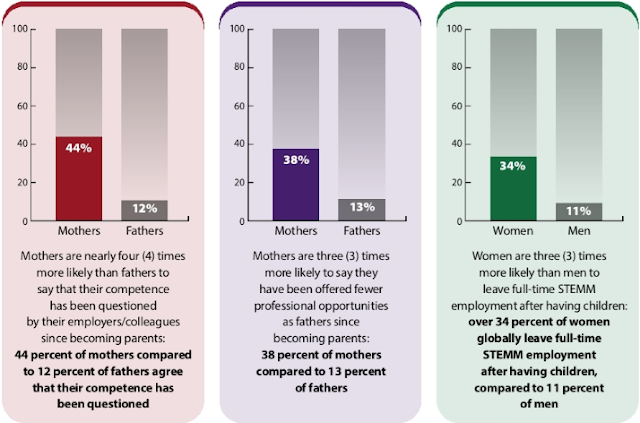
According to research from Mothers in Science's 2020 global survey on the impact of parenthood in STEM careers, mothers are more likely to be perceived as less competent and offered fewer professional development opportunities compared to fathers. 

Research shows that women who become mothers are offered fewer opportunities and earn less over their careers. Men who become fathers do not experience these severe consequences. Consider these data points from the Mothers in Science 2020 pre-COVID-19 global survey* “Impact of Parenthood on Career Progression in STEMM.”

Mothers are perceived as less dedicated employees and less competent due to implicit bias and structural problems that have nothing to do with motherhood. For example, as the COVID-19 pandemic has demonstrated, women carry more of the burden for childcare and eldercare than men. Mothers require support from their partner at home, flexible workplace policies, and affordable and accessible childcare options. However, not everyone has access to these resources.

To be healthy and successful at work, women need to be able to 1) seek medical attention and informed advice and 2) to be able to make decisions about their reproductive health, including the choice about whether to have, and when to have, children. In science-oriented careers, particularly those in higher education where tenure may depend on stepped and timed advancement, the impact of an unplanned pregnancy can be especially significant.

Since men do not experience these challenges, any laws that interfere with women’s reproductive health, including the timing of pregnancy, unfairly target women — especially underprivileged women who do not have access to birth control, proper healthcare, transportation, and/or finances to obtain the care they need. To support women’s careers, we need to support their right to choose.

To learn more about Mothers in Science and ways to support the right to parenthood for all scientists, be sure to check out the Association for Women in Science's What’s Next webinar at 3 PM EST on Thursday, November 18, 2021 featuring Dr. Isabel Torres, CEO and co-founder of Mothers in Science.

*The Mothers in Science survey “Impact of parenthood on career progression in STEMM” was conducted between September 15th and December 31st, 2020. All responses correspond to the participants’ situation prior to COVID-19, and therefore, do not reflect the additional pressures brought on by the pandemic. The answers are based on self-report. A total of 8,930 participants, including mothers, fathers and non-parents, completed the survey. The study brings together survey participants from 128 countries, although the following countries are over-represented: the US, France, UK, Germany and Australia. As expected, women are also over-represented in the survey, which can be common in surveys related to women and caregiving issues. The survey was designed and led by Mothers in Science and conducted in partnership with INWES, Washington University St Louis, Parent in Science, Femmes & Sciences and 500 Women Scientists. Mothers in Science is analyzing the data in collaboration with a team of statisticians from the Universities of Grenoble, France and University of Toulouse, France.

Friday, July 23, 2021