Showing posts with label academia. Show all posts

Thursday, October 16, 2025

Guest Post: Invisible Journeys: The Struggles and Strengths of Displaced Women Scholars

Today, we welcome guest blogger Dr. Encieh Erfani, who is currently a researcher at the University of Mainz, Germany, and who writes passionately about science communication, as well as the struggles of women and displaced scholars in academia.

Invisible Journeys: The Struggles and Strengths of Displaced Women Scholars
By Encieh Erfani, Ph.D.
When I first heard the term “displaced scholar”, it sounded abstract, as if it belonged in a policy document rather than in someone’s life story. Yet for thousands of academics around the world, including myself, displacement is not abstract at all. It is a lived reality that reshapes careers, families, and identities. For women in particular, displacement magnifies pre-existing inequalities, creating a double burden: surviving exile while navigating the gendered challenges of academic life.
Today, as conflicts, authoritarianism, and crises push more scholars into exile, it is time to reflect on who these displaced women scholars are, what obstacles they face, and how the scientific community can respond.


Who Are Displaced Women Scholars?

There is no single, universally agreed-upon definition of displaced or at-risk scholars. Broadly, they are academics who are forced to leave their home institutions and, often, their home countries because of political repression, conflict, discrimination, or threats to their safety.
While all displaced scholars experience professional and personal upheaval, women often face unique challenges. Many juggle responsibilities as caregivers while trying to rebuild their academic careers in new and uncertain environments. Others encounter cultural or institutional barriers that make it harder to re-enter academia abroad. And because women are already underrepresented in many STEM fields, their forced displacement silences voices that are already too few.


Photo Courtesy of Encieh Erfani, Ph.D.
The Challenges of Displacement

The barriers facing displaced women scholars are complex and interconnected. Four of the most pressing are:
1. Interrupted Careers
Academic careers depend on continuity — building long-term projects, supervising students, publishing steadily, and securing grants. Displacement severs that chain. Labs are left behind, collaborations are cut short, and years of research may be lost overnight. For women, who already face systemic barriers to advancement, these interruptions can be devastating.
2. Visa and Immigration Uncertainty
A displaced scholar’s ability to continue her work often depends on navigating complex, lengthy, and stressful visa and immigration processes. For women who may also be responsible for children or other dependents, this uncertainty adds another layer of difficulty.
3. Isolation
Moving into a new academic environment without networks is isolating. Women scholars may find it even harder to access male-dominated networks of influence in science, making integration and recognition more challenging.
4. Gendered Barriers Amplified
Exile compounds gender inequities. Women displaced from countries with restrictive gender norms often face stereotypes in host institutions as well. At the same time, they may lack childcare support, mentoring, or policies tailored to their circumstances.
Behind each of these categories are human stories: an Afghan astrophysicist banned from teaching because of her gender; an Iranian scientist forced into exile for her activism; Ukrainian researchers trying to balance caring for their children while keeping their research alive abroad.


Why It Matters for Astronomy and STEM

Why should the scientific community, and especially astronomers, care? Because displacement is not only a humanitarian issue, but also a scientific one.
Every displaced woman scholar represents years of training, expertise, and creativity that science risks losing. Astronomy, like all sciences, thrives on diversity of thought and global collaboration. Yet when women are forced into silence or leave academia because of exile, our field becomes narrower, poorer, and less representative of humanity.
Astronomy in particular offers a symbolic reminder: while we study distant galaxies and exoplanets, we cannot ignore the struggles of those whose scientific journeys on Earth are disrupted. Science is a universal human pursuit, but access to it is not yet universal.


Pathways Forward

There are already organizations working to support displaced scholars. The Scholars at Risk (SAR) network and the Institute of International Education’s Scholar Rescue Fund (IIE-SRF) have provided placements, fellowships, and funding to thousands of at-risk academics worldwide. SAR arranged at least 164 positions in the 2023–24 period [1]. The IIIE-SRF reports that it supported 234 scholars in 2024 (and documents its cumulative totals since 2002 of over 1,100 fellows) [2].
For women, targeted support is critical. This includes:
  • Institutional commitments: Universities can develop fellowships specifically designed for displaced women scientists.

  • Mentorship and networks: Connecting displaced women to mentors and peers can reduce isolation.

  • Practical support: Childcare, relocation assistance, and mental health resources are often as important as research funding.

  • Recognition: Host institutions and professional societies should actively highlight and celebrate the contributions of displaced women scientists.

Astronomy departments and associations, including the International Astronomical Union (IAU), the American Astronomical Society (AAS) community, can play a role by opening opportunities, finding host institutes, inviting displaced women to conferences, and advocating for inclusive funding policies.


Photo Courtesy of Encieh Erfani, Ph.D.

Conclusion

The journeys of displaced women scholars are often invisible. Yet they are journeys of resilience as well as struggle. Supporting these women is not only a moral imperative; it is also essential for the vitality of science itself.
If we allow displacement to silence women scholars, we risk losing knowledge, perspectives, and discoveries that could shape the future of astronomy and beyond. If we act to support them, we affirm that science is truly a global and inclusive endeavor.
The sky reminds us daily that boundaries are human-made. Science, too, should transcend borders,  ensuring that no voice, especially that of a displaced woman, is left unheard.
References
  1. https://www.scholarrescuefund.org/about-us/by-the-numbers/?utm_source=chatgpt.com

About our Guest Blogger:

Encieh Erfani is originally from Tabriz, Iran. She earned her Bachelor's degree in Physics from Tabriz University, followed by a Master's degree in Physics with a focus on Gravitation from Azarbaijan Shahid Madani University.

In 2007 she was awarded a Postgraduate Diploma Scholarship in High Energy Physics from the International Centre of Theoretical Physics (ICTP) in Trieste, Italy. She completed her dissertation, "The Standard Model Higgs Boson as the Inflaton?" under the guidance of Paolo Creminelli in August 2008.
Erfani pursued a PhD in the Physics Department of Rheinische Friedrich-Wilhelms-Universität Bonn in Germany, where she successfully defended her thesis, "Inflation and Dark Matter Primordial Black Holes" under the supervision of Manuel Drees in August 2012.
After completing her PhD, she moved back to Iran and worked as a Post-Doctoral fellow at the School of Physics in the Institute for Research in Fundamental Sciences (IPM) in Tehran, and a visiting researcher at ICTP-SAIFR in Brazil. 
She returned to Iran in 2015 and joined the Physics Department at the Institute for Advanced Studies in Basic Science (IASBS) as an Assistant Professor. However, Erfani resigned on 23 September 2022 in support of the "Woman, Life, Freedom" protests, which led to her exile. Currently, she is a researcher at Mainz University in Germany.
Learn more about her work at her LinkedIn profile or website.

Thursday, September 11, 2025

Cross-post: Why Leaving Academia Doesn't Mean Leaving Your Identity Behind

Today's cross-post is an excerpt from "From the Lab to the World," a LinkedIn newsletter by Silvia Pineda-Munoz, PhD. She is the founder of Climate Ages & Outreach Lab. Pineda-Munoz's reflections on transitioning to work outside academia are relevant for many scientists, both inside and outside academia.

Why Leaving Academia Doesn’t Mean Leaving Your Identity Behind

When I left academia, I thought I was leaving myself behind, too.

So much of my identity was wrapped up in being “the scientist.” The one who spent years piecing together the climate past through fossils and data. The one who was trusted to write papers, teach students, and present findings at conferences.
The titles mattered. The postdoc mattered. Even the conference name tag mattered more than I’d like to admit.
So when I started to imagine a life outside of academia, I hit a wall:
If I wasn’t “Dr. Pineda-Muñoz, paleontologist and ecologist,” then who was I?

The Hidden Weight of Academic Identity

I think a lot of us who have been through the PhD pipeline feel this. You spend years proving your worth in publications and grant proposals, measuring your value in metrics that don’t always translate to the outside world.
And when you even consider walking away, people ask:
“But what about all those years of training?” “Won’t you waste your degree?” “Don’t you want tenure?”
It’s hard not to internalize those questions. For me, it felt like I was betraying a part of myself if I admitted I wanted something different.
But here’s what I realized: leaving academia doesn’t mean leaving your identity behind. It means carrying it forward in a different way.

The Scientist’s Brain in a Different Arena

When I stepped into entrepreneurship, I didn’t stop being a scientist.
I brought the same habits with me:

  • Asking questions first. Science trains you to start with curiosity. In business, that means listening to your audience before trying to sell them anything.
  • Running experiments. I can’t help but treat every campaign like a hypothesis. Try it, measure it, adjust. That’s not failure; it’s iteration.
  • Thinking in systems. Ecology taught me that nothing exists in isolation. Entrepreneurship is no different: content, audience, offers, operations: they’re all interconnected. And just like in the natural world, if one part fails, your whole business ecosystem collapses.

The lab coat may be gone, but the brain that put it on every day is still here.

Photo: Silvia Pineda-Munoz, PhD.

Read the rest of Pineda-Munoz's journey from academia to becoming an entrepreneur, science communicator, and founder at "From the Lab to the World."
Silvia Pineda-Munoz is also happy to speak with anyone further on what leaving academia is like, her journey, and any other questions. Reach out to her on LinkedIn at Silvia Pineda-Munoz.


Thursday, November 7, 2024

Nat'l Career Development Month - Part 1

Eds note: November is National Career Development Month, an annual observance dedicated to highlighting the importance of career development and planning. For the next several weeks, we will post relevant articles related to career development in Astronomy, Planetary Science, Physics, and science in general.


Crosspost: How researchers and their managers can build an actionable career-development plan

By Tomasz Głowacki

Having navigated both [industry and academia], I’ve realized that one area in which industry particularly excels is in providing employees with structured and specific career advice, tailored to their specific interests and goals. This is often done through a career-development plan, something that I think could also be effective for academics.

Making a plan is generally a collaborative effort, requiring buy-in from your manager or mentor. But this doesn’t mean that they have to initiate the process. Try to express interest in discussing your career path and invite them to share their suggestions. Involve them by showing how this exercise could enhance your effectiveness and engagement at work.

Be open about your strengths and weaknesses, and the direction in which you want your career to develop, and ask for their perspective on your work habits and performance. If, for example, you’d like to move towards more of a leadership role, say that you are a good organizer, manage your time well and help your team members to plan their activities. However, you might also need to learn more about giving feedback or improve your assertiveness skills.

Moreover, seek input from your team, collaborators, students and other faculty members (or 360-degree feedback, in professional-development jargon) to understand their perspectives.

Learn more about creating a career-development plan at


More information:

Thursday, May 9, 2024

Advocating to Change Academia for Mothers


Chromatography Flowers (Image Credit: BuggyandBuddy.com)


In a commentary for Nature, Fernanda Staniscuaski writes that "[w]orldwide, mothers are too often pushed out of academia. But we are stepping up to push for a revolution in academia. Individuals and groups affected by the hostile academic environment should unite.

By organizing to seek change, mothers put ourselves at the forefront of work to reshape academic culture. Our efforts extend beyond personal struggles — we are architects of a transformative movement. The struggle for change spearheaded by mothers yields benefits for the entire academic community."

Eds note: Check out some of our other posts about mothers in STEM:

Resources:


Thursday, May 2, 2024

AAS Committee on Employment and You! Services and Recent Updates

By Luisa Fernanda Zambrano-Marin, Emily Mason, Chelsea Sharon, and Julia Kamenetzky


The AAS Committee on Employment is here for you! What will you do for work once you complete your degree? How far up in the degree ladder are you interested in going? What branch of work would you want to go into? Here is a summary of what we have been up to this year to help you answer these questions and more!


The AAS Committee on Employment has been quite active updating our online resources and providing training to AAS members. We are composed of fourteen passionate members, led by Julia Kamenetzky from Westminster University; our charge is to


facilitate the professional development and employment of astronomers

at all career stages and on all career paths, and

to promote balance and fairness in the job market


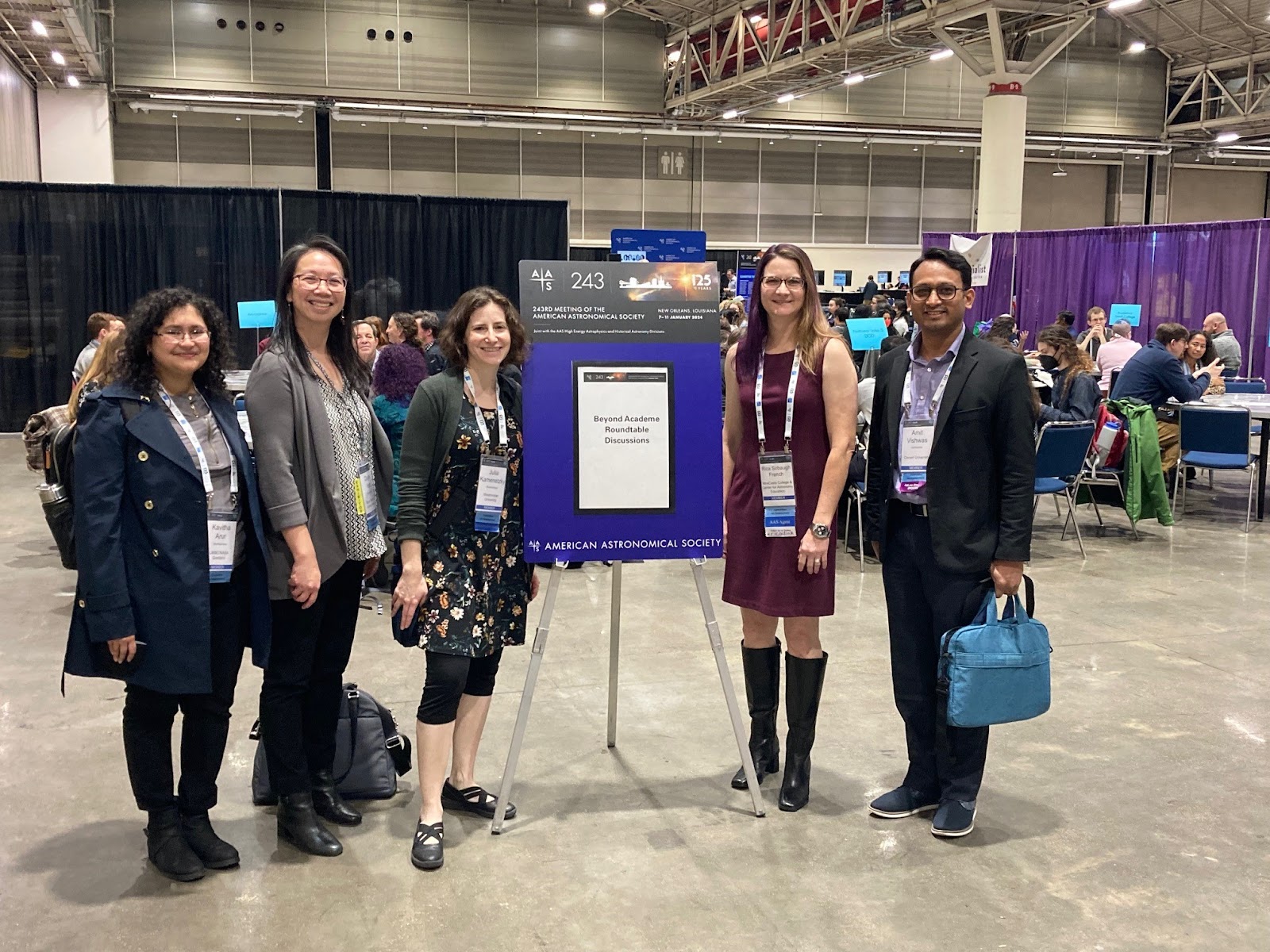
Our most visible activities for the AAS community are workshops and splinter sessions at the winter AAS meetings. This year kicked off with the popular How to Give Great Presentations workshop, led by Rob Coyne and Kavitha Arur at the AAS 243 Winter meeting in New Orleans. Next came Beyond Academe, an awesome event showcasing diverse career paths beyond the traditional academic track. We had a panel discussion featuring NASA scientists, science communicators, and more, who painted a vivid picture of the possibilities for careers beyond academia. The roundtables, where 75 participants were guided by 20 expert facilitators, dove into specific career paths in an engaging exchange of ideas. The committee also sponsored the Software & Data Carpentries Workshops and the Astronomers Turned Data Scientists Splinter Session.


AAS Committee on Employment members (from left to right): Kavitha Arur, Quyen Hart, Julia Kamenetzky, Rica Sirbaugh French, and Amit Vishwas at the Beyond Academe Roundtable Discussion event at AAS 243 in New Orleans. Photo credit to Diane Frendak.


Our committee also works behind the scenes to support AAS members. The committee joined forces with AAS staff to provide feedback and suggestions for the revamp of the Job Register webpage, ensuring clarity and ease of use for both employers and job seekers. Members Emily Mason and Dave Principe have been conducting detailed textual analysis of job postings, in addition to our annual quantitative analysis of postings. 


We kept on with the redesign and update of the list of resources available at the AAS Career Resources webpage including the Academic Career Advice page! Updates to more resource pages will be available shortly. For a summary of the resources available to job seekers and those in charge of hiring (including resources to help ensure an equitable and fair search process) see Chelsea Sharon’s post on the AAS Digest. 


Collaboration is key. We actively engage with other AAS groups, such as the Committee on the Status of Women in Astronomy and the AAS Education and Mentoring Specialist Tom Rice, fostering knowledge sharing and identifying areas of common interest. Additionally, we joined forces with the Beyond Academic Careers Advisory Committee (BACAC), aiming to amplify their collective impact. AAS Committee on Employment members also serve on the Meetings Task Force, the Early Career Engagement Task Force, and the AAS Workshop Task Force. 


Looking ahead, our main projects are to continue with popular workshops at AAS meetings. We plan to

  • introduce a new Project Management workshop,
  • nurture collaborations with BACAC and other AAS committees and task forces,
  • keep analyzing job data,
  • improve website access to career resources, and
  • support international students' and employees’ special concerns.


The AAS Committee on Employment continues to support astronomers’ career aspirations worldwide. We seek to empower individuals at every career stage, foster collaboration, advocate for transparency within the field, and pave the way for a brighter future for the astronomy community.