Showing posts with label Central American-Caribbean Astronomers. Show all posts

Thursday, September 18, 2025

Celebrating Hispanic Heritage Month

Hispanic Heritage Month is celebrated from September 15 to October 15 each year. The month provides space to spotlight the ongoing achievements of those from Hispanic and Latino communities. 

Below are just a few articles about how scientists from Hispanic and Latino backgrounds are finding ways to honor their heritage, preserve their language within science, and become the future faces of STEM. 


In Raising the Visibility of Latin American Science, writer Humberto Basilio explores how Latin American scientists are finding ways to publish in Spanish and Portuguese, in their native languages, and the challenge of breaking through the dominance of the "Global North" in scientific publishing. 

The YouTube series La Pola Geológica (The Geological Beer) was created by three female Colombian geoscientists: Carolina Ortiz-Guerrero, Daniela Muñoz-Granados, and Lina C. Pérez-Angel. Through their series, they chat (in Spanish) with other scientists and explore the natural world.

In 2024, Science Friday and América Futura partnered to produce the series “Astronomy: Made in Latin America” in English and Spanish. The series reflects on the struggles and successes of astronomy in Latin America, from "The feat of building the world's largest telescope" to three Latina scientists who are battling sexism in "Latina space scientists want to stop being the exception." 

The Committee on the Status of Women also featured nine students in 2024/2025 from the Cenca Bridge Program. The Central American - Caribbean Bridge in Astrophysics (Cenca Bridge) is a nonprofit organization with the mission to create and develop astronomy research opportunities in Central America and the Caribbean.

Cenca Bridge connects undergraduates from Central America and the Caribbean to mentors and advisors overseas to increase their chances of pursuing astrophysics as a profession. Every year, Cenca Bridge holds the remote internship program, where undergraduate students from the region apply to be selected for a 3-month-long paid research internship. As the only organization to provide a paid remote research internship, it is important to highlight the contributions that many women in astrophysics from Central America and the Caribbean have already contributed to our field.

Learn about the 2024/2025 Central American - Caribbean Bridge in Astrophysics (Cenca Bridge) Fellows:

Natalia Ramirez Vega (Costa Rica)
Catalina Morales-Gutiérrez (Costa Rica)
Kaylan-Marie Achong (Trinidad and Tobago)
Nicole Stephanie Mejia Cerros (Honduras)
Valeria Hurtado (Nicaragua)
Leiany De Oleo Rodriguez (Puerto Rico)
Linsy Abigail Martinez Rubio (Honduras)
Thara Caba (Dominican Republic)
Lynne-Flore Simy (Haiti)

We look forward to featuring more Cenca Bridge Fellows in the future. 

Happy Hispanic Heritage Month.

Friday, August 23, 2024

AASWomen Newsletter for August 23, 2024

AAS Committee on the Status of Women in Astronomy     
Issue of August 23, 2024
eds: Jeremy Bailin, Nicolle Zellner, Sethanne Howard, and Hannah Jang-Condell

[We hope you all are taking care of yourselves and each other. --eds.]

This week's issues:

August 26, 2026 (Image: oprahdaily.com)

1. Meet Central American-Caribbean Astronomy Bridge Program Fellows - Part 9    
2. Register for the Equity in Graduate Admissions Workshops
3. Women's Equality Day, August 26 2024  
4. Gender bias might be working at level of whole disciplines  
5. How do we bring more diversity to STEM?    
6. Job Opportunities
7. How to Submit to the AASWomen Newsletter
8. How to Subscribe or Unsubscribe to the AASWomen Newsletter
9. Access to Past Issues of the AASWomen Newsletter

An online version of this newsletter will be available at http://womeninastronomy.blogspot.com/ at 3:00 PM ET every Friday.

-------------------------------------------------------------------------------

Thursday, August 22, 2024

Meet Central American-Caribbean Astronomy Bridge Program Fellows - Part 9

The Central American - Caribbean Bridge in Astrophysics (Cenca Bridge) is a nonprofit organization established in the state of Tennessee in the United States with the mission to create and develop astronomy research opportunities in Central America and the Caribbean. Opportunities to pursue astrophysics in the region are few with only a handful of programs offering master’s in physics with a concentration in astronomy.  Cenca Bridge connects undergraduates from Central America and the Caribbean to mentors and advisors overseas in hope that they have the choice to pursue astrophysics as a profession. Every year, Cenca Bridge holds the remote internship program, where undergraduate students from the region apply to be selected for a 3-month long paid research internship. As the only organization to provide a paid research remote internship, it is important to highlight the contributions that many women in astrophysics from Central America and the Caribbean have already contributed to our field.


In this series, we will highlight selected fellows. If you'd like to learn more about the program and ways you can get involved please visit https://cencabridgeastro.weebly.com/.


In France, during one of many travels.
My name is Thara Caba. I am 24 years old and I was born in the Dominican Republic. I earned my Bachelor’s Degree in Physics at the Autonomous University of Santo Domingo. 

How did you first become interested in astronomy or planetary science?
I first became interested in astronomy by watching TV shows like Doctor Who and Cosmos. In my undergrad I had the opportunity to do my thesis at the University of PadovaUniversity of Padova in Italy and reaffirmed my love for astronomy and astrophysics and that this is the path I want to follow.

What are your aspirations?
I want to complete a PhD and establish the first astrophysics research group in my country and give Dominican students the opportunity to do research in this field without having to leave the country. 

What are you currently working on?
I recently started my Master’s Degree in Astrophysics and Space Science at the University of Rome Tor Vergata. It is an Erasmus Mundus Joint Masters program, so every semester I am in a different country. I am studying with a very diverse group of people from all over the world. In my Bachelor’s program, I did research in astroparticle physics and would love to continue on that field.

What else is important to you and how do you make time for it?
My family is very important to me and with a 6-hour time difference, the only way to make time is by having a very strict to-do list (haha!).

I also love traveling and I’ve been very privileged that science has allowed me to do so. :)

What community issues are important to you and why?
Student engagement and the participation of young people in policy making is very important to me. Time and time again, we have seen what happens when young people fall to apathy and don’t engage in the world around them. I recently started working with the Office of Astronomy for Development to see how physics and astronomy students can be incorporated and engaged in their projects. I also worked on the Executive Committee of the International Association of Physics Students and got to meet lots of physics students from around the world and help different student associations. 

During my Bachelor’s degree, I was one of the few women in it and now in my Master’s program, I am the only Black student, so I am also very passionate about the engagement of underrepresented groups in science, With the help of the Office of Astronomy for Development, I had the opportunity to organize an event in the Dominican Republic to encourage women and girls to study astronomy and physics. 

Finally, access to resources and education is very important to me. Astronomy or astrophysics research programs like the Central-American Caribbean Bridge are very important and I am happy that this year I am mentoring one of the students participating in the program. 

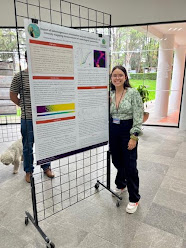
Presenting a poster at the
Giambiagi Winter School on Cosmology
at the University of Buenos Aires.
What are your near-future plans?
After surviving my Master’s studeis and the craziness of changing what country I live in every 6 months, I would love to spend some quiet time with my family. After that, I hope to start applying for PhD programs.

Thursday, July 11, 2024

Meet Central American-Caribbean Astronomy Bridge Program Fellows - Part 8

The Central American - Caribbean Bridge in Astrophysics (Cenca Bridge) is a nonprofit organization established in the state of Tennessee in the United States with the mission to create and develop astronomy research opportunities in Central America and the Caribbean. Opportunities to pursue astrophysics in the region are few with only a handful of programs offering master’s in physics with a concentration in astronomy.  Cenca Bridge connects undergraduates from Central America and the Caribbean to mentors and advisors overseas in hope that they have the choice to pursue astrophysics as a profession. Every year, Cenca Bridge holds the remote internship program, where undergraduate students from the region apply to be selected for a 3-month long paid research internship. As the only organization to provide a paid research remote internship, it is important to highlight the contributions that many women in astrophysics from Central America and the Caribbean have already contributed to our field.


In this series, we will highlight selected fellows. If you'd like to learn more about the program and ways you can get involved please visit https://cencabridgeastro.weebly.com/.


My name is Lynne-Flore Simy, patriot, the youngest of five siblings. I'm speak Creole and French, and I'm learning English. 
Lynne-Flore Simy

My journey into the world of science has been an exciting one. I was born in Haiti, a country rich in culture, but where science is not part of my initial universe. When I finished high school, I  was faced with a dilemma: I clearly knew what I didn't want to do, but I was still searching for my true passion - so much so, in fact, that I had to change direction six months after starting university, and wisely wait at home for the academic year to come to an end before reorienting myself. 

It was then that a cousin advised me to consider computer science as an option. At the time, I  had no idea what I was getting myself into, but I decided to follow her advice. It was the best  decision I ever made! As soon as I started to delve into the world of computer science, I felt a  deep connection with the discipline. 

I decided to pursue a degree in computer science, and it was there that I discovered my true passion: data engineering. Manipulating data, understanding it, and using it to solve complex problems is the best thing ever. Regardless of the field in which the data is manipulated, it's noble and appealing. 

In 2021, when I had just joined the school, the director offered me a course in Astronomy, which was to be my first step into astronomy. I spent almost a month learning Python on Google Colab, without really delving into the big concepts of astronomy. My determination, however, guided me through academic and professional challenges, and I persevered and tried to deepen my knowledge on a daily basis. It was incredible to see how a seemingly insignificant decision to follow my cousin's advice propelled me into a career, a world that excited me more and more every day. 

And then I landed this astrophysics internship at Cenca Bridge. It was an opportunity I was really excited about. I seized it with enthusiasm, because it was a unique chance to explore a whole new field. I wanted to understand the relationship that coexisted between the cosmic world, terrestrial evolution and technological innovations. Ultimately, I'd like to become a technology figure in Haiti so I can help more young people, more girls, to find their way. That's why I co-created a women's technology club, TechnoLead-Women, inaugurated on February 11, 2023. We provide training in a number of digital fields, such as digital marketing, graphic design, virtual and augmented reality, and data. At the moment, we have 10 girls in training. 

I'd like to encourage more young people in my country to learn about and consider science. It's all very well to have an enriching culture, but without science, without technology, we'll never achieve the progress we all dream of. I make time to take part in scientific conferences when I have the opportunity, and I make time for the women's technology club. For all this, I sacrifice part of my sleep. I tell myself that as long as there are more young people with digital training, there's a chance, however small, of getting things moving a bit. 

At 22, I'm realizing that the sky is no longer the limit, but rather the starting point of my exceptional career in astronomy and data engineering. I'm convinced that my passion for these fields will lead me to new and exciting discoveries, and I can't wait to continue exploring the  mysteries of our world and the universe. 

Friday, January 26, 2024

AASWomen Newsletter for January 26, 2024

AAS Committee on the Status of Women          
Issue of January 26, 2024
eds: Jeremy Bailin, Nicolle Zellner, Sethanne Howard, and Hannah Jang-Condell

[We hope you all are taking care of yourselves and each other. --eds.]

This week's issues:

Rubio
Linsy Abigail Martizez Rubio
1. Meet Central American-Caribbean Astronomy Bridge Program Fellows - Part 7
2. Gender equity: toward redefining values
3. Black women in academia face unique challenges on the job
4. The Lost Women of Science Initiative Announces New Grants and Projects for 2024
5. N3 Internship Application is Now Open!
6. Job Opportunities
7. How to Submit to the AASWomen Newsletter
8. How to Subscribe or Unsubscribe to the AASWomen Newsletter
9. Access to Past Issues of the AASWomen Newsletter

An online version of this newsletter will be available at http://womeninastronomy.blogspot.com/ at 3:00 PM ET every Friday.

Thursday, December 21, 2023

Meet Central American-Caribbean Astronomy Bridge Program Fellows - Part 6

The Central American - Caribbean Bridge in Astrophysics (Cenca Bridge) is a nonprofit organization established in the state of Tennessee in the United States with the mission to create and develop astronomy research opportunities in Central America and the Caribbean. Opportunities to pursue astrophysics in the region are few with only a handful of programs offering master’s in physics with a concentration in astronomy.  Cenca Bridge connects undergraduates from Central America and the Caribbean to mentors and advisors overseas in hope that they have the choice to pursue astrophysics as a profession. Every year, Cenca Bridge holds the remote internship program, where undergraduate students from the region apply to be selected for a 3-month long paid research internship. As the only organization to provide a paid research remote internship, it is important to highlight the contributions that many women in astrophysics from Central America and the Caribbean have already contributed to our field.

In this series, we will highlight selected fellows. If you'd like to learn more about the program and ways you can get involved please visit https://cencabridgeastro.weebly.com/.


Leiany De Oleo Rodriguez
Reading is crucial
My name is Leiany De Oleo Rodriguez. I was born in Puerto Rico to Dominican immigrants who had 3 children already. Growing up, I have always been passionate about learning and understanding the world around me. My parents and my siblings have always encouraged this. Even before I could read, I analyzed and tried to make sense of the world around me. My mother recalls how, in preschool at just 4 years old, I would craft detailed stories for my classmates based on what we learned each day. I was introduced to astronomy around this time by my older siblings, who saw my excitement and appreciation for learning and would share with me what they learned. They would share what they learned in different classes like history or science, but I was most fascinated by learning about the universe. I have always been particularly interested in space and planets ever since. As I got older, my interests shifted. I became interested in literature and then social issues. I picked up the habit of reading, and it has become crucial to me. Reading became such an enjoyable habit that I became inspired to learn different languages to read texts in their original form. I taught myself English from about 8 years old and went on to become the first fully bilingual member of my immediate family. 

At 12 years old, I read One Hundred Years of Solitude and began to learn about the history of independence in South America. Gabriel Garcia Marquez’s books actually sparked a number of interests in me, and the history of military government has been one of them. Being knowledgeable and passionate about social issues pushed me toward studying law and pursuing a career as either a lawyer or a political figure. I wanted to study and work on something that I truly felt passionate about. I started university with a major in criminal justice, believing I wanted to be a lawyer. As I navigated the reality of how the career would be, I realized it was not for me. I changed my major to literature, believing a career in writing would suffice. But that did not feel challenging or fulfilling enough. Then, in 2019, my father tragically passed away. That loss really set me back and made me wonder what exactly I wanted to do with my life. My dad always told me I was capable of anything I set my mind to. Despite how encouraging he was, I was utterly lost for a while. While completing general requirements for the degree I was pursuing at the time, I took a pre-calculus class required for the degree, and there I rediscovered how much I enjoyed problem-solving and research. After that, a physics class revived my passion for astronomy and became the last piece that solidified my direction. As I continue to delve into the field, I fall more in love with it. In the future, I hope to become an astrophysicist. As difficult as classes and topics can be, it feels exciting and fulfilling to combine all my skills in this fascinating field. 

How did you first become interested in astronomy 
or planetary science? 
I first became interested in astronomy and planetary science at a young age, thanks to my older siblings who shared their knowledge from school. The joy of receiving my first telescope and gazing at the moon for the first time is probably the earliest memory I can trace my passion for understanding the universe to. For a couple of years, I struggled with finding the right career for me, one that could challenge me and utilize the skills I love. It was during my second year at university, while taking a pre-calculus class, that I rediscovered my passion for problem-solving and research. A subsequent physics class solidified my direction, leading me toward the field of astrophysics.
Leiany De Oleo Rodriguez writing
A passion for problem-solving and research

What are your aspirations? 
I aspire to be a research astrophysicist, as well as a mentor and inspiration to others, especially young women and minorities, to pursue their passions in the STEM fields. I also aspire to publish my writing on a variety of topics, ranging from science to politics and philosophy, as well as some works of fiction. In this way, I hope to make a lasting impact on the scientific community and society as a whole. 

What are you currently working on? 
I am studying physics at Arizona State University and participating as an intern on the Cenca Bridge Remote Internship. In this internship, I am assisting with research on circumgalactic mediums. The project consists of writing a program that uses artificial lines to locate emissions within the circumgalactic medium. I am currently working on establishing a strong foundation in tool knowledge, specifically Python for data science. Since programming is so vital for research, I am taking my time to ensure that I can understand and work with it smoothly and efficiently. 


Leiany De Oleo Rodriguez reading
More reading!
What else is important to you, and how do you make time for it? 

One thing I absolutely love and believe is very important is reading. I enjoy reading scientific articles for school and work, but I also make time, usually in the morning or at night, to indulge in a little pleasure reading. Currently, I have a pocket collection of all Sylvia Plath’s poetry and read one poem every morning. It’s important to me to have these moments to connect with what I love, as it makes me feel alive. It’s as important and intuitive as brushing my teeth. 

What community issues are important to you and why? 
I aim to be a conscious citizen both in the realm of science and in the social context. Growing up in a governmental housing assistance program has made me aware of the many injustices that systematic prejudice has inflicted on us. Besides caring about those very real issues, I care about the lack of support the science community suffers from. Not only because it affects me, but because this is the community that propels humanity forward. They are vital for the advancement of knowledge and a sustainable future. It is truly bothersome how science these days is disregarded as a suggestion. That’s one of the consequences of the lack of support. I care about these issues because I want a society that is fair to every member of it and values their contributions. 

What are your near-future plans? 

Looking ahead, my near-future plans involve furthering my education and research in astrophysics, working towards a Ph.D., and actively engaging in scientific exploration.

Thursday, November 30, 2023

Meet Central American-Caribbean Astronomy Bridge Program Fellows - Part 5

The Central American - Caribbean Bridge in Astrophysics (Cenca Bridge) is a nonprofit organization established in the state of Tennessee in the United States with the mission to create and develop astronomy research opportunities in Central America and the Caribbean. Opportunities to pursue astrophysics in the region are few with only a handful of programs offering master’s in physics with a concentration in astronomy. Cenca Bridge connects undergraduates from Central America and the Caribbean to mentors and advisors overseas in hope that they have the choice to pursue astrophysics as a profession. Every year, Cenca Bridge holds the remote internship program, where undergraduate students from the region apply to be selected for a 3-month-long paid research internship. As the only organization to provide a paid research remote internship, it is important to highlight the contributions that many women in astrophysics from Central America and the Caribbean have already contributed to our field.
In this series, we will highlight selected fellows. If you'd like to learn more about the program and ways you can get involved, please visit https://cencabridgeastro.weebly.com/.
My name is Kaylan-Marie Achong and I grew up in Chaguanas, Trinidad and Tobago. The expansive history and culture of my twin-island state have deeply influenced my outlook on life and have greatly influenced my love for astronomy. I am a recent graduate from the University of the West Indies, St. Augustine Campus, with a BSc in Physics & Mathematics, and I have just started my PhD in Astronomy at UW-Madison. Although astronomy is not as popular back home as it is in the US, I have always felt a deep sense of joy in my academic pursuit of the field. 

Growing up, I enjoyed learning and being (sometimes overly) curious about everything around me. I think that initial drive is what helped me to define that I wanted to remain in a field where I could always continue learning. 

How did you first become interested in astronomy or planetary science ? 

Behind my house, there was a wide expanse of bush known as the rice paddy fields, or land, my ancestors once worked to make a living. With no street lights, the night sky stretched clearly overhead. Even without a telescope, I could spent time watching Orion move steadily across my part of the sky each year, and noticing how planets like Venus and Mars appeared and disappeared over time.
Those early experiences sparked a sense of wonder that drew me toward astronomy.
Today, as I pursue this path, I carry a strong sense of gratitude and purpose. I hope to use that position to inspire and uplift other women from the Caribbean, showing that a career in science is not out of reach, even if it may seem that way at first.

What are your aspirations? 

I really love astrobiology. I hope to build a career in research within it to continue our understanding of how chemical and environmental conditions could support life. At the same time, I think that science is something people should feel connected to, not excluded from. As such, I hope that I can share that excitement through science outreach, connecting with others and making science more approachable and engaging to communities that would not have easy access to fields like this. 

What are you currently working on ? 

Currently, I work in a lab focusing heavily on prebiotic chemistry. The overall goal of my research is in trying to understand how certain chemicals, prevalent in early Earth, might have influenced the origin of life. My work right now is in its preliminary stages, but I hope to be able to publish my first paper soon.

What else is important to you and how do you make time for it?

I think this is such an important question, especially when I think about how busy life in graduate school is. I really care about community outreach. I make a conscious effort to stay involved by supporting and participating in club and department events that promote engagement beyond academia. 

What community issues are important to you and why? 

I feel very deeply for the inclusion of Women in STEM. Although the Caribbean has advanced tremendously, and I am grateful to the guidance my country has offered me during my academic career, I think that there are still a lot of issues our region has to tackle. 

When I think about my grandmother, that stopped school at ~13, I recognize the privilege that I have to attend graduate school in a foreign country. It is with privilege that I recognize that although, in my case, my grandmother’s case was 2 generations ago, there are still many young women in the region that are not able to pursue their dreams due to cultural pressures. I hope that throughout the course of my career I am able to make a positive impact in this regard. 


What are your near-future plans? 

Well, I just adopted a kitten (her name is Sweet Pea), so my near-future plans are to train her to stop trying to eat my plants...ha-ha! 

Additionally, I hope to make it through graduate school successfully and continue in the wonderful multidisciplinary field of astrobiology. 


iPoster at 241st AAS meeting (Seattle, WA)


Fort Milfort, Tobago


Friday, October 27, 2023

AASWomen Newsletter for October 27, 2023

AAS Committee on the Status of Women
Issue of October 27, 2023
eds: Jeremy Bailin, Nicolle Zellner, Sethanne Howard, and Hannah Jang-Condell
[We hope you all are taking care of yourselves and each other. --eds.]

Catalina Morales-Gutiérrez
From Item #1
This week's issues:
1. Meet Central American-Caribbean Astronomy Bridge Program Fellows - Part 4 
2. Margaret Burbidge Visiting Professorship
3. Women faculty feel ‘pushed’ from academia by poor workplace climate
4. Job Opportunities
5. How to Submit to the AASWomen Newsletter
6. How to Subscribe or Unsubscribe to the AASWomen Newsletter
7. Access to Past Issues of the AASWomen Newsletter

An online version of this newsletter will be available at http://womeninastronomy.blogspot.com/ at 3:00 PM ET every Friday.

-------------------------------------------------------------------------------
1. Meet Central American-Caribbean Astronomy Bridge Program Fellows - Part 4
From: Catalina Morales-Gutiérrez via womeninastronomy.blogspot.com

I am from San Jose, Costa Rica and I am very passionate about science and outreach. My journey began as a student at the University of Costa Rica, pursuing a major in Food Engineering. It took just 1.5 years for me to discover that my true passion and purpose lay in the field of Physics. Although, my actual journey began as a kid, inspired by scientists and their ability to both conduct research and effectively communicate their findings. But also, while playing with my favorite toys a microscope and my dad's old binoculars – using them to explore the wonders of the world, from the tiny details in everyday objects to trying to identify constellations.

Read more at

https://womeninastronomy.blogspot.com/2023/10/meet-central-american-caribbean.html

-------------------------------------------------------------------------------
2. Margaret Burbidge Visiting Professorship
From: Shelley Wright [s2wright_at_ucsd.edu]

We wanted to bring to your attention that UC San Diego currently has its nomination process open for the Margaret Burbidge Visiting Professorship. This position offers support to women faculty members that wish to visit UC San Diego Astronomy & Astrophysics that includes a weekly stipend and potential support for child-care expenses if needed. 

For more information please see

https://astro.ucsd.edu/research/burbidge/index.html

-------------------------------------------------------------------------------
3. Women faculty feel ‘pushed’ from academia by poor workplace climate
From: Jeremy Bailin [jbailin_at_ua.edu]

By Christie Wilcox

Within the first 20 years of a faculty member’s career post-Ph.D., attrition rates range from approximately 2% to 5%—and at all stages that number is higher for women. That’s according to an analysis of employment records for nearly 250,000 U.S. faculty, published today in Science Advances. A follow-up survey of 10,000 of these researchers revealed that most left—or would leave—because they felt “pushed” out of academia rather than “pulled” toward a better opportunity, and this is especially true for women. The gender gap also increased with seniority: Women full professors are 19% more likely than men at the same career stage to leave academia, as compared with 6% for women assistant professors and 10% for associates. Women’s attrition rates were also higher at less prestigious schools and in non-STEM fields.

Read more at

https://www.science.org/content/article/women-faculty-feel-pushed-academia-poor-workplace-climate  

and

https://www.nature.com/articles/d41586-023-03251-8 

Read the peer-reviewed article at

https://www.science.org/doi/10.1126/sciadv.adi2205  

-------------------------------------------------------------------------------
4. Job Opportunities

For those interested in increasing excellence and diversity in their organizations, a list of resources and advice is here:

https://aas.org/comms/cswa/resources/Diversity#howtoincrease

- Clinical Assistant Professor, Liberal Studies at New York University
        https://apply.interfolio.com/131842

-------------------------------------------------------------------------------
5. How to Submit to the AASWOMEN newsletter

To submit an item to the AASWOMEN newsletter, including replies to topics, send email to aaswomen_at_lists.aas.org .

All material will be posted unless you tell us otherwise, including your email address.

When submitting a job posting for inclusion in the newsletter, please include a one-line description and a link to the full job posting.

Please remember to replace "_at_" in the e-mail address above.

--------------------------------------------------------------------------------
6. How to Subscribe or Unsubscribe to the AASWOMEN newsletter

Join AAS Women List through the online portal:

To Subscribe, go to https://aas.simplelists.com/aaswlist/subscribe/ and enter your name and email address, and click Subscribe. You will be sent an email with a link to click to confirm subscription.

To unsubscribe from AAS Women by email:

Go to https://aas.simplelists.com/aaswlist/subscribe/ , in the "My account and unsubscriptions", type your email address. You will receive an email with a link to access your account, from there you can click the unsubscribe link for this mailing list.

--------------------------------------------------------------------------------
7. Access to Past Issues

https://aas.org/comms/cswa/AASWOMEN

Each annual summary includes an index of topics covered.

Thursday, October 26, 2023

Meet Central American-Caribbean Astronomy Bridge Program Fellows - Part 4

The Central American - Caribbean Bridge in Astrophysics (Cenca Bridge) is a nonprofit organization established in the state of Tennessee in the United States with the mission to create and develop astronomy research opportunities in Central America and the Caribbean. Opportunities to pursue astrophysics in the region are few with only a handful of programs offering master’s in physics with a concentration in astronomy.  Cenca Bridge connects undergraduates from Central America and the Caribbean to mentors and advisors overseas in hope that they have the choice to pursue astrophysics as a profession. Every year, Cenca Bridge holds the remote internship program, where undergraduate students from the region apply to be selected for a 3-month long paid research internship. As the only organization to provide a paid research remote internship, it is important to highlight the contributions that many women in astrophysics from Central America and the Caribbean have already contributed to our field.

In this series, we will highlight selected fellows. If you'd like to learn more about the program and ways you can get involved please visit https://cencabridgeastro.weebly.com/.


My name is Catalina Morales-Gutiérrez, and I am from San Jose, Costa Rica and I am very passionate about science and outreach. My journey began as a student at the University of Costa Rica, pursuing a major in Food Engineering. It took just 1.5 years for me to discover that my true passion and purpose lay in the field of Physics. Although, my actual journey began as a kid, inspired by scientists and their ability to both conduct research and effectively communicate their findings. But also, while playing with my favorite toys a microscope and my dad's old binoculars – using them to explore the wonders of the world, from the tiny details in everyday objects to trying to identify constellations. 


How did you first become interested in astronomy or planetary science?

I have a vivid childhood memory of being astonished by the pictures of the 1991 solar eclipse, which was visible in Costa Rica. As I grew older, my fascination for this subject deepened and I became more aware of it. This happened during my teenage years that I stumbled upon the Zooniverse website; a platform dedicated to people-powered research. I enthusiastically engaged with their astrophysics projects during my free time. 


What are your aspirations?

I aspire to be a researcher in the area of physics, specifically I aspire to increase my knowledge on experimental optics, quantum sciences and nanoscience, and their applications to other areas of physics such as astrophysics. Also, I aspire to create opportunities for students and to create safe spaces within science.


What are you currently working on?

I currently have several projects. My main research has focused on theoretical and computational cosmology, mainly studying the Epoch of Reionization via the post-reionization epoch (using the Lyman-alpha Forest or HI line intensity mapping). My work has consisted of modeling, testing, and analyzing, using semi-numerical simulations (21cmFAST), the inhomogeneous nature of the reionization process for warm dark matter models (WDM) as well for different reionization histories. A recent publication, "Impact of inhomogeneous reionization on post-reionization 21-cm intensity mapping measurement of cosmological parameters", can be found here.


I have interest in other areas of physics as well, such as optical sciences, instrumentation, and atmospheric science. In optical sciences, I have been working on the measurement and analysis of reflectance spectra of cuticles of scarab metallic beetles of Costa Rica using a microspectrophotometer setup. For instrumentation and atmospheric science, I am part of the launch team for the NASA Ticosonde Project, in which I am responsible of the calibration procedures of electrochemical concentration cell (ECC) ozone sondes and I also work on the development of computational tools to facilitate data collection and analysis.


What else is important to you and how do you make time for it?

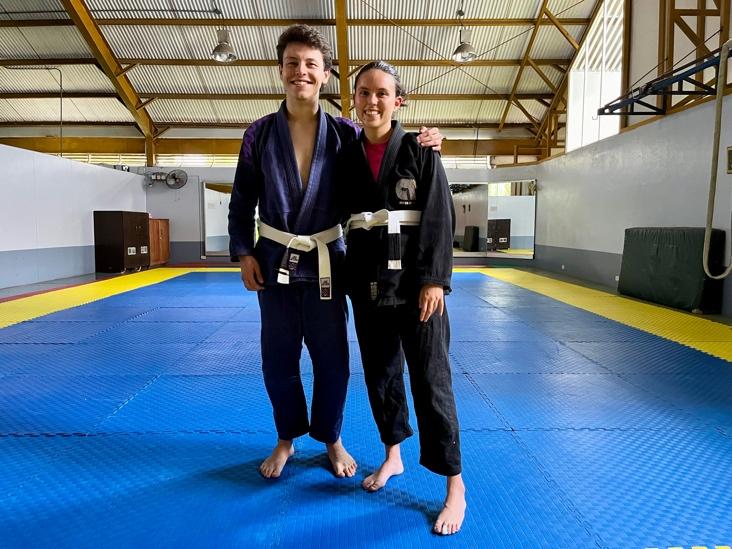
Physical activity is important for me, walking, swimming, or going to jiu jitsu classes. I am part of the Japanese jiu jitsu recreational team at my university which has established classes and that helps me make time for it. 


Spending time with friends and family is also important for me and I usually spend time with them over the weekends, by playing board games, going to the movies, and going out to eat. 


What community issues are important to you and why?

Based on my personal experiences, I am particularly passionate about the issues of education equity and opportunities for women. During my time in university, I became acutely aware of the disparities that existed among my classmates, such as varying levels of English proficiency and differing levels of preparation in science subjects, particularly math. It became apparent to me that some individuals who had attended public schools faced more obstacles in comparison to those who had received a private education. This situation seemed inherently unfair to me, as our educational system should be designed to provide equal opportunities for success based on the required level of knowledge.


Furthermore, I am particularly concerned about the limited opportunities available to women in the field of physics. This started when being witness of the disproportionately small number of women pursuing this career path. Moreover, I encountered discouraging comments suggesting that physics is primarily a field meant for men. I firmly believe that every individual, regardless of their gender, should have equal access to opportunities and be able to pursue their interests and passions without being limited by societal stereotypes.


What are your near-future plans?

My near-future plans are to finish my undergraduate degree next December, and I am currently working on my applications for physics graduate programs to start on fall 2024. While also, being active on my outreach programs.