Showing posts with label job. Show all posts

Friday, August 23, 2024

AASWomen Newsletter for August 23, 2024

AAS Committee on the Status of Women in Astronomy     
Issue of August 23, 2024
eds: Jeremy Bailin, Nicolle Zellner, Sethanne Howard, and Hannah Jang-Condell

[We hope you all are taking care of yourselves and each other. --eds.]

This week's issues:

August 26, 2026 (Image: oprahdaily.com)

1. Meet Central American-Caribbean Astronomy Bridge Program Fellows - Part 9    
2. Register for the Equity in Graduate Admissions Workshops
3. Women's Equality Day, August 26 2024  
4. Gender bias might be working at level of whole disciplines  
5. How do we bring more diversity to STEM?    
6. Job Opportunities
7. How to Submit to the AASWomen Newsletter
8. How to Subscribe or Unsubscribe to the AASWomen Newsletter
9. Access to Past Issues of the AASWomen Newsletter

An online version of this newsletter will be available at http://womeninastronomy.blogspot.com/ at 3:00 PM ET every Friday.

-------------------------------------------------------------------------------

Thursday, June 27, 2024

Career Profile: From Physics Faculty to Director of Undergraduate Advising

The AAS Committee on the Status of Women in Astronomy has compiled dozens of interviews highlighting the diversity of career trajectories available to astronomers, planetary scientists, etc. The interviews share advice and lessons learned from individuals on those paths.
Dr Monika Kress

Below is our interview with Dr. Monika Kress, the Undergraduate Advising Director in the Office of the Vice Provost for Undergraduate Education at Stanford University. She has been in this position since 2023, after following a fairly linear academic career path, from PhD to two postdocs, with a little bit of adjuncting to get teaching experience while doing the postdocs. She most recently served as a tenured faculty member in the Department of Physics and Astronomy at San Jose State University (SJSU) for 19 years, including five years as department Chair. 

Describe job hunting and networking resources you used, as well as any other advice/resources.
It was comical. I feel like Cinderella. The short story goes as follows: I was telling one of my professional mentor/friends about my interest in data analytics, and he told me that he had a friend who does data analytics at Stanford. The idea was to connect the two of us to discuss data analytics in higher ed. Which we did! My new Stanford friend informed me that there was a job opening in data analytics in the Undergraduate Education division at Stanford. Despite my new credentials, I was completely unqualified for it. However, the job ad right next to it was “Undergraduate Advising Director.” That job ad read like my CV! It was all of my favorite things to do (basically talk with students and help them decide on their major, find resources to help them succeed in their classes, navigate university policies and procedures, find opportunities for research, etc). I put together a cover letter, stripped my CV of all my publications, grants, and presentations, and applied for the job. The rest is history. 

What have been particularly valuable skills for your current job that you gained through completing your degree?
Throughout my career, I was unknowingly building a formidable skillset. My most important skills were interpersonal: helping good people who are experiencing difficult situations; dealing with people who are just outright difficult; helping students make good choices about their academic career; being a good listener; being kind; being good at understanding complex policies and how they pertain to the difficult situations that students find themselves in, being able to absorb a lot of complex information and coming up with an optimized if not analytical solution to the problem.  Overall, my experience in working with students in higher ed was the main qualification. 

I also found that it is very helpful to be proficient in whatever software and computer systems are commonly used in academia (which are also in use throughout the business world). Google docs/sheets/forms are a must-have skillset for any industry. Adobe Acrobat does amazing things with PDFs - learn all the things! Excel does so much more than just calculate your grades - you should definitely learn pivot tables and other cool functions of Excel. It also helped that I know how to use Canvas and PeopleSoft, as we use those quite a bit in my org. You’d be amazed at how far you can go career-wise, simply being a nice person and a reliable, high-functioning adult with good communication skills and knowledge of these software packages and platforms. 

Describe a typical day at work.
The commute from my house in San Jose to the Stanford campus is an epic horror show, if undertaken at rush hour (30 miles of bumper-to-bumper traffic can take an hour and a half). Fortunately, my hours are very flexible. I work from home 2 days a week, so I actually look forward to my drive to the beautiful Stanford campus, which gives me 35 minutes to listen to podcasts. When I am home, I work 9-5. When on campus, my hours are 10:30am-7pm, which is great because students often come see me during my 5-7 office hours, and then I have no traffic on the way home. 

I do some email and/or meetings with colleagues before noon, then I have a working lunch with colleagues or students. From 1-6:30pm, my schedule is open for students to make meetings with me to discuss all things academic. Sometimes I am almost booked solid during that time, other times in the quarter are quite slow (no looming deadlines). How busy I am varies. It is very busy at the start and end of each quarter, and extremely busy in September when we are onboarding the new freshmen. Overall, my workload is such that I can take my time with each student, pay careful attention to details, and go the extra mile for them, all without feeling exhausted at the end of the day. I find it very reasonable. 

Wellness is huge at Stanford - seriously, we have the world’s leading researchers on wellness! The culture is such that everyone understands that overwork does not make for better outcomes; stressed out employees do not make for a productive work environment for anyone. Stanford is well known for hiring professors who are at the top of their fields. The university commits to supporting them by hiring the best staff, paying us well, and making the workplace somewhere that the best staff want to come and carry out their careers. I have several colleagues who have been at Stanford for decades, their entire careers, including one lady who had her 50th work anniversary shortly after I arrived. Stanford also has a huge commitment to undergraduate education, including two dozen people like me to serve as academic advisers (not major advisers) for students. I mostly work with freshmen and sophomores before they declare their majors. 

What are the most enjoyable aspects of your job?
I love talking to my students about their goals and aspirations, as well as their problems. Nothing makes me feel better than helping a student sort out a sticky situation. From the outsider’s perspective, it may seem weird that sending emails and filling in PDF forms makes for a meaningful career for someone with a resume like mine, but I absolutely love it because I am making an impact in a positive way, numerous times every day. 

What do you like most about your working environment? 
I love my colleagues. We are all academics (PhDs), and many of us have either been, or wanted to be, professors, and for whatever reason it either didn’t work out, or it did and we then left tenured or tenure-track positions for various reasons (two-body problem, etc). Many of my colleagues are in the humanities where the job market for tenure-track positions is grim. Most of the other advisers also teach a class now and then. The students are amazing, too. They have incredibly diverse backgrounds, hopes, and aspirations. 

What opportunities does your job provide to be creative and/or to take initiative?
Every student case is unique. They are all individuals with interesting personal histories and various hopes, goals, and dreams. So I am creative all day long in how I ask questions, how I respond to the things they say, how I advise them, how I engage with their professors, etc. Also there are a lot of ongoing professional development and training opportunities provided to me.

How family-friendly is your current position?  
Very. We always have a Zoom option for meetings, although we usually meet in person by default because we like in-person meetings. We also try not to hold meetings before 10 am or after about 3 pm because many people have little kids they need to bring to/from school. I personally do not have kids, but I do have parents who live far away from me and who are getting older. I am trying to make more time to travel to see them, and the people at work are very understanding about this as well. I also was encouraged to take family leave when my dog was horribly injured a few months ago. I did not ultimately need to do that because I was able to work from home, but it was nice to know it was available. (My dog is fine now!) 

What is your salary? 
$114,000 (12 months) with excellent benefits (comparable to my old faculty salary)

What is your level of satisfaction with your current job? And the work-life balance?
100%!!! It has completely exceeded my expectations. My colleagues are incredible and I Have so much in common with them. 

And the work-life balance?
Also 100%!!

What advice do you have for achieving work-life balance (including having a family)?
As someone with no biological children, I still do have a family: two parents, a husband, three grandsons (thanks to my husband), his immediate (and extended) family, as well as my own sister and her kids. I readily acknowledge that not having children has made my life a lot easier than those who do have children. I am fortunate that my workplace is respectful of different family configurations. 

As far as work-life balance, you need to be clear about what your needs are, keeping in mind that you are hired to do a job and that you need to get your work done and to do it well. If you do those things, you will be able to have a job that allows more flexibility if you need to take time off during “normal business hours.” People seem to think being in academia, being a professor, is super flexible, but it can be quite inflexible. Classes are taught at certain times. There are a lot of committee meetings. Your research takes time and you have commitments to your collaborators and students. You should not be working in a vacuum. You need to show up.  If you’re out sick, work piles up, and you have more to do later. I find that my new job is far more flexible than my professor job ever was. I would strongly encourage people who want flexible working conditions to think outside academia or at least outside the usual tenure-track pathway. 

What do you do for fun (e.g., hobbies, pastimes, etc.)?
After so many years as an academic, I am trying to re-familiarize myself with the idea of having things you do for fun. Wasn’t work supposed to be my hobby and pastime, and take up 100% of my waking hours? I AM SO PASSIONATE ABOUT ASTRONOMY I DO IT ALL THE TIME. (I actually never felt that way about astronomy...) So I have been trying to do more fun things.  I make time to go see my grandsons play little league and soccer. I cook healthy meals from scratch (I have discovered that I like cooking!). I go to my fitness class twice a week, where I have made new friends. I take my dog for long hikes and go on road trips with my husband and dog. I take more trips to see family and friends, which I can do any time of year now, not just summer! I’ve never had this kind of life, and I am totally enjoying it now!

Can we include your email address for people who may want to contact you directly about your specific career route?  
Yes, use monika.kress_at_sjsu.edu (replace _at_ with @). I am now Professor Emerita and still use that email address regularly for career-related things.

Thursday, May 2, 2024

AAS Committee on Employment and You! Services and Recent Updates

By Luisa Fernanda Zambrano-Marin, Emily Mason, Chelsea Sharon, and Julia Kamenetzky


The AAS Committee on Employment is here for you! What will you do for work once you complete your degree? How far up in the degree ladder are you interested in going? What branch of work would you want to go into? Here is a summary of what we have been up to this year to help you answer these questions and more!


The AAS Committee on Employment has been quite active updating our online resources and providing training to AAS members. We are composed of fourteen passionate members, led by Julia Kamenetzky from Westminster University; our charge is to


facilitate the professional development and employment of astronomers

at all career stages and on all career paths, and

to promote balance and fairness in the job market


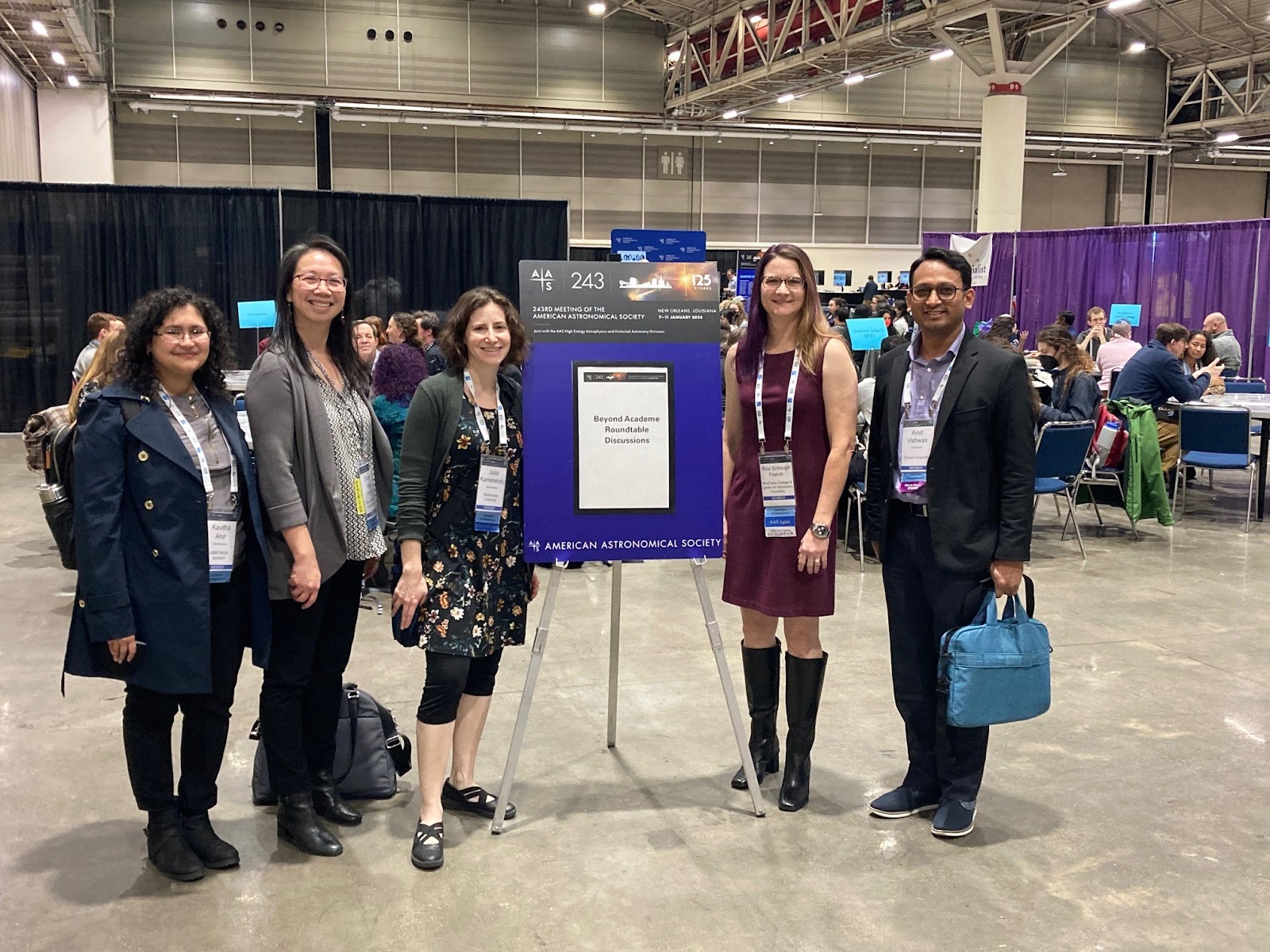
Our most visible activities for the AAS community are workshops and splinter sessions at the winter AAS meetings. This year kicked off with the popular How to Give Great Presentations workshop, led by Rob Coyne and Kavitha Arur at the AAS 243 Winter meeting in New Orleans. Next came Beyond Academe, an awesome event showcasing diverse career paths beyond the traditional academic track. We had a panel discussion featuring NASA scientists, science communicators, and more, who painted a vivid picture of the possibilities for careers beyond academia. The roundtables, where 75 participants were guided by 20 expert facilitators, dove into specific career paths in an engaging exchange of ideas. The committee also sponsored the Software & Data Carpentries Workshops and the Astronomers Turned Data Scientists Splinter Session.


AAS Committee on Employment members (from left to right): Kavitha Arur, Quyen Hart, Julia Kamenetzky, Rica Sirbaugh French, and Amit Vishwas at the Beyond Academe Roundtable Discussion event at AAS 243 in New Orleans. Photo credit to Diane Frendak.


Our committee also works behind the scenes to support AAS members. The committee joined forces with AAS staff to provide feedback and suggestions for the revamp of the Job Register webpage, ensuring clarity and ease of use for both employers and job seekers. Members Emily Mason and Dave Principe have been conducting detailed textual analysis of job postings, in addition to our annual quantitative analysis of postings. 


We kept on with the redesign and update of the list of resources available at the AAS Career Resources webpage including the Academic Career Advice page! Updates to more resource pages will be available shortly. For a summary of the resources available to job seekers and those in charge of hiring (including resources to help ensure an equitable and fair search process) see Chelsea Sharon’s post on the AAS Digest


Collaboration is key. We actively engage with other AAS groups, such as the Committee on the Status of Women in Astronomy and the AAS Education and Mentoring Specialist Tom Rice, fostering knowledge sharing and identifying areas of common interest. Additionally, we joined forces with the Beyond Academic Careers Advisory Committee (BACAC), aiming to amplify their collective impact. AAS Committee on Employment members also serve on the Meetings Task Force, the Early Career Engagement Task Force, and the AAS Workshop Task Force


Looking ahead, our main projects are to continue with popular workshops at AAS meetings. We plan to

  • introduce a new Project Management workshop,
  • nurture collaborations with BACAC and other AAS committees and task forces,
  • keep analyzing job data,
  • improve website access to career resources, and
  • support international students' and employees’ special concerns.


The AAS Committee on Employment continues to support astronomers’ career aspirations worldwide. We seek to empower individuals at every career stage, foster collaboration, advocate for transparency within the field, and pave the way for a brighter future for the astronomy community.

Friday, February 16, 2018

AASWomen Newsletter for February 16, 2018

AAS Committee on the Status of Women
February 16, 2018
eds: Nicolle Zellner, Heather Flewelling, Christina Thomas, and Maria Patterson

This week's issues:

1. Talking About the Tesla          
2. NASA's First Chief Astronomer, the Mother of Hubble 
3. Who’s Important? A tale from Wikipedia   
4. OSA Foundation and The Optical Society celebrates women in our field by sharing special tributes from Members 
5. I want girls to learn math and science — and their own self-worth — despite stereotypes  
6. Job Opportunities   
7. How to Submit to the AASWomen Newsletter
8. How to Subscribe or Unsubscribe to the AASWomen Newsletter
9. Access to Past Issues of the AASWomen Newsletter

Friday, May 26, 2017

AASWomen Newsletter for May 26, 2017

AAS Committee on the Status of Women
Issue of May 26, 2017
eds: Nicolle Zellner, Heather Flewelling, Christina Thomas, and Maria Patterson

This week's issues:

1. Peer Review as a Lens Into Bias        
2. Is This How Discrimination Ends?
3. Scholarships for Women and Grants for Mothers Added to AAS Resource Page
4. How Women Mentors Make a Difference in Engineering
5. Pearl I. Young
6. Job Opportunities
7. How to Submit to the AASWomen Newsletter
8. How to Subscribe or Unsubscribe to the AASWomen Newsletter
9. Access to Past Issues of the AASWomen Newsletter

Friday, February 5, 2016

AASWOMEN Newsletter for February 5, 2016

AAS Committee on the Status of Women
Issue of February 5, 2016
eds: Daryl Haggard, Nicolle Zellner, Meredith Hughes, & Elysse Voyer

This week's issues:

1. Student Highlight: Moiya McTier    
2. Career Profiles: Spectroscopist to Technology Solutions Scientist to Astronomy Professor
3. The Status of Mental Health in Planetary Science
4. If Male Scientists Were Written About Like Female Scientists    
5. Job Opportunities
6. How to Submit to the AASWomen Newsletter
7. How to Subscribe or Unsubscribe to the AASWomen Newsletter
8. Access to Past Issues of the AASWomen Newsletter

Wednesday, October 14, 2015

Career Profiles: Astronomer to STEM Education Policy Executive

The AAS Committee on the Status of Women in Astronomy and the AAS Employment Committee have compiled dozens of interviews highlighting the diversity of career trajectories available to astronomers. The interviews share advice and lessons learned from individuals on those paths.

Below is our interview with Anita Krishnamurthi, an astronomer turned STEM education after-school executive and advocate.   If you have questions, suggestions, advice to share, etc. about this career path, please leave a comment below.

For access to all our Career Profile Project interviews, please visit http://aas.org/jobs/career-profiles

Friday, August 21, 2015

AASWomen Newsletter for August 21, 2015

AAS Committee on the Status of Women
Issue of August 21, 2015
eds: Daryl Haggard, Nicolle Zellner, Meredith Hughes, & Elysse Voyer

This week's issues:

1. The SEP in Astronomy
2. My Impressions: The IAU XXIX General Assembly
3. Status magazine for June 2015 is published
4. Practical policies can combat gender inequality     
5. Astronomer Celebrates Female Scientists’ “Special Natural Gift for Caring and Educating” 
6. Job Opportunities
7. How to Submit to the AASWomen Newsletter
8. How to Subscribe or Unsubscribe to the AASWomen Newsletter
9. Access to Past Issues of the AASWomen Newsletter

Wednesday, June 3, 2015

Addressing Career Breaks Head-on in CVs and Cover Letters

Emily Nicholson, an Australian ecologist, has written a fascinating 1-pager at Science Magazine about addressing career breaks head-on in your CV and cover letter when applying for jobs and grants. She writes:
My early job applications—using a standard CV that mentioned my maternity leaves only in passing... didn’t get so much as an interview... Then, with mentoring and advice from colleagues and friends, I reshaped my CV to account for the time I’d spent raising my family. I put my career breaks front and center, and I reported my productivity metrics to account for my time away from work. 
The result: My first application after I made the adjustments yielded a tenured position...Reframing my track record undoubtedly helped. Here’s how I did it. 
Her approach was to:
  • Get the data
  • Do the math
  • Write about career interruptions up front and in a positive way

Thursday, July 24, 2014

Career Profiles: Astronomer to Financial Analyst

The AAS Committee on the Status of Women in Astronomy and the AAS Employment Committee have compiled dozens of interviews highlighting the diversity of career trajectories available to astronomers. The interviews share advice and lessons learned from individuals on those paths.

Below is our interview with an astronomer turned financial analyst. S/he went straight to finance after obtaining her/his Ph.D. Location, salary, and work environment were important factors in his/her decision to leave astronomy. If you have questions, suggestions, advice to share, etc. about this career path, please leave a comment below.

For access to all our Career Profile Project interviews, please visit http://aas.org/jobs/career-profiles. We plan to post a new career profile to this blog every Thursday.

Thursday, July 17, 2014

Career Profiles: Astronomer to Associate Professor of Physics at a Small Liberal Arts College

The AAS Committee on the Status of Women in Astronomy and the AAS Employment Committee have compiled dozens of interviews highlighting the diversity of career trajectories available to astronomers. The interviews share advice and lessons learned from individuals on those paths.

Below is our interview with an astronomer turned Associate Professor of Physics. S/he is the only astronomer in her/his department within a small liberal arts college. In the profile below, s/he discusses the enjoyable aspects as well as the challenges of her/his position. If you have questions, suggestions, advice to share, etc. about this career path, please leave a comment below.

For access to all our Career Profile Project interviews, please visit http://aas.org/jobs/career-profiles. We plan to post a new career profile to this blog every Thursday.


Thursday, July 10, 2014

Career Profiles: Astronomer to Head of Bioinformatics

The AAS Committee on the Status of Women in Astronomy and the AAS Employment Committee have compiled dozens of interviews highlighting the diversity of career trajectories available to astronomers. The interviews share advice and lessons learned from individuals on those paths.

Below is our interview with Alicia Oshlack, an astronomer turned Head of Bioinformatics for Murdoch Children's Research Institute at the Royal Children's Hospital. She is very satisfied with her job and the family friendly environment. If you have questions, suggestions, advice to share, etc. about this career path, please leave a comment below.

For access to all our Career Profile Project interviews, please visit http://aas.org/jobs/career-profiles. We plan to post a new career profile to this blog every Thursday.

Thursday, June 26, 2014

Career Profiles: Astronomer to Software Engineer at SpaceX

The AAS Committee on the Status of Women in Astronomy and the AAS Employment Committee have compiled dozens of interviews highlighting the diversity of career trajectories available to astronomers. The interviews share advice and lessons learned from individuals on those paths.

Below is our interview with Patrik Jonsson, an astronomer turned software engineer at SpaceX. He made his career switch at the age of 41 and works remotely from Hawaii. If you have questions, suggestions, advice to share, etc. about this career path, please leave a comment below.

For access to all our Career Profile Project interviews, please visit http://aas.org/jobs/career-profiles. We plan to post a new career profile to this blog every Thursday.

Thursday, June 12, 2014

Career Profiles: Astronomer to Data Scientist

The AAS Committee on the Status of Women in Astronomy and the AAS Employment Committee have compiled dozens of interviews highlighting the diversity of career trajectories available to astronomers. The interviews share advice and lessons learned from individuals on those paths.

Below is our interview with Jessica Kirkpatrick, an astronomer turned data scientist. She went directly from graduate school to working as a data scientist for Microsoft/Yammer and recently became the Director of Data Science at the education start-up InstaEDU. If you have questions, suggestions, advice to share, etc. about this career path, please leave a comment below.

For access to all our Career Profile Project interviews, please visit http://aas.org/jobs/career-profiles. We plan to post a new career profile to this blog every Thursday.

Thursday, May 8, 2014

Career Profiles: Astronomer to Soft Money Researcher

The AAS Committee on the Status of Women in Astronomy and the AAS Employment Committee have compiled dozens of interviews highlighting the diversity of career trajectories available to astronomers. The interviews share advice and lessons learned from individuals on those paths.

Below is our interview with an astronomer turned soft money researcher. S/he is the PI for a major instrument on a 10-m class telescope. S/he is also in a dual astronomy career couple. If you have questions, suggestions, advice to share, etc. about this career path, please leave a comment below.

For access to all our Career Profile Project interviews, please visit http://aas.org/jobs/career-profiles. We plan to post a new career profile to this blog every Thursday.