Read Jörg Matthias Determann's career profile interview from 2024 with the CSWA and an interview with the CSWA about his book, "Diversity, Equity, and Inclusion in Astroomy: A Modern History.
The AAS Committee on the Status of Women in Astronomy maintains this blog to disseminate information relevant to astronomers who identify as women and share the perspectives of astronomers from varied backgrounds. If you have an idea for a blog post or topic, please submit a short pitch (less than 300 words). The views expressed on this site are not necessarily the views of the CSWA, the AAS, its Board of Trustees, or its membership.
Thursday, February 5, 2026
Crosspost: Preserving the History of Women’s Activism in Science
Read Jörg Matthias Determann's career profile interview from 2024 with the CSWA and an interview with the CSWA about his book, "Diversity, Equity, and Inclusion in Astroomy: A Modern History.
Thursday, May 15, 2025
Cross-post: More Than a Name – Why Women in Physics Deserve Context
![]() |
| Dr. Claire Davies Photo: University of Exeter |
Thursday, August 22, 2024
Meet Central American-Caribbean Astronomy Bridge Program Fellows - Part 9
The Central American - Caribbean Bridge in Astrophysics (Cenca Bridge) is a nonprofit organization established in the state of Tennessee in the United States with the mission to create and develop astronomy research opportunities in Central America and the Caribbean. Opportunities to pursue astrophysics in the region are few with only a handful of programs offering master’s in physics with a concentration in astronomy. Cenca Bridge connects undergraduates from Central America and the Caribbean to mentors and advisors overseas in hope that they have the choice to pursue astrophysics as a profession. Every year, Cenca Bridge holds the remote internship program, where undergraduate students from the region apply to be selected for a 3-month long paid research internship. As the only organization to provide a paid research remote internship, it is important to highlight the contributions that many women in astrophysics from Central America and the Caribbean have already contributed to our field.
![]() |
| In France, during one of many travels. |
I first became interested in astronomy by watching TV shows like Doctor Who and Cosmos. In my undergrad I had the opportunity to do my thesis at the University of PadovaUniversity of Padova in Italy and reaffirmed my love for astronomy and astrophysics and that this is the path I want to follow.
I want to complete a PhD and establish the first astrophysics research group in my country and give Dominican students the opportunity to do research in this field without having to leave the country.
I recently started my Master’s Degree in Astrophysics and Space Science at the University of Rome Tor Vergata. It is an Erasmus Mundus Joint Masters program, so every semester I am in a different country. I am studying with a very diverse group of people from all over the world. In my Bachelor’s program, I did research in astroparticle physics and would love to continue on that field.
My family is very important to me and with a 6-hour time difference, the only way to make time is by having a very strict to-do list (haha!).
Student engagement and the participation of young people in policy making is very important to me. Time and time again, we have seen what happens when young people fall to apathy and don’t engage in the world around them. I recently started working with the Office of Astronomy for Development to see how physics and astronomy students can be incorporated and engaged in their projects. I also worked on the Executive Committee of the International Association of Physics Students and got to meet lots of physics students from around the world and help different student associations.
![]() |
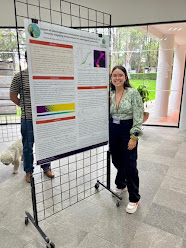
| Presenting a poster at the Giambiagi Winter School on Cosmology at the University of Buenos Aires. |
Thursday, July 11, 2024
Meet Central American-Caribbean Astronomy Bridge Program Fellows - Part 8
The Central American - Caribbean Bridge in Astrophysics (Cenca Bridge) is a nonprofit organization established in the state of Tennessee in the United States with the mission to create and develop astronomy research opportunities in Central America and the Caribbean. Opportunities to pursue astrophysics in the region are few with only a handful of programs offering master’s in physics with a concentration in astronomy. Cenca Bridge connects undergraduates from Central America and the Caribbean to mentors and advisors overseas in hope that they have the choice to pursue astrophysics as a profession. Every year, Cenca Bridge holds the remote internship program, where undergraduate students from the region apply to be selected for a 3-month long paid research internship. As the only organization to provide a paid research remote internship, it is important to highlight the contributions that many women in astrophysics from Central America and the Caribbean have already contributed to our field.
In this series, we will highlight selected fellows. If you'd like to learn more about the program and ways you can get involved please visit https://cencabridgeastro.weebly.com/.
![]() |
| Lynne-Flore Simy |
Thursday, December 21, 2023
Meet Central American-Caribbean Astronomy Bridge Program Fellows - Part 6
In this series, we will highlight selected fellows. If you'd like to learn more about the program and ways you can get involved please visit https://cencabridgeastro.weebly.com/.
![]() |
| Reading is crucial |
How did you first become interested in astronomy or planetary science?
![]() |
| A passion for problem-solving and research |
What are your aspirations?
I aspire to be a research astrophysicist, as well as a mentor and inspiration to others, especially young women and minorities, to pursue their passions in the STEM fields. I also aspire to publish my writing on a variety of topics, ranging from science to politics and philosophy, as well as some works of fiction. In this way, I hope to make a lasting impact on the scientific community and society as a whole.
I am studying physics at Arizona State University and participating as an intern on the Cenca Bridge Remote Internship. In this internship, I am assisting with research on circumgalactic mediums. The project consists of writing a program that uses artificial lines to locate emissions within the circumgalactic medium. I am currently working on establishing a strong foundation in tool knowledge, specifically Python for data science. Since programming is so vital for research, I am taking my time to ensure that I can understand and work with it smoothly and efficiently.

![]() |
| More reading! |
One thing I absolutely love and believe is very important is reading. I enjoy reading scientific articles for school and work, but I also make time, usually in the morning or at night, to indulge in a little pleasure reading. Currently, I have a pocket collection of all Sylvia Plath’s poetry and read one poem every morning. It’s important to me to have these moments to connect with what I love, as it makes me feel alive. It’s as important and intuitive as brushing my teeth.
What community issues are important to you and why?
I aim to be a conscious citizen both in the realm of science and in the social context. Growing up in a governmental housing assistance program has made me aware of the many injustices that systematic prejudice has inflicted on us. Besides caring about those very real issues, I care about the lack of support the science community suffers from. Not only because it affects me, but because this is the community that propels humanity forward. They are vital for the advancement of knowledge and a sustainable future. It is truly bothersome how science these days is disregarded as a suggestion. That’s one of the consequences of the lack of support. I care about these issues because I want a society that is fair to every member of it and values their contributions.
What are your near-future plans?
Looking ahead, my near-future plans involve furthering my education and research in astrophysics, working towards a Ph.D., and actively engaging in scientific exploration.
Thursday, November 30, 2023
Meet Central American-Caribbean Astronomy Bridge Program Fellows - Part 5
Behind my house, there was a wide expanse of bush known as the rice paddy fields, or land, my ancestors once worked to make a living. With no street lights, the night sky stretched clearly overhead. Even without a telescope, I could spent time watching Orion move steadily across my part of the sky each year, and noticing how planets like Venus and Mars appeared and disappeared over time.
Those early experiences sparked a sense of wonder that drew me toward astronomy.
Today, as I pursue this path, I carry a strong sense of gratitude and purpose. I hope to use that position to inspire and uplift other women from the Caribbean, showing that a career in science is not out of reach, even if it may seem that way at first.
I really love astrobiology. I hope to build a career in research within it to continue our understanding of how chemical and environmental conditions could support life. At the same time, I think that science is something people should feel connected to, not excluded from. As such, I hope that I can share that excitement through science outreach, connecting with others and making science more approachable and engaging to communities that would not have easy access to fields like this.
Currently, I work in a lab focusing heavily on prebiotic chemistry. The overall goal of my research is in trying to understand how certain chemicals, prevalent in early Earth, might have influenced the origin of life. My work right now is in its preliminary stages, but I hope to be able to publish my first paper soon.
When I think about my grandmother, that stopped school at ~13, I recognize the privilege that I have to attend graduate school in a foreign country. It is with privilege that I recognize that although, in my case, my grandmother’s case was 2 generations ago, there are still many young women in the region that are not able to pursue their dreams due to cultural pressures. I hope that throughout the course of my career I am able to make a positive impact in this regard.
![]() |
| iPoster at 241st AAS meeting (Seattle, WA) |
![]() |
| Fort Milfort, Tobago |
Thursday, October 26, 2023
Meet Central American-Caribbean Astronomy Bridge Program Fellows - Part 4
How did you first become interested in astronomy or planetary science?
I have a vivid childhood memory of being astonished by the pictures of the 1991 solar eclipse, which was visible in Costa Rica. As I grew older, my fascination for this subject deepened and I became more aware of it. This happened during my teenage years that I stumbled upon the Zooniverse website; a platform dedicated to people-powered research. I enthusiastically engaged with their astrophysics projects during my free time.
What are your aspirations?
I aspire to be a researcher in the area of physics, specifically I aspire to increase my knowledge on experimental optics, quantum sciences and nanoscience, and their applications to other areas of physics such as astrophysics. Also, I aspire to create opportunities for students and to create safe spaces within science.
What are you currently working on?
I currently have several projects. My main research has focused on theoretical and computational cosmology, mainly studying the Epoch of Reionization via the post-reionization epoch (using the Lyman-alpha Forest or HI line intensity mapping). My work has consisted of modeling, testing, and analyzing, using semi-numerical simulations (21cmFAST), the inhomogeneous nature of the reionization process for warm dark matter models (WDM) as well for different reionization histories. A recent publication, "Impact of inhomogeneous reionization on post-reionization 21-cm intensity mapping measurement of cosmological parameters", can be found here.
I have interest in other areas of physics as well, such as optical sciences, instrumentation, and atmospheric science. In optical sciences, I have been working on the measurement and analysis of reflectance spectra of cuticles of scarab metallic beetles of Costa Rica using a microspectrophotometer setup. For instrumentation and atmospheric science, I am part of the launch team for the NASA Ticosonde Project, in which I am responsible of the calibration procedures of electrochemical concentration cell (ECC) ozone sondes and I also work on the development of computational tools to facilitate data collection and analysis.
What else is important to you and how do you make time for it?
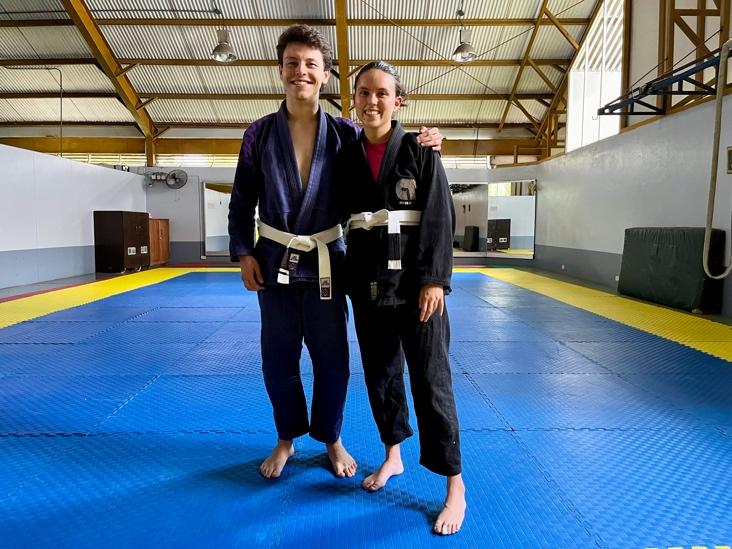
Physical activity is important for me, walking, swimming, or going to jiu jitsu classes. I am part of the Japanese jiu jitsu recreational team at my university which has established classes and that helps me make time for it.
Spending time with friends and family is also important for me and I usually spend time with them over the weekends, by playing board games, going to the movies, and going out to eat.
What community issues are important to you and why?
Based on my personal experiences, I am particularly passionate about the issues of education equity and opportunities for women. During my time in university, I became acutely aware of the disparities that existed among my classmates, such as varying levels of English proficiency and differing levels of preparation in science subjects, particularly math. It became apparent to me that some individuals who had attended public schools faced more obstacles in comparison to those who had received a private education. This situation seemed inherently unfair to me, as our educational system should be designed to provide equal opportunities for success based on the required level of knowledge.
Furthermore, I am particularly concerned about the limited opportunities available to women in the field of physics. This started when being witness of the disproportionately small number of women pursuing this career path. Moreover, I encountered discouraging comments suggesting that physics is primarily a field meant for men. I firmly believe that every individual, regardless of their gender, should have equal access to opportunities and be able to pursue their interests and passions without being limited by societal stereotypes.
What are your near-future plans?
My near-future plans are to finish my undergraduate degree next December, and I am currently working on my applications for physics graduate programs to start on fall 2024. While also, being active on my outreach programs.
Wednesday, June 1, 2022
Crosspost: First-ever study of LGBT+ experiences in physics reveals red flags
![]() |
| University of California-San Diego Executive Vice Chancellor, Elizabeth Simmons, co-authored a comprehensive study on the experiences of LGBTQ+ identifying members of the physics community. Credit: University of California-San Diego |
The authors found that the two biggest factors that influence a person's decision to leave physics are the overall climate of the organization they belong to and more specifically observing exclusionary behavior.
"People feel shunned, excluded, and they were continually having to readjust and twist themselves to fit into the physics community," said Ramón Barthelemy, assistant professor of physics at the University of Utah and co-lead author of the study. "LGBT+ people are inherently a part of this field. If you want physics to be a place that anyone can participate, we have to talk about these issues."
"Nearly everybody I know who is LGBT+ in physics has left, to be honest," said Tim Atherton, associate professor of physics at Tufts University and co-lead author of the study. "We're talking dozens and dozens of students and faculty. I can empathize with the experiences of the study's participants from some of my own experiences."
Thursday, April 21, 2022
Infusing IDEA Culture throughout Astronomy
![]() |
| Image credit: John Sim |
Although we have made progress with this model, imagine the differences that might be achievable if we could infuse IDEA culture throughout our organizations/businesses/universities/communities.
This idea for IDEA Infusion was inspired by questions I often get from my staff at USRA during performance appraisal season regarding the Diversity category. Many do not know what to include because their jobs do not involve hiring. As a result, I created a check list to help them out. IDEA culture began to infuse throughout USRA as staff members built IDEA awareness (Step 1); became stronger IDEA allies (Step 2), and transitioned to IDEA advocates (Step 3).
Although this plan was originally created specifically for USRA, it is easily adaptable for any organization. It has the advantages of both motivating staff members to participate through more positive evaluations on their performance reviews and providing straightforward suggestions on how they might achieve higher scores. Implementation was also straightforward, since USRA already had a Diversity category as part of its existing performance appraisal. Staff members simply keep track of the activities that they participate in throughout the year and record them with the appraisal tools. If your organization does not evaluate diversity as part of the appraisal system, I highly encourage you to add this vital category.
Step 1: Building IDEA awareness (learning, reading, viewing, listening)
The check list items for Step 1 are primarily passive – read a book, watch a documentary, listen to a podcast – and they encouraged everyone to invest time in becoming more aware of the issues. The deliberate wording of the USRA initiative recommended that the staff consider enhancing their own personal IDEA awareness/knowledge by selecting and participating in some activities.
- Attend IDEA seminars at your organization/community
- Read the IDEA blog posts from the AAS diversity committees
- Participate in IDEA events at your organization/business/university/community
- Attend a lecture or workshop about IDEA topics at the AAS or other conference
- View a Ted Talk on diversity
- Listen to IDEA Podcasts: pick one from a recommended list like here or here or just Google ‘best podcasts on diversity and inclusion
Step 2 of this initiative is becoming a stronger IDEA ally. The suggestions in the check list below are now active (rather than passive) and encourage former bystanders to engage – join a committee, write an article, mentor a student – as they begin to make a difference in their community.
- Join a diversity committee or working group at your organization/community
- Write an article on an IDEA topic of your choice (including a book/podcast/Ted Talk recommendation/critique/review from Step 1) for a diversity blog or newsletter
- Invite and escort your supervisor/manager/professor/department chair to an IDEA event at your organization/community
- Write the IDEA section of a proposal or policy document you are working on
- Mentor a student or intern from an underrepresented community
- Give a talk at a minority-serving institution
- Assist in planning and/or organizing an IDEA event at your organization/business/university/communityStep 3: Transitioning to an IDEA advocate (leading, managing, guiding)
- Chair a diversity committee or working group at your organization/community
- Create and lead an IDEA initiative at your organization/community
- Start an IDEA committee at your organization/community
- Give a colloquium on an IDEA topic at your organization/community
- Write and publish a peer-reviewed paper on an IDEA topic
- Give an invited talk on an IDEA topic at a professional conference
- Lead an IDEA-related discussion for your team/department
Tuesday, February 8, 2022
Crosspost: Physics Conference Creates Positive Experience for Kassaye, Stapley
But her interest in another subject led her to an opportunity outside the classroom, as she was one of two College of Idaho students to make presentations at the 2022 Conferences for Undergraduate Women in Physics in January.
“I’ve always loved physics, that’s why I ended up taking the research opportunity,” Kassaye said. “I love physics, I am interested in astronomy, and it integrated computer science with it.”
Kassaye and senior Makenzie Stapley, a math-physics major, each presented on different aspects of the same project: research on star-forming regions within the Milky Way galaxy called Yellowballs that is led by physics professor Dr. Katie Devine. Kassaye’s presentation focused on the distance to the Yellowball regions while Stapley’s presentation focused on the colors. The conference was slated to be an in-person event but was shifted online due to COVID trends. The result was everyone presenting at one virtual conference, rather than multiple regional conferences. The volume of presentations limited the number of interactions, but both students were grateful for the opportunity.
Thursday, February 3, 2022
Crosspost: #BlackInQuantum
The sixth person to earn a doctoral degree in physics from an American institution was African American scientist Edward Alexander Bouchet. It was 1876, just 11 years after the US had adopted a constitutional amendment that outlawed slavery.
Never again have African Americans made up such a large percentage of US physicists. In fact, it would take another 42 years before a second African American man earned a physics PhD in the United States.
That was Elmer Imes, a contemporary of Albert Einstein, who earned his degree from the University of Michigan in 1918. His doctoral work established some of the earliest direct experimental evidence of quantum theory, making him a crucial historical figure in quantum physics and quantum information science.
But the accomplishments of Black scientists like Imes and Bouchet are not well known, says Charles Brown, a postdoctoral researcher at the University of California, Berkeley. “Black people have been contributing to the progress of research groups for a long time, and just not really having enough of a spotlight on them… which is why when you go to Wikipedia, and you try to look people up, it's hard to find anything,” he says.
Like Imes, Brown searches for insights into the quantum realm. And like fellow Yale graduate Bouchet, Brown finds himself in a small pool of physics PhDs: According to a survey by the American Institute of Physics, “quantum foundations and information science” ranks among the smallest subfields in physics, having granted an average of just 30 PhDs per year in 2017 and 2018.
The US and other nations plan to grow what they’re calling the “quantum workforce,” and they’re going to need people with the right level of expertise to fill it, says Thomas Searles, an associate professor at the University of Illinois, Chicago. “There is a large issue of this new, burgeoning industry where there are going to be significant problems with the workforce and sustaining it,” he says.
Physicists like Searles and Brown see an opportunity during this period of growth: to prioritize diversity, equity and inclusion now, rather than trying to fix more entrenched issues later. They suggest this will require confronting systemic problems in education and academia while simultaneously investing in programs that will help Black researchers succeed.
The hope is that there will be more physicists like Imes and Bouchet. But their stories will feature fewer frustrations and more support—and people will make sure to tell them.
https://www.symmetrymagazine.org/article/black-in-quantum
Thursday, January 13, 2022
Crosspost: Advancing equity, diversity, and inclusion: a how-to guide
Thursday, December 23, 2021
Crosspost: Astronomy Decadal Survey Reckons with Demographic Disparities, Societal Impacts
Written By Andrea Peterson for the American Institute of Physics
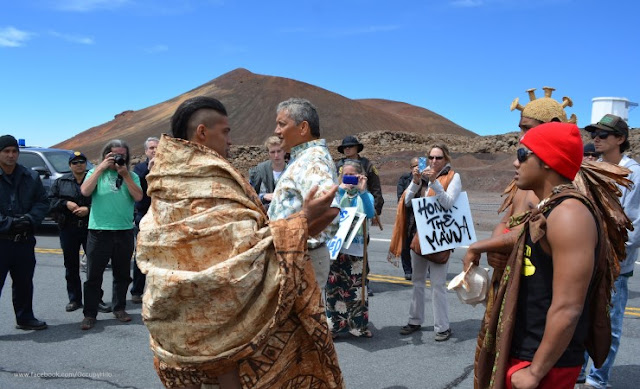
| Indigenous Hawaiian activists protest the development of the Thirty Meter Telescope (TMT) on Mauna Kea, a dormant volcano sacred to native Hawaiian culture. Image credit: Occupy Hilo. Released last month, the National Academies’ latest decadal survey of astronomy and astrophysics includes an intensive assessment of the “state of the profession” and its “societal impacts” for the first time in the survey’s 60-year history. A dedicated survey panel was tasked with gathering community input and data on demographic trends, as well as with developing “actionable suggestions” to promote the health of the workforce and improve the diversity of the field. The panel also proposed that astronomers re-envision their approach to outreach and “broader impacts,” including by deepening their consultation with local communities over the placement of telescopes — a major issue confronting the proposed construction of the Thirty Meter Telescope in Hawaii. Based on the panel’s input, the full survey committee presents 10 recommendations to improve the “foundations of the profession,” spanning matters such as expanding demographic data collection and diversity programs to adopting a “Community Astronomy” model of engagement and reducing astronomy’s environmental impacts. While the recommendations are not binding, they will carry considerable weight with NASA, the National Science Foundation, and the Department of Energy, which sponsored the survey. Read the rest of the article and learn more about trends in racial and gender diversity in astrophysics at: https://www.aip.org/fyi/2021/astronomy-decadal-survey-reckons-demographic-disparities-societal-impacts |
Thursday, August 12, 2021
Crosspost: Mallory Molina awarded Ford Fellowship for astrophysics research, diversity efforts
Written By Rachel Hergett for MSU News Service