Showing posts with label astrophysics. Show all posts

Thursday, September 3, 2026

Meet the Women Behind the Nancy Grace Roman Telescope

This week the Nancy Grace Roman Telescope launched perfectly and is now on its journey to Lagrange Point 2 (L2). A million miles from Earth, the telescope will begin its mission to map the universe in a wide-angle, infrared view. Named for Nancy Grace Roman, NASA's first chief of astronomy and first woman executive, the telescope celebrates one of the most famous female astronomers to date. As part of that legacy, many of those involved in building and operating Roman are women. 

The Nancy Grace Roman Telescope launches on a SpaceX Falcon rocket on August 30, 2026. 
Photo: NASA/Joel Kowsky

Jackie Townsend, Roman Space Telescope Project Manager

Jackie Townsend didn't follow a straight path to NASA and the Roman project. She went to college twice, dropping out the first time to work in various jobs before rediscovering her love for space and going back to study physics. Townsend brought this penchant for problem-solving to NASA's Goddard Space Flight Center, where she worked on Hubble missions as a materials engineer and contributed to James Webb as well. As a manager for Roman, she said, "I find it wonderful and empowering to think that everyone from a kindergarten kid to a Nobel laureate will have the same access to data to do whatever great science they have in mind." (Jackie Townsend - Roman Team - NASA)

Rebekah Hounsell, Assistant Research Scientist

Rebekah Hounsell knew she wanted to be an astrophysicist from the age of ten. She worked on data from Hubble at the Space Telescope Science Institute and found her way to Roman early in its development when it was known as WFIRST. Hounsell helped design the High Latitude Time Domain Survey, which will discover and categorize Type Ia supernovae during Roman's mission. Hounsell is excited to see Roman discover transient events as she continues her role as Co-Principal Investigator of of the Roman Supernova Project Infrastructure Team. (Rebekah Hounsell - Roman Team - NASA)

Ami Choi, Research Astrophysicist and Roman’s Deputy Wide Field Instrument Scientist
Ami Choi leads a tour stop at NASA Goddard. 
Credit: NASA/Travis Wohlrab

Ami Choi didn't find physics or math easy, but she pursued a career in astrophysics relentlessly, first through dark matter and energy and now as the deputy Wide Field Instrument scientist for Roman. Choi's curiosity drives her work, and she is looking forward to the moment Roman begins transmitting data back. (Ami Choi - Roman Team - NASA)

Sangeeta Malhotra - Research Astrophysicist

Sangeeta grew up in India, and her town's planned power outages at night gave her the opportunity to view dark skies and fall in love with the stars. She built her first telescope while in high school and never looked back. She studied dark matter while doing her PhD at Princeton and then the Hubble Constant and dark energy. She worked on the Hubble instrument NICMOS and advised using spectroscopy measurements on Hubble Ultra Deep Field planning. All of this experience led her to wonder what more could be observed from a wide-field telescope. Malhotra joined the team for WFIRST early on doing calibration and is currently working on her next mission, Habitable Worlds Observatory. (Sangeeta Malhotra - Roman Team - NASA)

Bente Eegholm - Optical Engineer

Bente Eegholm with Roman's primary mirror.
Credit: NASA/Chris Gunn

Eegholm came to the United States from her native Denmark and worked as a contractor supporting the James Webb Space Telescope. Her work focused on a speckle interferometer used for stability in one of Webb's mirrors. Then she was a developmental lead for the ICESat-2 mission and participated in building both the ATLAS flight telescope and a spare one. She joined the Roman team in 2019 as optics lead on the prism assembly. Eegholm appreciates the Roman project's relatively fast timeline from development to launch, as well as the shorter development cycles for Earth-observing missions, as she sees value in going through a development and launch cycle. (Bente Eegholm - Roman Team - NASA)

Building and developing the Nancy Grace Roman Telescope was truly a team effort, with thousands of people contributing to the telescope's creation, launch, and ongoing mission. Keep up with the latest mission updates through the Roman Space Telescope blog from NASA. 

Read more about the Roman Team at Nasa.gov.


Quotes used in this blog were originally published as part of the Roman Team page at NASA.gov, through an interview series by Ashley Balzer, NASA science writer for the Nancy Grace Roman Telescope. 


Thursday, January 8, 2026

Crosspost: Picture an Astronomer: Best Practices for Retaining Talent in Astrophysics

Our crosspost today is from a newly released whitepaper edited by Ava Polzin and Katherine E. Whitaker about the challenges women in astronomy face and how these might be overcome.

Cover: Illustration of Vera Rubin, based on the 1948 picture of her at the Vassar College Observatory from the Carnegie Science Vera C. Rubin Photograph Collection. The background is one of the first light images from the NSF-DOE Vera C. Rubin Observatory released June 2025. It is the first major observatory to be named after a woman. All art by Julie Malewicz.

Summary:


Women are consistently underrepresented in astrophysics yet are simultaneously subject to disproportionate attrition at every career stage. This disparity between demonstrated efficacy in job performance and ultimate career outcome was the primary motivation for the Picture an Astronomer series, which included both targeted public outreach to increase representation of women in astrophysics and high-level, solution-oriented discussions among professional astronomers. 

In March 2025, more than 200 astronomers came together in a hybrid-format symposium focused on the state of the field for female scientists, combining scientific exchange with discussions of policies and practices to strengthen retention of talent in the field. This white paper is the result of those discussions, offering a wide range of recommendations developed in the context of gendered attrition in astrophysics but which ultimately support a healthier climate for all scientists alike.

Excerpt from the foreword by C. Megan Urry:


One particular conversation when I was a postdoc in the 1980s clarified both the ubiquity and inaccuracy of the upside-down notion that women had it easier than men. It started with the usual statement from a male colleague that, thanks to affirmative action, I would have no difficulty advancing in the field (a claim wildly contrary to the lack of encouragement I experienced to that point). I challenged him to substantiate that view. He launched into a story about a woman hired as faculty at a top university despite her complete lack of qualifications, and despite overwhelming competition from an outstanding young man for whom the job had actually been intended. But an interfering Dean had insisted that this woman be added to the short list and then insisted that she be hired. I might have believed this story—after all, such stories were commonplace—but when I asked who the woman was and what her research area was, the storyteller didn’t know any details. 

Wait, I said, you don’t know who she is or what she does but you are sure she was unqualified? “Everyone knows this is true,” he responded

As scientists, we know this isn’t how evidence and scientific analysis is supposed to work. Before coming to conclusions, we seek facts and are skeptical of broad claims— you don’t just accept some story because it aligns with your beliefs. Later, I happened to meet someone who had been on the actual search committee for that position. When I recounted the story to him, he—a person who was there, who participated in the deliberations and the decision to hire this woman—told me the story was flat out wrong. 

In fact, the woman had been on the short list from the get-go and was hired because she was the strongest candidate by far. According to this first-hand account, she blew the rest of them out of the water, including the young man who was a supposed shoo-in. This jolted me into a new awareness of the realities of my profession. I began to see that women2 were judged differently than men—indeed, much more harshly—which the social science literature confirms. We were less likely to be seen as academic stars, more likely to be criticized or overlooked. At the Space Telescope Science Institute (STScI), created in 1981, the tenure-track staff included only one woman (Neta Bahcall) among the first 60 people hired. This was despite the fact that women received 10-20% of the PhDs in astronomy in the 1980s. I was the third woman hired onto the tenure track, after Anne Kinney. 

She and I started asking, “Why so few?”

Read the whitepaper from the "Picture an Astronomer Symposium" at arXiv: Picture an Astronomer: Best Practices for Retaining Talent in Astrophysics.

Thursday, August 28, 2025

Women in Astronomy: Space for Students Part 11: Hurum Maksora Tohfa

By: Libby Fenstermacher

In our popular Career Profile series, the AAS Committee on the Status of Women in Astronomy has compiled dozens of interviews highlighting the diversity of career trajectories available to astronomers, planetary scientists, and those in related fields. In a twist on this series, we video-interviewed students in astronomy and astrophysics to highlight their personal and academic career paths. A written interview option was also provided. The purpose of this series is three-fold. It aims not only to give a voice and exposure to those who are up and coming in the field but also to give feedback to the Astronomical community at large about the experiences of students who identify as women. The hope is that these interviews will not only share advice and lessons learned but will shed light on how to encourage and inspire more women, from various backgrounds and skill sets, to follow space trajectories, and reach towards the stars. 
Unlike past editions of this series, the following interview will only be available as a written interview.
Meet Hurum Maksora Tohfa, a third-year Astrophysics PhD student at the University of Washington. When this interview was conducted, she was just about to enter her second year. Alongside her PhD, Hurum is also a Graduate Assistant for Professor Matt McQuinn, where she works on projects that explore the effects of baryon streaming velocity on structure formation in the early universe.
Hurum Maksora Tohfa
Her path into astrophysics began with a love for mathematics that grew into a passion for physics and cosmology. With a BA in physics and mathematics with a concentration in scientific computing, she has worked on projects ranging from fine structure constant variation to simulations of early star formation, developing a strong foundation in computational cosmology.
What excites Hurum most about astronomy is its ability to address fundamental questions about the universe while reminding us of our place within it. She acknowledges the challenges of complex equations and overwhelming data, but sees them as opportunities to sharpen her computational skills and contribute to the field. For aspiring astrophysicists, her advice is to take things one day at a time, be patient with yourself, and never hesitate to ask for help.
What is your background?
I got my BA(Hons.) in physics and mathematics with a concentration in scientific computing. I am currently a second year PhD student at the University of Washington. I have been involved in various research projects that span cosmology, high-energy physics, and computational methods.
What inspired you to choose a path in astronomy/astrophysics?
My interest in mathematics eventually led me to physics. While exploring different areas of physics, I found my passion for computational cosmology while working with Professor Daniel Grin on fine structure constant variation. I like how it lies at the intersection of many fundamental questions related to both particle physics and the origin of our universe and can address them in a novel and concrete way.  
What are your aspirations?
My aspirations are to pursue a PhD in computational cosmology, where I aim to expand upon my previous work by applying my computational skills to test and develop numerical tools to test or create alternative cosmological theories. After completing my PhD, I hope to continue my research in academia and share my knowledge with the next generation of physicists.
What about astronomy excites you?
What excites me about astronomy is its ability to address fundamental questions about the universe by intersecting multiple disciplines like particle physics, mathematics, and data analysis. On a deeper level, contemplating our insignificance on the vast cosmic scale humbles me and inspires me to make a positive difference in the tiny part of the cosmos I inhabit.
What about astronomy is challenging for you and what have you done to overcome these challenges?
One of the significant challenges in astronomy, particularly in computational cosmology, is dealing with analytically unsolvable dynamic equations and complex numerical evaluations. Many of the equations governing cosmic phenomena cannot be solved analytically due to their complexity, requiring sophisticated numerical methods and high-performance computing to approximate solutions. Additionally, as detectors and telescopes become more sensitive, we are entering an era where next-generation telescopes will produce an overwhelming amount of data. Managing this "big data" to extract meaningful insights poses another substantial challenge. To overcome these challenges, I have focused on developing a strong computational skillset to tackle the analytical and data-intensive challenges in the field.
What do you think is a common misperception about astronomers or astronomy as a discipline or/and educational path?
A common misperception about astronomers and the field of astronomy is that it's solely about stargazing or observing celestial objects through telescopes. Many people imagine astronomers spending their nights looking at the sky and cataloging stars, planets, and galaxies. While observation is a fundamental part of astronomy, the discipline is much more diverse and technologically advanced than this romanticized view suggests.
In reality, modern astronomy and astrophysics are highly interdisciplinary fields that integrate physics, mathematics, computer science, and data analysis. For example, as a theorist, I spend most of my time developing advanced statistical methods, running N-body simulations, and analyzing computational models to formulate theories that explain observational data. My work involves complex algorithms and high-performance computing, which are far removed from the traditional image of an astronomer gazing through a telescope.
Another misperception is that the educational path in astronomy is narrow and limits career opportunities to academia or observatories. In truth, the skill set developed—such as critical thinking, quantitative analysis, and expertise in machine learning and data science—is highly transferable to various industries, including technology, finance, and healthcare.
What are you currently working on? (Projects, Classes, Goals?)
I’m currently working on two research projects: The first project investigates the impact of baryon-dark matter streaming velocities on the formation of the first stars in the universe. In the early universe, radiation was coupled to baryons but not to dark matter, leading to a relative velocity difference between them after recombination—this phenomenon is known as streaming velocity. Previous studies show some contradicting results on the mass of dark matter halos that were affected by streaming. I'm using N-body simulations to explore how this streaming velocity impacted star formation in the early universe, which can help us better understand observations from telescopes like the James Webb Space Telescope.
I am also working on the effect of observational systematics on a relatively new summary statistics called scattering transform for Lyman alpha forest data. Along with my research, I am continuing to take graduate level courses. 
What are your near-future plans?
I am hoping to finish my current project and take the qualifier exam by the end of my second year.
What advice would you give to someone considering a trajectory similar to yours? 
If you're considering a trajectory similar to mine, my advice is to take things one day at a time and be patient with yourself. Research can be challenging and often complex, so don't hesitate to ask for help when you encounter obstacles. It's likely that someone else has already spent months resolving the same issues you're facing, and seeking their guidance can save you a lot of time and frustration. Additionally, focus on developing a strong computational background.
Did/Do you receive any mentorship and if so, what is the most important guidance you have garnered along your journey?
Yes, I have been fortunate to receive mentorship from several esteemed professors, including Professor Matt McQuinn, Professor Simeon Bird, and Professor Daniel Grin. Their passion for astronomy and cosmology has been incredibly inspiring and has significantly influenced my decision to continue in this field. From each of them, I have learned invaluable lessons about cosmology, research methodologies, and the importance of critical thinking. The most important guidance I have garnered along my journey is the value of perseverance—being consistent in tackling challenging problems and not giving up.
What if any changes would you like to see for women in astronomy? 
I would like to see a more inclusive and supportive environment for women in astronomy. This includes increasing representation of women at all levels—from students and researchers to faculty and leadership positions. Mentorship programs and networking opportunities specifically designed for women can provide valuable support and foster career development. Additionally, promoting work-life balance through flexible scheduling and acknowledging the challenges that disproportionately affect women can help retain brilliant individuals in the field.
Favorite movie/Tv show?
Bojack Horseman


Thursday, May 16, 2024

An Undergraduate Perspective: Why Studying Astrophysics Is Worth It

By Jade Marchant, Weber State University


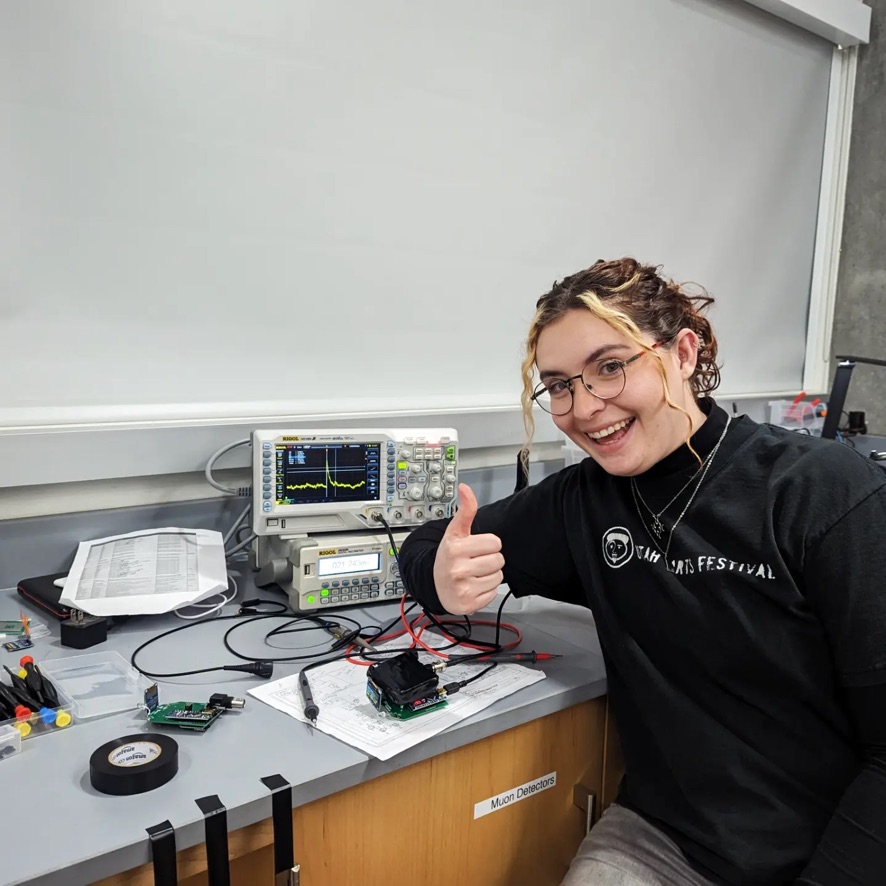
The author celebrates the first particle received from the self-constructed
CosmicWatch portable muon detector. Image credit: Jade Merchant.


Studying astrophysics throughout my undergraduate career has changed my life in so many wonderful ways. Currently, I am finishing up my last semester of undergrad at Weber State University in Ogden, Utah. Writing this has been a lovely way to reflect on what I’ve done and experienced in the last few years at this school. This education has encouraged enormous personal growth, allowed me to see the universe from a unique and beautiful perspective, and introduced me to so many incredible people.
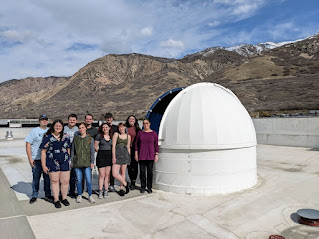
The astrophysics group at Weber State, led by Dr. Stacey Palen,
stands by the Keith Terry Palen Observatory.
Image credit: Jade Merchant.
The Physics and Astronomy Department at Weber State has a unique gift for helping students find their scientific identity. One of the ways our faculty has helped students discover their passions in science is by offering numerous pathways for students to explore experimental physics. Over the course of one undergraduate degree, I was an observational astronomer taking data on eclipsing binary stars, a particle physicist who built their own portable muon detector, and an engineer who built a radio telescope out of a kitchen wok! In addition to these projects, our faculty replaced final exams with final papers or presentations so that we could explore our interests. These assignments allowed me to demonstrate my knowledge while simultaneously providing opportunities for me to become a better science communicator and they gave me excuses to explore those initial questions that drove me to study astrophysics.
The relationships I have cultivated with my peers have also greatly benefited my undergraduate experiences. The faculty and students at Weber State have created a space for collaboration that has resulted in a strong and friendly community of physicists. One of my favorite memories in lab was when we retied a friend’s hair bow after it had come loose while she kept fiddling away with wires on the rover she was building. This memory is simple, but I feel so lucky to exist in a space where physics, femininity, and friendship were able to coexist in such an effortless way. In the same vein, staying up all night to run a telescope and observe the universe is an incredible experience, but it is infinitely more fun when you get to do it with your friends who are also gigantic nerds! I am incredibly fortunate to have been a part of such a wonderful group with such diverse skill sets and passion for what they do. Through example, my peers have continually shown me how to be a better teammate and a better scientist.
Astrophysics is nothing without community and educators, but I also know that I, individually, have worked diligently to make this degree worth it for me. Deciding to go to college was a huge and terrifying step for me. My high school experience was pretty rough, and I ended up dropping out in my junior year and taking the GED. After this, I thought that my chances at pursuing further education had gone out the window. I am so glad that I gave myself a second chance, because from that second chance I learned that I had as many chances as I needed to change my mind and try again. That persistence and my love for astronomy have carried me through this degree and I know that it will carry me even further.
This degree was so challenging in so many different ways (it is, after all, astrophysics!), but I’ve always tried to maintain hope that this is what I am supposed to be doing and that there is a space for me in this field. In the future I’d love to be an educator, so that I can show more people like me that school doesn’t have to be awful, that hard things are worth doing, and that you can fail as many times as you want. I want to help others find their scientific identity in astrophysics as my peers and the faculty at Weber State have done for me time and time again. For me, astrophysics is SO worth it! 


Jade and friends do radio astronomy with
a kitchen wok reflector. Image credit: Jade Merchant.


Ed’s note: After graduation Jade will be applying physics skills and experience to a job in industry, doing work in electromagnetic compatibility testing. Congratulations!


Thursday, June 22, 2023

Crosspost: Astrophysicist hopes her story resonates with Egyptian women

By Ashraf Amin for ahramonline

In her new book, Starstruck: A Memoir of Finding Light in the Dark, astrophysicist Sarafina El-Badry Nance links her knowledge of the universe to her journey as a child of immigrants who witnessed 9/11 and tried to integrate into white Texas society in every chapter.
Credit: ahramonline


Born in the US to an Egyptian mother and Albanian-German father, Nance is a PhD candidate at UC Berkeley and a science communicator who makes complex subjects fascinating and accessible. She has been named in Forbes' 30 Inspirational Women and 30 under 30 lists, as well as the Arab America Foundation's 40 under 40 list.

In the following interview, Sarafina talks about her journey as a scientist, the surgery she had to go through after finding out she had an 87 percent chance of getting breast cancer in her lifetime and the journey of sharing science on social media.

Read more at


Read more about Nance's choice to pose for Sports Illustrated at 

Thursday, December 1, 2022

Cross-post: An American’s five-country research tour

Written by Tess Jaffe for the career issue of Physics Today.


Photo Credit: NASA
A year ago former Physics Today editor-in-chief Charles Day asked me to write a narrative of what we termed my “rather bizarre career path.” That’s a reasonable summation. My first research experience in astronomy was a summer internship I did after my freshman year of college. Having no astronomy background, I applied on a whim and happened to be accepted as their wild card for the year. While modeling stellar atmospheres, I fell in love with the subject. It was a fantastic experience that made me decide to pursue a physics major. But when I returned for my sophomore year, motivated and with a plan, I effectively flunked out of the physics program. That roller-coaster experience turned out to be a microcosm of my career.


Read more about Dr. Jaffe's career path and salary history at

https://physicstoday.scitation.org/doi/10.1063/PT.3.5100

Thursday, September 30, 2021

Crosspost: Shandera appointed director of Institute for Gravitation and the Cosmos

From Penn State News

Dr. Sarah Shandera is a theoretical cosmologist at Pennsylvania State University researching the earliest stages of our universe. 

The Internal Advisory Board of the Penn State Institute for Gravitation and the Cosmos (IGC) has selected Sarah Shandera, associate professor of physics, as the IGC’s new director.

The ICG is a multidisciplinary institute dedicated to the study of the most-fundamental structure and constituents of the universe. It is comprised of the Center for Fundamental Theory, the Center for Theoretical and Observational Cosmology, and the Center for Multimessenger Astrophysics. The mission of the IGC is to foster the highest-quality education and research in cosmology, general relativity, gravitational-wave astronomy, particle astrophysics, quantum gravity, and string theory, focusing on the highest-energy phenomena and fundamental issues in the science of the cosmos. As director of the IGC, Shandera will work with its members to communicate the IGC’s shared scientific vision while supporting its three centers. Shandera also holds a vision for the ICG that fosters bridging the growing quantum information science and technology community at Penn State.

"I am thrilled by the opportunity to lead the Institute for Gravitation and the Cosmos," Shandera said. "It has a long history of high-impact science and a stellar group of faculty at the forefront of discovery today. I look forward to serving them in this role as we strengthen the community at the institute and seek the next frontiers in the physics and astronomy of the universe."

Congratulations to Dr. Sarah Shandera for this amazing opportunity! Check out the rest of the article at: https://news.psu.edu/story/669702/2021/09/17/research/shandera-appointed-director-institute-gravitation-and-cosmos 

Thursday, September 2, 2021

Crosspost: ‘She astonishes me’: How an astrophysicist is helping the Oakland A’s fine-tune their pitches

Written By: Shayna Rubin for The Mercury News

Dr. Samantha Schultz, an astrophysicist turned pitching analyst for the Oakland Athletics, is shown here in the field with Oakland A's pitcher, Lou Trivino. Credit: Nhat V. Meyer/Bay Area News Group.

Samantha Schultz called her mom from college in the middle of a meltdown, frustrated with the complicated math she needed to master for her degree in astrophysics from St. Mary’s College.

Her post-graduate plan had been to get her Ph.D. in particle physics. That wasn’t her plan anymore. Through tears over the phone, Schultz told her mother the new one: to work in baseball.

Huh?

That her science-obsessed daughter wanted to go in another direction was shocking enough. But getting where she wanted to go in baseball was harder than math.

“You look at the front office names, and going off first names, 98 percent of women are in marketing or something similar — not baseball operations,” Schultz’s mother, Elizabeth Baldwin, said last week. “I told her, ‘You might have to start out with something boring like cricket, or hockey.’

“She said, ‘Nah, I’m gonna do baseball.’”

Now 26, Schultz is a pitching analyst for the A’s. In four years, she has gone from the Big Bang to the big leagues.

“She was confident it would be baseball and not some other sport she had minimal interest in — and she did it,” Baldwin said. “She astonishes me.”


First love

When it came to baseball, the Giants were Schultz’s first love.

While other baseball fans in the Bay Area and around the globe were engrossed by Barry Bonds’ home run chase and enigmatic stardom, Schultz was drawn to the pitching — Jason Schmidt, Robb Nen and, later, Matt Cain and Sergio Romo. But it was the undersized Tim Lincecum, with his powerful delivery and the supernatural movement on his pitches, that gave flight to her love of pitching.

“It was the dominance,” she said. “Watching him be dominant with mechanics that are not routine and something you wouldn’t teach. The beauty of his changeup. The way he used his pitches, it made me fall in love with pitching as its own art form.”

After leaving St. Mary’s with her astrophysics degree and math minor, Schultz enrolled in the sports management program at Columbia University. It was there, while working with the baseball team, that opportunity began to knock. And knock. And knock.

The woman who had worked without pay for the St. Mary’s baseball team, serving as official scorer and in any other capacity, had been recruited by Major League Baseball’s diversity fellowship program. She had an internship with the New York Mets and was juggling offers from the Tampa Bay Rays and the San Diego Padres. She had been a runner-up for a uniformed position as a traveling analyst with the Cincinnati Reds, which would have made her the first uniformed woman on an MLB coaching staff — a few years before Giants trailblazer Alyssa Nakken.

In a baseball landscape where teams are constantly looking for a unique edge and expertise, an astrophysics background was proving attractive.

Read more about Samantha Schultz's fascinating career turn from astrophysicist to pitching analyst for the Oakland A's and how her extensive math background has helped pitcher, Lou Trivino, improve his game:
https://www.mercurynews.com/2021/08/14/how-an-astrophysicist-is-helping-the-oakland-as-fine-tune-their-pitches/

Thursday, August 12, 2021

Crosspost: Mallory Molina awarded Ford Fellowship for astrophysics research, diversity efforts

 Written By Rachel Hergett for MSU News Service

Credit: Adrian Sanchez-Gonzalez for MSU

Mallory Molina, who studies black holes in dwarf galaxies at Montana State University, was awarded a 2021 Ford Foundation Postdoctoral Fellowship in June.

In addition to recognizing the academic achievements of the awardees, the competitive Ford Foundation Fellowship Program — administered by the National Academies of Sciences, Engineering and Medicine — is grounded in a mission to increase diversity on college campuses.

“The Ford expects you to not only do research but to increase the diversity in higher academia, using the diverse human experience to enrich the academic experience,” Molina said. “It speaks to how both my research and my equity and inclusion efforts are valuable. That means a lot to me. Equity and inclusion work has always been a very strong component of who I am as a researcher.”

Molina is one of 26 postdoctoral Ford Fellows for 2021 and the first postdoctoral fellow at MSU. The fellowship includes a $50,000 stipend and an invitation to attend the Conference of Ford Fellows in October. It will support Molina’s ongoing inclusion initiatives and fund a year of astrophysics research with Amy Reines in the Department of Physics in MSU’s College of Letters and Science.

“Mallory is exactly the kind of person we need as a leader in academia,” Reines said. “In addition to being a top-quality researcher making important discoveries, they also work hard toward making physics and astronomy more inclusive.”

Molina knew they wanted to be an astronomer at age 4, when a visit to NASA’s Johnson Space Center in Houston opened their mind to myriad questions about the universe. But early in their academic career, Molina considered abandoning the dream.

“It wasn’t because I didn’t like astronomy,” Molina said. “It was because I felt isolated and alone.”

As a Mexican American, Molina was met with negative comments and cultural bias from peers as an undergraduate student at Ohio State University. The young university student craved a supportive community within the field, people to engage in conversations about the things they were learning and share in the struggles.

Molina was discouraged and the situation didn’t improve in graduate school. The Sloane scholar was contemplating dropping out of Pennsylvania State University when they reached out to their academic inspiration: their father, David, who grew up in Mexico City and is now chair of the economics department at the University of North Texas. Molina’s father pushed them to find other solutions, both for themself and students who come after.  

“If someone leaves because they don’t like astronomy, fine,” Molina said. “But it’s not fine if they leave because they think no one cares.”

Read more about Dr. Molina's work creating equitable spaces for future astronomers and her incredible research on supermassive black holes at the link below:


Thursday, May 14, 2015

Statement affirming respectful debate during current TMT protests

This was submitted to the WiA blog by leaders on diversity issues from within the AAS community. There has also been a statement from AAS President Meg Urry.

The last few weeks have brought to a head a confrontation between Native Hawaiian protesters and the Thirty Meter Telescope project. There are varied perspectives on all sides of this issue, amongst supporters and opponents, Hawaiians and mainlanders, astronomers and the general public, and all intersections of these groups. Events associated with the protests, including some cases of violence or threats of violence, have created significant divisions within our community, divisions which have manifested themselves in heated debates and discussions both in person and over social media.

Unfortunately, recent rhetoric in our community has crossed the line into racism and hostility, with language (e.g., describing Native Hawaiian protestors as a “horde” or other people of color as “snakes”) that dehumanizes individuals who oppose the placement of the Thirty Meter Telescope on Mauna a Wakea. This language is a painful reminder of past acts of violence perpetrated against native people and others, and only serves to inflame rather than bring about understanding and resolution. In many cases, apologies have been issued, and these have been appreciated. Still, that this language was used in the first place by highly esteemed members of our community is troubling, because the effects linger, are particularly harmful to junior researchers and students, and create an environment of hostility and exclusion.

Wednesday, June 29, 2011

Posting of the Boston AAS Panel Discussion Video

In a previous post I provided a teaser of the information presented during our Boston AAS panel discussion on 'Transforming Cultural Norms: Mentoring and Networking Groups for Women and Minorities".

Thank you again to our panelists for their thoughtful responses. Our panelists were:
  • Marcel Agueros -- astronomy faculty and Director of Columbia University's Bridge to PhD program in the Natural Sciences
  • Ed Bertschinger -- Chair of the MIT Physics department and deeply involved in a number of mentoring, networking, and cultural change initiatives, member of the CSWA
  • Kim Coble -- physics/astronomy faculty at Chicago State University, a minority serving institution in Chicago, deeply involved in mentoring and pipeline issues
  • Meredith Danowski -- astronomy PhD student and co-founder of Boston University's women in STEM mentoring and networking program
  • Jim Ulvestad -- NSF-AST director, head of astro2010 demographics study group, and former member of the CSWA
Below is the videotape we made of this special session (thank you BU graduate student!), split into 3 parts.

I strongly recommend viewing the higher quality version, posted here.
(This blog site only supports very small file sizes.)


-L. Trouille

Wednesday, September 29, 2010

A Trip Through the “Milky” Way: Adventures in Astrophysics and Breastfeeding


Breastfeeding and working can be done, and can be pursued for a year and beyond. Recently I’ve met three women who nursed to between 14 – 24 months while maintaining research astrophysics careers. Support is available, you just have to ask for it and you do have to plan a little bit. FYI, you can read up on the amazing health benefits to you and baby elsewhere (I recommend La Leche League). This is about astrophysics and breastfeeding, focusing on “travel” issues (including just being away from your normal routine).

For instance, in August when my daughter Anya was 5 months old (still completely sustained on breastmilk) I attended a NASA proposal review. I had to send an email to someone I did not know well, asking for a room in which to pump and for breaks during the review (I noted that I could only participate in the review if I got 20 minute breaks in the morning and afternoon). I also chatted with the panel chair before the review started. They really took care of me! Our panel room was partitioned and yours truly got the other side of the partitioned room as a pumping room. My panel chair (male, FYI) was willing to have the proposals on which I was conflicted be discussed slightly out-of-order so I was able to take my pumping breaks and not hold up deliberations. I did have to fess up to the whole committee about what I was doing (at first I tried not to, but one guy was kind of wondering why I kept disappearing through that wall partition). Luckily, I brought Medela “cleaning wipes” with me to the NASA review. The room was wonderfully convenient but there was no sink right there so I had to clean the parts of the pump using the wipes. I had a cooler pack for the milk (no refrigerator handy).

This year I am on research sabbatical with frequent trips to Northwestern in Chicago. I travel Southwest Airlines as they allow you to carry nearly-infinite "baby stuff" with you and I bring a nursing cover and breastpump with me. I managed to time the first visit to coincide with a personal trip so my parents were in Chicago and found a grad student through my personal network who was happy to watch my daughter for 2 days. I pump milk in the morning, leaving the “sitter” with milk, and then get together with Anya at lunchtime and mid-afternoon to nurse. Once again, I was pretty open about the whole thing, including asking colleagues for offices. I got multiple offers for locations to nurse within the department and enthusiastic help (doors opened, keys lent, etc.). Also, I started with a shorter trip involving no airplanes to State College, PA where I was able to establish an "away from home" pumping routine, that time with my mother-in-law with me. You may think it is crazy to travel with your mother-in-law, but you may find that a grandmother is perfect when you need to work, even if it isn't your mother. She focused on the kid so I could focus on work!


Next up, I’m taking my daughter, my husband and my breastpump on a trip to Greece (AGN/binaries conference) so I can keep the nursing going. So, I took baby steps (first a local NASA review, then a drive to State College, then a plane trip to Chicago, now we go international). The next new thing is that the pump operates on batteries (which I am testing today at home!) and I can bring little plastic bags into which to pump milk so I don’t need to pack a ton of collection bottles.

So far, so good but you have to plan and communicate, and as I hope is obvious, you have to really make breastfeeding a priority. But here I am at six months and Anya hasn’t been sick even once and is a very happy, healthy baby. I feel good too. So, it cost a little extra in terms of money for sitters, time arranging things, and time to pump, but it was really worth it.