Showing posts with label undergraduate research. Show all posts

Thursday, May 16, 2024

An Undergraduate Perspective: Why Studying Astrophysics Is Worth It

By Jade Marchant, Weber State University
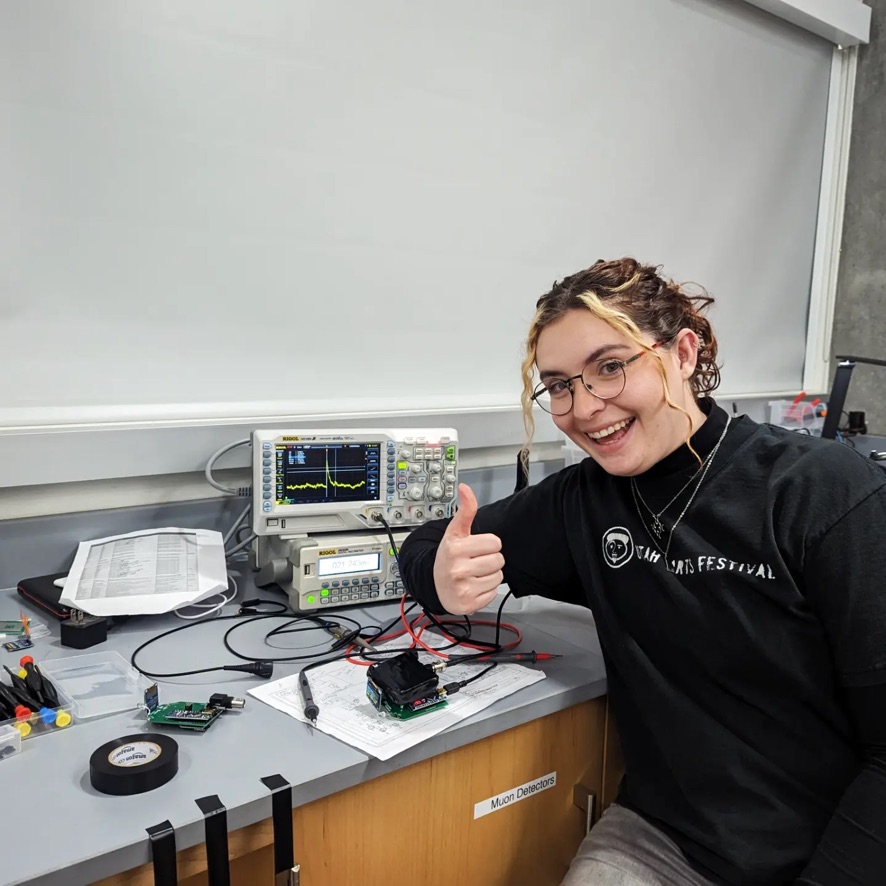

The author celebrates the first particle received from the self-constructed
CosmicWatch portable muon detector. Image credit: Jade Merchant.


Studying astrophysics throughout my undergraduate career has changed my life in so many wonderful ways. Currently, I am finishing up my last semester of undergrad at Weber State University in Ogden, Utah. Writing this has been a lovely way to reflect on what I’ve done and experienced in the last few years at this school. This education has encouraged enormous personal growth, allowed me to see the universe from a unique and beautiful perspective, and introduced me to so many incredible people.
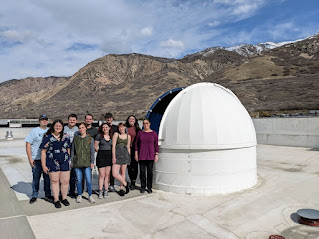
The astrophysics group at Weber State, led by Dr. Stacey Palen,
stands by the Keith Terry Palen Observatory.
Image credit: Jade Merchant.
The Physics and Astronomy Department at Weber State has a unique gift for helping students find their scientific identity. One of the ways our faculty has helped students discover their passions in science is by offering numerous pathways for students to explore experimental physics. Over the course of one undergraduate degree, I was an observational astronomer taking data on eclipsing binary stars, a particle physicist who built their own portable muon detector, and an engineer who built a radio telescope out of a kitchen wok! In addition to these projects, our faculty replaced final exams with final papers or presentations so that we could explore our interests. These assignments allowed me to demonstrate my knowledge while simultaneously providing opportunities for me to become a better science communicator and they gave me excuses to explore those initial questions that drove me to study astrophysics.
The relationships I have cultivated with my peers have also greatly benefited my undergraduate experiences. The faculty and students at Weber State have created a space for collaboration that has resulted in a strong and friendly community of physicists. One of my favorite memories in lab was when we retied a friend’s hair bow after it had come loose while she kept fiddling away with wires on the rover she was building. This memory is simple, but I feel so lucky to exist in a space where physics, femininity, and friendship were able to coexist in such an effortless way. In the same vein, staying up all night to run a telescope and observe the universe is an incredible experience, but it is infinitely more fun when you get to do it with your friends who are also gigantic nerds! I am incredibly fortunate to have been a part of such a wonderful group with such diverse skill sets and passion for what they do. Through example, my peers have continually shown me how to be a better teammate and a better scientist.
Astrophysics is nothing without community and educators, but I also know that I, individually, have worked diligently to make this degree worth it for me. Deciding to go to college was a huge and terrifying step for me. My high school experience was pretty rough, and I ended up dropping out in my junior year and taking the GED. After this, I thought that my chances at pursuing further education had gone out the window. I am so glad that I gave myself a second chance, because from that second chance I learned that I had as many chances as I needed to change my mind and try again. That persistence and my love for astronomy have carried me through this degree and I know that it will carry me even further.
This degree was so challenging in so many different ways (it is, after all, astrophysics!), but I’ve always tried to maintain hope that this is what I am supposed to be doing and that there is a space for me in this field. In the future I’d love to be an educator, so that I can show more people like me that school doesn’t have to be awful, that hard things are worth doing, and that you can fail as many times as you want. I want to help others find their scientific identity in astrophysics as my peers and the faculty at Weber State have done for me time and time again. For me, astrophysics is SO worth it! 


Jade and friends do radio astronomy with
a kitchen wok reflector. Image credit: Jade Merchant.


Ed’s note: After graduation Jade will be applying physics skills and experience to a job in industry, doing work in electromagnetic compatibility testing. Congratulations!


Tuesday, February 8, 2022

Crosspost: Physics Conference Creates Positive Experience for Kassaye, Stapley

Written by  The College of Idaho 
The College of Idaho sophomore, Bezawit Kassaye (left), and senior Mackenzie Stapley (right) present their research on star-forming regions in the Milky Way at the January 2022 Conferences for Undergraduate Women in Physics (CUWiP).
Sophomore Bezawit Kassaye one day wants to own her own business that integrates the fashion industry with technology, which is why she’s double-majoring in computer science and business administration.

But her interest in another subject led her to an opportunity outside the classroom, as she was one of two College of Idaho students to make presentations at the 2022 Conferences for Undergraduate Women in Physics in January.

“I’ve always loved physics, that’s why I ended up taking the research opportunity,” Kassaye said. “I love physics, I am interested in astronomy, and it integrated computer science with it.”

Kassaye and senior Makenzie Stapley, a math-physics major, each presented on different aspects of the same project: research on star-forming regions within the Milky Way galaxy called Yellowballs that is led by physics professor Dr. Katie Devine. Kassaye’s presentation focused on the distance to the Yellowball regions while Stapley’s presentation focused on the colors. The conference was slated to be an in-person event but was shifted online due to COVID trends. The result was everyone presenting at one virtual conference, rather than multiple regional conferences. The volume of presentations limited the number of interactions, but both students were grateful for the opportunity.

Learn more about Kassaye and Stapley's experience at CUWiP 2022 and Dr. Devine's unique approach on mentoring undergraduate students at:

Monday, December 10, 2012

End-of-Year Bits

It's the end of the semester, and for many of us, that means grading the last homework sets and papers, writing a final exam, and calculating final grades.  However, mentoring and professional development continue, even if the calendar says it's time to take a break.

Mentoring: Now is a good time to talk to your undergraduate students about applying for summer research positions at NASA, JPL, and with various NSF REU programs around the country.  Once the semester is over, they will have all the time in the world (well, between video gaming, texting, and FBing!) to research opportunities in which they have an interest.  If you have a colleague who has funding for an undergraduate (or more), now would also be a good time to do some networking on behalf of your students.  In my experience, undergraduate students who participate in summer research programs beyond their home campus return the following fall with renewed interest and motivation and are more likely to pursue graduate study in our field(s).