Showing posts with label Diversity in Physics and Astronomy. Show all posts

Tuesday, February 8, 2022

Crosspost: Physics Conference Creates Positive Experience for Kassaye, Stapley

Written by  The College of Idaho 
The College of Idaho sophomore, Bezawit Kassaye (left), and senior Mackenzie Stapley (right) present their research on star-forming regions in the Milky Way at the January 2022 Conferences for Undergraduate Women in Physics (CUWiP).
Sophomore Bezawit Kassaye one day wants to own her own business that integrates the fashion industry with technology, which is why she’s double-majoring in computer science and business administration.

But her interest in another subject led her to an opportunity outside the classroom, as she was one of two College of Idaho students to make presentations at the 2022 Conferences for Undergraduate Women in Physics in January.

“I’ve always loved physics, that’s why I ended up taking the research opportunity,” Kassaye said. “I love physics, I am interested in astronomy, and it integrated computer science with it.”

Kassaye and senior Makenzie Stapley, a math-physics major, each presented on different aspects of the same project: research on star-forming regions within the Milky Way galaxy called Yellowballs that is led by physics professor Dr. Katie Devine. Kassaye’s presentation focused on the distance to the Yellowball regions while Stapley’s presentation focused on the colors. The conference was slated to be an in-person event but was shifted online due to COVID trends. The result was everyone presenting at one virtual conference, rather than multiple regional conferences. The volume of presentations limited the number of interactions, but both students were grateful for the opportunity.

Learn more about Kassaye and Stapley's experience at CUWiP 2022 and Dr. Devine's unique approach on mentoring undergraduate students at:

Thursday, December 23, 2021

Crosspost: Astronomy Decadal Survey Reckons with Demographic Disparities, Societal Impacts

Written By Andrea Peterson for the American Institute of Physics

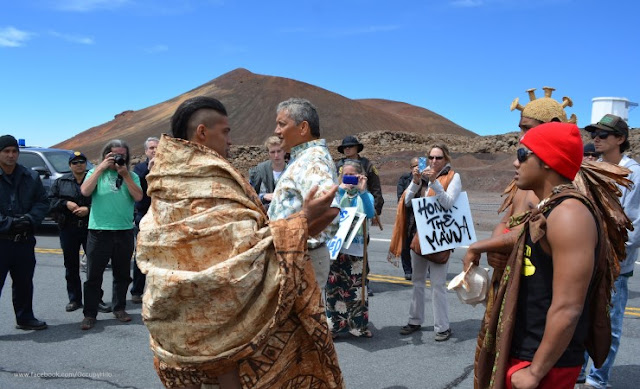
Indigenous Hawaiian activists protest the development of the Thirty Meter Telescope (TMT) on Mauna Kea, a dormant volcano sacred to native Hawaiian culture. Image credit: Occupy Hilo.

Released last month, the National Academies’ latest decadal survey of astronomy and astrophysics includes an intensive assessment of the “state of the profession” and its “societal impacts” for the first time in the survey’s 60-year history.

A dedicated survey panel was tasked with gathering community input and data on demographic trends, as well as with developing “actionable suggestions” to promote the health of the workforce and improve the diversity of the field. The panel also proposed that astronomers re-envision their approach to outreach and “broader impacts,” including by deepening their consultation with local communities over the placement of telescopes — a major issue confronting the proposed construction of the Thirty Meter Telescope in Hawaii.

Based on the panel’s input, the full survey committee presents 10 recommendations to improve the “foundations of the profession,” spanning matters such as expanding demographic data collection and diversity programs to adopting a “Community Astronomy” model of engagement and reducing astronomy’s environmental impacts. While the recommendations are not binding, they will carry considerable weight with NASA, the National Science Foundation, and the Department of Energy, which sponsored the survey.

Read the rest of the article and learn more about trends in racial and gender diversity in astrophysics at: https://www.aip.org/fyi/2021/astronomy-decadal-survey-reckons-demographic-disparities-societal-impacts

Tuesday, May 11, 2021

Crosspost: Black women’s experiences in STEM inspire an annual workshop

By Bryné Hadnott

When LaNell Williams arrived at Harvard University in 2017 to begin a graduate program in physics, several of her peers told her she had been admitted only because she was a Black woman—her 3.9 GPA, NSF Graduate Research Fellowship, and two coauthored scientific papers notwithstanding. During an open house for the incoming class, she asked her fellow students why they thought no other underrepresented racial minority woman had been admitted to the physics department that year. “We [women of color] hear many different things in those conversations, one of them being that we’re not interested in physics, which isn’t true,” Williams says. “Or that some of us don’t have the pedigree, which is also not true. And then the last thing is that we don’t apply—and in some cases that is true.”


Photo courtesy of LaNell Williams

In Williams’s experience, however, many women of color had both the grades and the aptitude for physics, but they were discouraged from applying to graduate programs by their professors, advisers, and classmates. “I wanted to prove them wrong,” she says of her peers at Harvard. She was determined to show just how many talented candidates there really are. “I wanted to say to those women that you are as good as, if not better than, some of the people who might be applying to graduate school,” Williams explains.

In 2019 Williams founded the Women+ of Color (WOC+) Project, an annual three-day workshop that encourages women and gender-nonconforming people of color to pursue advanced STEM degrees and provides resources on how to apply for and succeed in graduate school. The WOC+ Project has gone on to win the Materials Today Agent of Change Award. Now, Williams, graduate students L. MichĂ© Aaron and Ayanna Jones, and several other graduate student volunteers are working to expand the workshop’s scope to support women of color throughout their academic careers.

Read the rest of the article at: https://physicstoday.scitation.org/do/10.1063/PT.6.5.20210510a/full/ 

Tuesday, January 7, 2020

Cross-Post: Task Force Recommendations Outline Changes Needed to Increase African American Physics and Astronomy Students


Gathering of African American women physicists; Credit: Jami Valentine Miller

There have been fewer than 100 PhDs in physics granted to African-American women as tracked by the AAWIP. Such depressing statistics require that physics and astronomy communities work to understand and change systemic barriers to African Americans succeeding in these fields. The National Task Force to Elevate African American representation in Undergraduate Physics & Astronomy (TEAM-UP) is working towards this goal and below we cross-post their January 5th press release made at the American Astronomical Society meeting.

Press Release:

WASHINGTON, January 5, 2020 -- Due to long-term and systemic issues leading to the consistent exclusion of African Americans in physics and astronomy, a task force is recommending sweeping changes and calling for awareness into the number and experiences of African American students studying the fields.

The National Task Force to Elevate African American representation in Undergraduate Physics & Astronomy, known as TEAM-UP, was chartered and funded by the American Institute of Physics to examine the persistent underrepresentation of African Americans in physics and astronomy in the U.S.

Report Summary Download https://www.aip.org/sites/default/files/aipcorp/files/teamup-preview.pdf
Full Summary Download https://www.aip.org/sites/default/files/aipcorp/files/teamup-full-report.pdf

In its report, “The Time Is Now: Systemic Changes to Increase African Americans with Bachelor’s Degrees in Physics and Astronomy,” the task force discusses the five factors it discovered as responsible for the success or failure of African American students in physics and astronomy: belonging, physics identity, academic support, personal support, and leadership and structures. The report was released on Jan. 5 at the 235th meeting of the American Astronomical Society in Honolulu, Hawaii.

Read more at:

https://www.aip.org/news/2020/team-up-report.

Wednesday, October 5, 2016

Celebrating National Hispanic Heritage Month: The Arecibo Observatory Space Academy

Photo montage by Ricardo Correa 

Today’s guest bloggers are Edgard Rivera-Valentin and Luisa Zambrano-Marin. Ed is the Project Manager for the Space Academy and a staff scientist in the Planetary Radar group at the Arecibo Observatory. Luisa is the Program Coordinator for the Space Academy and a data analyst for the Planetary Radar Group at Arecibo Observatory.

We are Latinos, we are Scientists, and we are Educators. We often struggle to succeed in a field in which we are underrepresented and devalued both consciously and unconsciously by peers. Our upbringing, culture, and expectations are diverse and diverge from the “norm”. We understand what it’s like to feel unprepared for college, graduate school, and the professional workforce. And all too often, we know the struggle of breaking through established barriers in the scientific community. We are the 3%. 

Hispanics and Latinos are the largest underrepresented group with a measured interest in STEM fields. Studies show that Hispanic and Latino students are equally as interested in entering a STEM major in college as their White counterparts, and yet we are less likely to graduate with a degree in a STEM field (Crisp and Nora, 2012). There is indisputably a gap to be filled, one that we know occurs past the interest in STEM and before the student decides their career path. At the professional stage, it gets even more noticeable, despite the fact Latinos and Hispanics compose nearly 20% of the U.S. population, we only account for 3% of the STEM doctoral degrees and 3% of Physics faculty in the United States. 

So something is very wrong when we have a significant percentage of the population of which a significant number show strong interest in STEM fields and yet are not well represented in the professional stage.

Friday, October 23, 2015

AASWOMEN Newsletter for October 23, 2015

AAS Committee on the Status of Women
Issue of October 23, 2015
eds: Daryl Haggard, Nicolle Zellner, Meredith Hughes, & Elysse Voyer

This week's issues:

1. Don’t Masculinize the Letter of Recommendation: Towards a Truly Gender-Brave Science Community  
2. The Discovery Program Series: Introduction and Interview with Michael New  
3. Op-Ed: Sexual harassment: Another roadblock for women in science
4. BBC Seeking Women to Speak on Sexual Harassment in Astronomy and Physics     
5. Emmy Noether Visiting Fellowship in Theoretical Physics
6. The Odds That a Panel Would 'Randomly' Be All Men Are Astronomical    
7. Job Opportunities
8. How to Submit to the AASWomen Newsletter
9. How to Subscribe or Unsubscribe to the AASWomen Newsletter
10. Access to Past Issues of the AASWomen Newsletter

Thursday, May 14, 2015

Statement affirming respectful debate during current TMT protests

This was submitted to the WiA blog by leaders on diversity issues from within the AAS community. There has also been a statement from AAS President Meg Urry.

The last few weeks have brought to a head a confrontation between Native Hawaiian protesters and the Thirty Meter Telescope project. There are varied perspectives on all sides of this issue, amongst supporters and opponents, Hawaiians and mainlanders, astronomers and the general public, and all intersections of these groups. Events associated with the protests, including some cases of violence or threats of violence, have created significant divisions within our community, divisions which have manifested themselves in heated debates and discussions both in person and over social media.

Unfortunately, recent rhetoric in our community has crossed the line into racism and hostility, with language (e.g., describing Native Hawaiian protestors as a “horde” or other people of color as “snakes”) that dehumanizes individuals who oppose the placement of the Thirty Meter Telescope on Mauna a Wakea. This language is a painful reminder of past acts of violence perpetrated against native people and others, and only serves to inflame rather than bring about understanding and resolution. In many cases, apologies have been issued, and these have been appreciated. Still, that this language was used in the first place by highly esteemed members of our community is troubling, because the effects linger, are particularly harmful to junior researchers and students, and create an environment of hostility and exclusion.

Monday, January 19, 2015

Astro-Diversity: Post #1 – The Pipeline to Astronomy Degrees

 
Dr. Lisa M. Frehill [1] is an IPA at NSF in Strategic Human Capital Planning working as an Organizational Evaluation and Assessment Researcher.  Her home institution is Energetics Technology Center in St. Charles, MD, where she has completed science, technology, engineering and mathematics (STEM) workforce analysis and assessment and evaluation in support of the Office of Naval Research, the DoD STEM Development Office and the American Association for the Advancement of Science.  A past NSF awardee, Dr. Frehill was the PI and Program Director of the ADVANCE: Institutional Transformation program when she was an associate professor of sociology at New Mexico State University. She is an expert on diversity in STEM and on program evaluation. A forthcoming volume (co-edited with Willie Pearson, Jr. and Connie L. McNeely) titled Advancing Women in Science: An International Perspective is due winter 2015 from Springer.  In her free time, Lisa enjoys hiking, yoga, visiting family and baking.

This is the first in a series of posts about diversity in astronomy. The idea for the series emerged from conversations with Dr. Joan Schmelz, who is serving as an NSF program officer in the Division of Astronomy on loan from the University of Memphis. Joan has been involved in issues for women in astronomy and is interested in being attentive to how to more generally increase the diversity of her field. 

This first post will provide a view of the pipeline into college and bachelor’s degree attainment in both astronomy and physics, which is an important “feeder field.” Future posts will look at U.S. astronomy degrees in greater detail.  This post relies on institutionally-reported data in the U.S. Department of Education’s Integrated Postsecondary Education Data System (IPEDS) were accessed via the National Science Foundation WebCASPAR database tool. 

What does the STEM pipeline into college look like from a diversity standpoint?  The answer to this is a “glass half full/half empty.”  On the one hand, we have seen a significant narrowing of the sex gap in high school preparation in mathematics and sciences. Indeed, high school boys recently caught up with high school girls to earn an average of 7.4 credits in mathematics and science (Nord et al., 2011).  Girls (14 percent) and boys (12 percent) are equally likely to have taken a “rigorous” high school curriculum consisting of at least four years of English and mathematics (including pre-calculus or higher), and three years each of social studies, science (including biology, chemistry and physics), and foreign language.  These are important increases since 1990, when just 4 percent of girls and 5 percent of boys had taken a rigorous high school curriculum.  Science, not mathematics, continues to be a more important issue for girls.  An additional 15 percent of girls would have completed a rigorous curriculum by taking just one more science class, as compared to an additional 9 percent of boys.