Call For Panelists
More information about the Rubin Town Hall:
| Illustration Credit: NASA/XC/SAO/K.Divona |
The AAS Committee on the Status of Women in Astronomy maintains this blog to disseminate information relevant to astronomers who identify as women and share the perspectives of astronomers from varied backgrounds. If you have an idea for a blog post or topic, please submit a short pitch (less than 300 words). The views expressed on this site are not necessarily the views of the CSWA, the AAS, its Board of Trustees, or its membership.
| Illustration Credit: NASA/XC/SAO/K.Divona |
Seeing our planet for the first time, a dream decades in the making.
— Emily Calandrelli (@TheSpaceGal) November 25, 2024
You’re seeing so many emotions intertwined. Excitement, awe, and pride - but to be honest a little fear and confusion too. You just launched on a rocket and you’re seeing something you’ve never seen before… pic.twitter.com/HlL85ENshC
Calandrelli received degrees in Mechanical and Aerospace Engineering from the University of West Virginia. She then attended MIT and earned master’s degrees in Aeronautics and Astronautics and Technology and Policy in 2013. Calandrelli also interned at NASA.
Calandrelli also pursued writing with Ada Lace, a STEM adventure series for kids. This six-book series follows 8-year-old Ada Lace as she uses science to solve problems. Calandrelli has also written a picture book, Reach For The Stars, and two science experiment books for kids.
In 2020, Calandrelli took her passion for STEM education a step further. She pitched the idea for a children’s science show to Netflix and the company picked up the show. Calandrelli, who was pregnant with her first child, got to choose whether she wanted to film the series pregnant or wait until after delivery. The science communicator took the opportunity to film the entire series of Emily’s Wonder Lab while 36 weeks pregnant.
In an interview with Parentaly, Calandrelli said, “On TV, you don’t usually see someone who is pregnant doing something other than being an expectant mother - or hiding it.” While the show wasn’t renewed for a second season, it still ranks high on Netflix’s list of shows.
Calandrelli has continued to support STEM education and careers for girls and women through her YouTube channel, recently launching Emily’s Science Lab, where she demonstrates science experiments for kids. Calandrelli also maintains active social media accounts on Instagram, Facebook, X, TikTok, and Bluesky, where she reaches several million followers as The Space Gal.
When Calandrelli traveled past the Kármán line in November, fulfilling a long-held dream to travel to space, she posted her reactions online, despite the risk of all-too-familiar disparaging comments from internet trolls. Calandrelli posted on Instagram, “I refuse to give much time to the small men on the internet.” Instead, she continues to focus her efforts on advocating for STEM and space exploration for all, particularly for girls and women.
Find out more about Emily Calandrelli at thespacegal.com.
By Nicolle Zellner, co-Chair of the CSWA
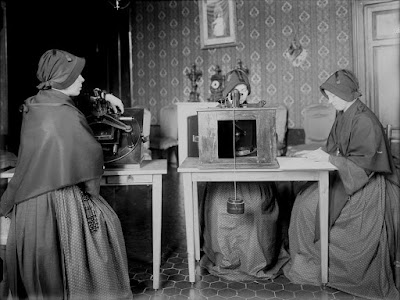
We stand on the shoulders of giants! March is Women's History Month, and this blog has honored women in science with multiple posts. It's hard to forget the pioneering work of those early female astronomers who worked as computers at the turn of the 20th Century, whether in the United States at Harvard or abroad at the Vatican.
| Sisters Emilia Ponzoni, Regina Colombo, Concetta Finardi and Luigia Panceri mapped the positions and brightness of 481,215 stars for the Vatican. Photo Credit: On Being (Flickr) |
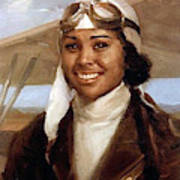
Other women tested the limits of aviation and space flight. Bessie Coleman, Jackie Cochran, Valentina Tereshkova, Sally Ride, Mae Jamison, Ellen Ochoa, and Eileen Collins flew fast, long, and high—breaking the air and space ceilings for all of us. Wally Funk, an original First Lady Astronaut Trainee, became the oldest woman to fly in space in July 2021. The next people on the Moon will include the first woman and the first person of color. Perhaps the final frontier really will be for everyone.
| Bessie Coleman "dared to dream". Photo credit: Alamy |
But if it weren't for the calculations (and just plain physics!), humans wouldn't travel safely into space and home again. On her experience working as a 'human computer' at NASA's Jet Propulsion Laboratory, Macie Roberts commented, "you have to look like a girl, act like a lady, think like a man, and work like a dog." Katherine Johnson, Dorothy Vaughan, and Mary Jackson were just some of the brain power behind those early NASA spaceflights.
Generations later, these women continue to inspire those of us who are reading their stories today. Those stories have been told in a variety of media, including The Glass Universe (review), Hidden Figures, Silent Sky, The Mercury 13, Right Stuff, Wrong Sex, and Rise of the Rocket Girls. Do you know of others? Post them in the comments section.
We should continue to support and recognize women and the work we all do. Helen Ling, a software engineer at the Jet Propulsion Laboratory in the 1950s and 1960s, once said "...if you hire [men] under you, they're uncomfortable, you're uncomfortable. So I just hired women just out of college. I thought that if you didn't give them a chance, they'll never get a chance."
The same could be said when standing on the shoulders of giants. Thanks, pioneers, for giving us all a chance.
Read more about pioneering women at
4000 Years of Women in Science
First Lady Astronaut Trainees (blog post, support for a Congressional Gold Medal, video)
Women in Astronomy, A Resource Guide (Astronomical Society of the Pacific)
![]() |
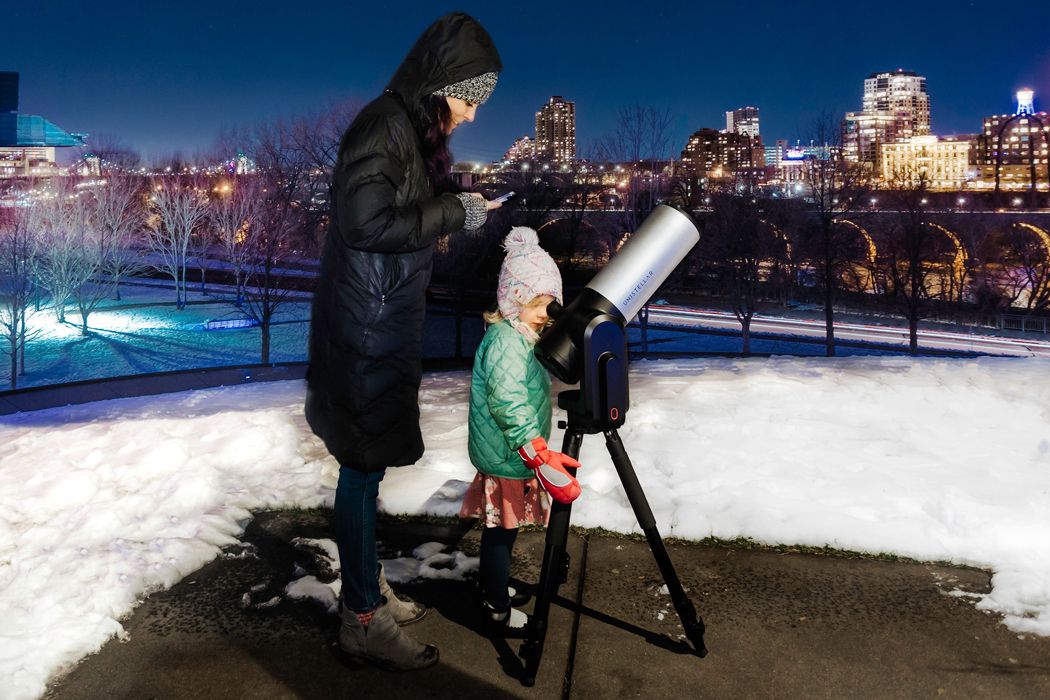
| A budding astronomer observes the night sky on a chilly, winter night with Unistellar's popular evScope. |