Showing posts with label AAS246. Show all posts

Thursday, June 19, 2025

The Current Landscape for Astronomy Public Policy and How You Can Make a Difference

On June 12, 2025, during the 246th AAS, a special town hall session was held to discuss the current landscape of public policy for astronomy and how individuals can help shape the future of the field. Dara Norman and the AAS Public Policy Team—Colin Hamill, Roohi Dalal, and Joel Parriott—curated the information for the town hall. Lori Porter (Graduate Student, Columbia University), Becka Phillipson (Assistant Professor, Villanova University), and Marcel Agüeros (Professor, Columbia University) were panelists, each bringing unique perspectives from their experiences engaging with policymakers and advocating for science.

The AAS Mission and Strategic Priorities

AAS.org


The AAS is dedicated to enhancing and sharing humanity’s scientific understanding of the universe as a diverse and inclusive astronomical community. Their strategic priorities for 2021–2026 focus on two main areas:
  • Addressing Significant Global Issues Affecting Astronomy
    • Advocating for the implementation of the Decadal Surveys’ recommendations.
    • Supporting STEM education initiatives.
    • Championing funding, programs, and policies that benefit the discipline.
    • Promoting policies to protect ground-based lighting and the full electromagnetic spectrum.
    • Addressing the increasing presence of satellites in Earth’s orbit and their impact on astronomical observations.
  • Building Equitable, Diverse, and Inclusive (EDI) Practices
    • Expanding staffing to support ongoing and new EDI initiatives.
    • Improving access and equitable participation in AAS meetings, events, and publications.
    • Increasing representation of marginalized groups in AAS leadership.
    • Implementing recommendations from recent task forces and consortia to advance equity, diversity, and inclusion.
    • Promoting just and equitable scientific standards and behavior within the community.

The Policy Landscape: Recent Developments

The past year has seen significant shifts in federal policy affecting astronomy and related sciences. Here are some highlights from the timeline:
  • Early 2025: Executive orders and agency directives led to funding freezes, layoffs, and reorganization plans at key agencies like the National Science Foundation (NSF) and the Office of Space Commerce.
  • March 2025: Congress passed a full-year Continuing Resolution for FY2025, but deep cuts to NASA’s Science Mission Directorate (SMD) were rumored.
  • April–May 2025: AAS organized Congressional Visits Day, released Action Alerts, and submitted comments and letters supporting NASA, NSF, and the Department of Energy (DOE).
  • May 2025: The NSF was ordered to abolish 37 science divisions, and the House passed the “One Big Beautiful Bill Act,” which included provisions to auction radio spectrum that could impact radio astronomy.
  • June 2025: The AAS continues to engage with Congress regarding NASA and NSF budget requests and has submitted Outside Witness Testimony to the Senate Appropriations Committee.

How You Can Make a Difference

AAS.org


The AAS emphasizes that everyone—regardless of their role within the astronomy community—has the power to influence policy. Here are actionable steps you can take, listed in order of increasing effectiveness:
  • Use Action Alert Forms: The AAS provides easy-to-use forms for writing to your member of Congress. These pre-written messages make it simple to support astronomy funding and policies.
  • Call or Leave a Voicemail: Contact your Congressional representatives directly. The AAS website provides scripts and guidance to help you get started.
  • Encourage Others: Ask friends, family, and colleagues in other states or districts to contact their representatives. A coordinated effort amplifies your voice.
  • Directly Contact Congressional Offices: Use the “contact” form on your representative’s webpage or email their staff. The AAS Public Policy Team is available to assist you.
  • Set Up a Meeting: Arrange a meeting with your Congressional office—either in person at their local district office or via Zoom. Personal engagement is highly effective.

Best Practices for Engaging with Policy Makers

When meeting with Congressional staff or representatives, keep these best practices in mind:
  • Remain Non-Partisan: Focus on the issues, not party politics.
  • Be Clear and Concise: Use the “Bottom Line Up Front” (BLUF) approach—state your main point at the beginning.
  • Keep It Conversational: Avoid jargon and make the discussion interactive.
  • Do No Harm: Never advocate for cutting other scientific programs.
  • Be Honest: If you don’t know the answer, say so.
  • Be a Resource: Offer to follow up with more information or answer questions.
  • Follow Up: Members of Congress have many priorities; a timely follow-up keeps your issue on their radar.

The Road Ahead

The next few months are critical for astronomy funding and policy:
  • June–July: Details of the President’s Budget Request for FY2026 are released.
  • July: House and Senate Appropriations Committees mark up key bills.
  • Fall: House and Senate conference to finalize appropriations.
  • October 1: Deadline for passing appropriations bills or adopting a continuing resolution—otherwise, the government could shut down.

Take Action Now

The AAS needs your voice to ensure that astronomy remains a priority for policymakers. Whether you’re a student, researcher, educator, or simply a supporter of science, your engagement makes a difference. Visit the AAS advocacy page, use the action alert forms, and consider reaching out directly to your representatives. Together, we can protect and advance the future of astronomy in the United States.

Visit the AAS website page, Advocacy-How to Get Involved, and contact the AAS Public Policy team to learn more. We look forward to hearing from you.

Your involvement is crucial—take action today and help shape the future of astronomy!

You can find the town hall slides on public policy here for a more detailed look. 
 

Thursday, June 5, 2025

The Vera Rubin Town Hall and Free Coin Giveaway Is Almost Here

The 246th AAS is nearly here. We want to invite everyone attending AAS this year to join us for a special event on June 11 and receive a free Vera Rubin coin and coin board just for attending!

Vera Rubin Celebration Town Hall at the 246th AAS (June 8-12), Anchorage, Alaska

Date/time: Wednesday, Jun 11, 6:30-7:30 p.m.
Building/room: Dena'ina Civic & Convention Center, Ballroom A
SESSION ID #:  46  (1 hour)
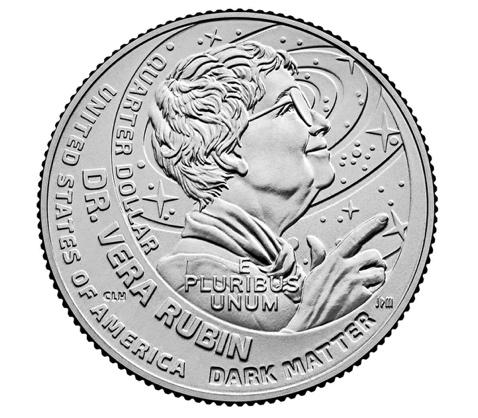
American Women Quarters 2025 Rolls and Bags - Dr. Vera Rubin image number 3
Credit: United States Mint
Come join us in celebrating the groundbreaking scientific achievements and enduring legacy of Dr. Vera Rubin, whose work provided the first compelling evidence for dark matter, fundamentally altering our understanding of the universe. 
Vera Rubin was a leading figure in observational cosmology whose critical observations of galaxy rotation curves led to one of the most profound discoveries in modern astrophysics, reshaped our understanding of galactic dynamics and laid the foundation for research that continues today, including the first direct evidence of dark matter from NASA’s Chandra X-ray Observatory and now, new studies at the Vera C. Rubin Observatory.
Rubin was also a lifelong advocate, mentoring generations of astronomers and advocating for greater participation in the field.  This one-hour panel discussion will honor Vera Rubin’s scientific contributions and advocacy, highlight ongoing research with missions and scientists that build on her discoveries, and foster dialogue on science, history, and public engagement.  The U.S. Mint’s newly released Vera Rubin coin will be showcased with free coin and coin board giveaways for the AAS audience attendees.
Our panel features Nicole Drakos, Amruta Jaodand, and Maddie Lucey. Drakos is a theoretical astrophysicist studying structure formation in the universe. Jaodand is a multi-wavelength astronomer and astroinfomatics aficionado. Lucey is an astronomy and astrophysics postdoctoral fellow whose research aims to build our understanding of the early universe by studying the ancient stars in our galaxy.  Kimberly Arcand will moderate this one-hour discussion hosted by the Smithsonian Astrophysical Observatory/Chandra X-ray Observatory, and AAS Committee on the Status of Women in Astronomy, with the U.S. Mint. Arcand is the Visualization scientist, emerging tech lead, and acting communications & public engagement lead for NASA’s Chandra X-ray Observatory.
With such an exceptional panel, we know you'll want to join us for this event. Mark June 11 at 6:30 p.m. in your calendars for this special AAS event and come get your free Vera Rubin coin, as well.

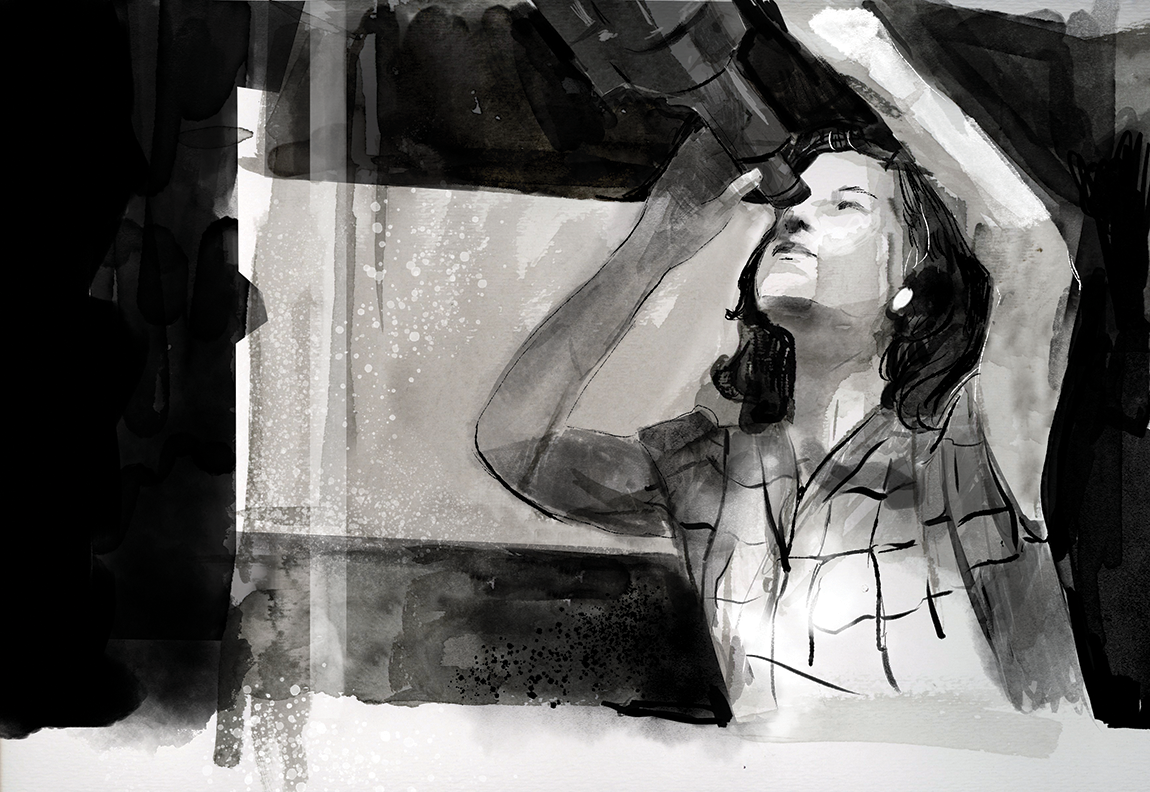
A person looking through a telescope

AI-generated content may be incorrect.
Illustration: NASA/CXC/SAO/K.Divona
In the 1970s, astrophysicist Vera Rubin discovered evidence that the Universe was made of more than what could be seen with telescopes — today known as "dark matter". Born in 1928, Vera was drawn to watching the stars at an early age. Her passion would lead her to become the sole astronomy major in her graduating class at Vassar in 1948. Rubin pursued advanced training at Cornell and then Georgetown, where she completed a Ph.D. She was a lifelong advocate for women in science and scientific literacy.


Thursday, May 1, 2025

Celebrate Dr. Vera Rubin at the Rubin Town Hall at the 246 AAS Meeting

Call For Panelists

The 246th AAS Meeting will be held June 8-12 in Anchorage, Alaska. The Rubin Town Hall will be held on June 12 to celebrate the legacy of Dr. Vera Rubin. 

Are you attending the 246th AAS Meeting? The Committee on the Status of Women in Astronomy is looking for members who would like to be panelists for this event. Selected panelists will participate in a 1-hour panel. 

Let's take the opportunity to celebrate the legacy that Dr. Vera Rubin left to astronomy and cosmology.

If you're interested in being a panel member or simply sharing a story or a remembrance of Dr. Rubin, please contact us or Kim Arcand. We would love to have your participation.

As part of this celebration, the U.S. Mint will showcase the newly released Vera Rubin quarter, part of the American Women Quarters Set 2025. 

More information about the Rubin Town Hall:


Rubin Town Hall at the 246th AAS
Anchorage, Alaska
Day/time TBD (likely Thursday, June 12, afternoon)
SESSION ID #:  46  (1 hour)
Come join us in celebrating the groundbreaking scientific achievements and enduring legacy of Dr. Vera Rubin, whose work provided the first compelling evidence for dark matter, fundamentally altering our understanding of the universe.  Vera Rubin was a leading figure in observational cosmology whose critical observations of galaxy rotation curves led to one of the most profound discoveries in modern astrophysics, reshaped our understanding of galactic dynamics and laid the foundation for research that continues today, including the first direct evidence of dark matter from NASA’s Chandra X-ray Observatory and now, new studies at the Vera C. Rubin Observatory. Rubin was a lifelong advocate as well, mentoring generations of astronomers and advocating for greater participation in the field.  In this one-hour panel discussion, we will honor Vera Rubin’s scientific contributions and advocacy, highlight ongoing research with missions and scientists that build on her discoveries, and foster dialogue on science, history, and public engagement.  The U.S. Mint will showcase newly released Vera Rubin coins.
This event is hosted by the Smithsonian Astrophysical Observatory/Chandra X-ray Observatory and AAS Committee on the Status of Women in Astronomy.
You can register for the 246th AAS Meeting at aas.org and find the full schedule of events on the website. We look forward to celebrating Dr. Vera Rubin with you at the Rubin Town Hall.

Illustration Credit: NASA/XC/SAO/K.Divona