Showing posts with label role models. Show all posts

Wednesday, May 27, 2015

Leadership, Role Models . . . and Captain Kathryn Janeway(?)

The January 2015 issue of CSWA's STATUS Magazine includes an article entitled, “Senior Women Moving into Leadership Positions: Has ADVANCE Affected Junior and Senior Women Scientists Differently?” by Sue V. Rosser, the Provost and Vice President for Academic Affairs at San Francisco State University. Part of the article describes responses to a survey question, “In your opinion, what changes in institutional policies and practices are most useful for facilitating careers of academic women scientists or engineers at the senior level?” The only response that got much traction was, “Training for leadership.”
 
I agree that training is an important, perhaps most important, component for leadership. I can think of another one, however, that doesn’t appear to have made the list: Role Models. This is one component of astronomical life that I, unfortunately, was not able to benefit from during the early stages of my career. When I was an undergrad at an engineering school, I knew other undergrad women but no women grad students, postdocs, or professors. When I was a grad student at a state university, I knew other women grad students but no women post docs or professors. When I was a postdoc, I finally started to become aware of senior women in astronomy, but they were not part of my research group and I was not able to interact with them on a personal or professional level.

Wednesday, February 18, 2015

Leadership and the Myers-Briggs Personality Test

Women of different personality types
In the wake of Kelly Korrick’s post, Becoming a Leader, and my own interest, On Leadership, I took the Myers-Briggs personality test. I know several colleagues, family members, and supervisors who have taken the test as part of their management training. The test is available free on-line. I took this version, which is comprised of 60 yes/no questions. I’ve seen other variations, but they are all similar and take only a few minutes. The final results give you a series of letters indicating your personality types as well as the strength in each of the following categories:
 
•Extraverted (E) vs. Introverted (I),
•Sensing (S) vs. Intuition (N),
•Thinking (T) vs. Feeling (F)
•Judging (J) vs. Perceiving (P)
 
I don’t need a test to tell me that I am Introverted (I), but it also told me the strength of this characteristic. The Extravert-Introvert dimension is a continuum:

Extravert [100% - - - 0% - - - 100%] Introvert

I was reasonably, but not overwhelmingly, introverted.
 
Sensing-Intuition preference represents the method by which one perceives information: Sensing (S) means an individual mainly relies on concrete, actual information. Intuition (N) means a person relies upon their conception about things based on their understanding of the world.
 
Thinking-Feeling preference indicates the way an individual processes information. Thinking (T) preference means an individual makes decisions based on logical reasoning. Feeling (F) preference means that an individual's base for decisions is mainly feelings and emotions.
 
Judging-Perceiving preference in more complex and involves both incoming and outgoing information. It is important to understand that Judging (J) is not the same as “judgmental,” which was my own first (incorrect) impression of its meaning.

Wednesday, October 15, 2014

Resource Guide for Websites for Women in STEM (with an emphasis on Astronomy)

As someone who has spoken up for women within our field, people tend to come to me for advice from time to time.  One question that I have repeatedly received is “do you know of one great STEM (Science, Technology, Engineering, and Mathematics) resource for women in our field or young women looking to enter this profession?”  And every time I say "no, I know of way more than one, " then Google every website I can think of that I have found useful previously.  The person usually leaves with their head swimming full of websites, and likely forgets most of what I said within minutes (but now knows I have a strange relationship with my iPhone and Google).  So I’m going to use my blog time this month to include the many sites that I have found useful, add some others that have been suggested to me along the way, and hopefully readers will take the opportunity to chime in on the comments section of this blog to add their own useful sites.  I’ll focus on websites targeting issues for women already in the STEM field, but will highlight one site that points out several resources for younger women/girls looking to enter in to the field. So the next time someone asks this question, this blog can be easily pointed to as a starting point.

Monday, June 2, 2014

UK's 'Your Life' Campaign: Government, Industry, and Universities' Concrete Steps to Recruiting Women in STEM


In early May the UK launched its ‘Your Life’ campaign, a new STEM initiative focused on spreading the message that science and math are the pathway to a successful and well-paid career*. The initiatives concrete goals are to:
  • Increase the total number of students studying A-level Maths and Physics by 50% over the next three years.
  • Double the proportion of undergraduate engineering and technology degrees that are taken by women to 30% by 2030 and increase the numbers taking these degrees overall.
  • Increase the number of women in STEM careers (no clear numbers/benchmarks are assigned to this goal)

Over 170 businesses, universities, schools, and other organizations have signed personalized pledges stating specific steps each company/organization will take to support these goals. The numerous pathways/programs fall under three main categories:
  • STEM companies are providing financial support for a new scheme called ‘Maths and Physics Chairs’ to recruit post-doctoral graduates to become science and math teachers, particularly for 14-16 year old students. This will inject teachers with top-level expertise at this critical age when girls are choosing non-STEM trajectories. 
  • New partnerships between universities and STEM companies to provide additional internship opportunities and improve targeted recruitment of women into STEM companies. 
  • Universities and STEM companies have pledged to identify women in STEM role models from within their organizations and provide support for these role models to participate in career panel discussions, classroom visits, online webinars, etc. The primary audience for these role model interactives will be 14-16 year olds as well as undergraduate students. 

Wednesday, December 4, 2013

Perhaps You Should Consider Wearing Racier Clothing

This video, by Emily Graslie of The Brain Scoop, has been making the internet rounds this week.


Emily does a good job of summarizing some of the reasons why it's hard to find women role models in science. A lot of it boils down to the fact that women frequently get judged based solely on appearances, and that the feedback we got often has more to do with how "hot" or "sexy" we are rather than the content of our work.

Wednesday, September 11, 2013

Boys need outreach, too

Lately, I've been finding myself doing a lot of public outreach directed towards boys.

This is mostly because I'm the mother of two boys, and both are heavily involved with Boy Scouts, and whenever they work on a badge related to science, they call upon their in-house scientist, namely me. And while I'd love to do more outreach to girls as well, it's easiest to follow the path of least resistance in pursuing outreach opportunities, given my busy life as pre-tenure faculty and working mother. The Girl Scouts don't seem to be nearly as active in my kids' school. It seems like the girls lose interest in scouting by 4th or 5th grade. I do volunteer in my kids' schools, too, but I don't do much exclusively with girls when I do.

So how does this jibe with my commitment and desire to increase the participation of women in STEM?

While I may not be directly encouraging girls in STEM by working with Boy Scouts, I do serve as an example to them. When I volunteered to talk about being a scientist to my older son's Webelos den, the den leader introduced me by saying, "We have a special guest scientist to speak to you today," and the kids all looked around wondering who the scientist was. They were a little surprised when I stepped forward. I believe I made an impression on them that day, that a scientist can look like someone's mom, and not always a wild-haired white man in a lab coat. Perhaps they will be more respectful of their female peers who go into STEM fields. Someday, they might support their spouses' career ambitions, whatever they might be. Maybe their younger sisters will hear about so-and-so's mom who is a scientist, and realize that it's something they could do, too. So not only do I get to increase the scientific literacy of these boys, but I also get to set an example for them, as a woman scientist and a working mother.

There was a time I thought that raising a daughter to be a confident, successful scientist would be the best way to help women in science. It's become more and more clear to me that it's just as important to raise sons who respect women, too.


Wednesday, August 14, 2013

The Importance of Mentoring for Fostering Diversity

When traveling to a completely new city, or especially to a different country, knowing how to do basic things like getting around via public transit and knowing where to eat can become difficult tasks. However, with the right person by your side, the difficulty in handling these activities melts away and the adventure becomes much more enjoyable. In this case the “right person” is someone who lives in the particular place, or has been there before. It takes very little effort for a French person to help the uninitiated travel around Paris and find a good place to have lunch and a latte. However, this small effort has a big effect on the newbie.
Similar arrangements can be set up along the well-trodden road of academe. For a first-year grad student, the journey ahead can seem daunting. Knowing what classes to take and which to put off till later; how to interpret Prof. X’s lack of eye contact; how to set up a new computer account; how to approach and pass the qualification exam. All of these tasks can be very challenging and frustrating for a young scientist. However, for an Nth-year student, a postdoc or professor, these tasks are very manageable if not completely trivial. The older person can act as a guide, or mentor, with a very small investment of time and effort, knowing that the investment can have a huge payoff for the mentee.

Wednesday, March 27, 2013

Lipsticks and Labcoats

March is Women's History Month, and this year's theme is Women in STEM. As part of my university's festivities, we had a panel discussion entitled, "Lipsticks and Lab Coats: Women’s Challenges and Journeys in STEM." Despite not being a wearer of either lipstick or a labcoat, I was invited to participate on the panel, and got a free lunch out of the deal.
The discussion touched on many of the issues that I've come to be very familiar with through my involvement with CSWA: unconscious and conscious bias, gender policing, lack of support for childcare, leaky pipelines, trying to lead while being a woman, two-body problems, and work-family balance, just to name a few. I have to remind myself at events like these that although I feel like I'm re-treading the same ground over and over again in discussing these issues, that's not true for everyone.
One of the things that I truly appreciated and enjoyed about the panel was hearing about all the panelists' journeys to where they are today. We were asked to discuss not just the challenges we faced along the way, but also why we loved our jobs and what skills and strengths helped us in our paths. It reminded me of why I became a scientist: the love of discovery, of exploration, of problem-solving.
At the same time, there were several of us who could speak to being the lone woman in her department at some point along the way. Despite all our talents and skills, there's a real lack of senior women faculty in our university. Many of our departments have achieved gender balance, or nearly so, among our graduate students, but our women students have few role models because of the lack of gender parity in the faculty. Solving that issue is going to take more than a panel discussion, however.
For my own part, I've been hosting a Women in Physics and Astronomy Tea on a semesterly basis. The next one will be a little late for Women's History Month, but better late than never. I'm doing my best to be a role model for these students, by showing them by example that they can do what they love and get a successful career out of it, and their gender doesn't have to get in the way.


Tuesday, October 16, 2012

'Wikithon' Honors Ada Lovelace and Other Women in Science


Today, October 16, is Ada Lovelace Day, an annual observation designed to raise awareness of the contributions of women in science, technology, engineering and math (STEM) disciplines. Groups in the U.S., U.K., Sweden and India are marking the occasion with a 'Wikipedia Edit-A-Thon', creating and improving upon the Wikipedia pages of prominent women in STEM fields. A Wikipedia edit-a-thon seems like a fitting tribute to the woman many consider to be the first computer programmer.

Science writer Maia Weinstock is the organizer of the U.S. Ada Lovelace Day edit-a-thon. She helped compile a list of scientists who should have Wikipedia pages or whose pages need cleaning up. A secondary goal of the project is to encourage more women to edit Wikipedia. Only about 10-15% of regular contributors to Wikipedia are women, which impacts the information provided and the lens through which it is written.

See Evelyn Lamb's post at the Scientific American Blogs for more details and resources.

Also, check out this sweet cartoon about Ada Lovelace from BrainPOP.


Wednesday, September 26, 2012

Guest-post by John Johnson: Zen and the Art of Astronomy Research

Guest-post by John Johnson, professor of Astronomy in the Caltech Department of Astrophysics. His research is on the detection and characterization of exoplanets. This post is a re-post from astrobites. With the start of a new academic year, his career-life advice seemed particularly timely and useful. Read on!

I had the pleasure of visiting the Harvard Center for Astrophysics back in February when I stopped through to give a colloquium. One of the CfA traditions is for the graduate students to treat the speaker to lunch. So on the day of my talk I hung out in a classroom with about two dozen graduate students where we munched on pizza and talked about everything from the difficulty of measuring stellar radial velocities at 1 m/s precision, to advice about applying for postdoctoral fellowships, to what it’s like to be a professor.

Near the end of our conversation one of the students asked me if I had any career advice for them. I’m sure this is a common if not boiler-plate question to ask speakers, so I thought carefully about what advice they likely haven’t heard before. Rather than talking about how many papers they should publish in order to get a named fellowship, or what fields of research are hotter than others, I decided to focus on a topic that I’ve found extremely important in my professional life lately: mental health.

Most people find the topic of mental health a bit unsettling, so I made sure to qualify what I meant by the term. I wasn’t insinuating that anyone in the room was crazy or mentally unstable. And I wasn’t trying to get all squishy with my audience by talking about warm fuzzies, or fuzzies of any  for that matter. But in the same way that it’s important for you to take care of your lower back by lifting with your legs, it’s important to take care of your mental state while you tackle the rigors of science. After all, you can in principle reduce your data with a bad back. However, if you’re not thinking clearly, or if you are perpetually unhappy with your lot in life, your astronomy research will certainly suffer.

I can’t remember all of the specific advice I gave to the Harvard astro-grads because it wasn’t really planned. So I hope the good folks who run Astrobites won’t mind if I riff once again. Here’s my advice about keeping things in order upstairs:

1) For most of us, if we were to wake up five mornings in a row with excruciating pain in our right arm, we’d probably go see a doctor and get it checked out. So why is it that we don’t get our minds checked out if we, say, wake up five mornings in a row feeling stressed, burned-out, or otherwise unhappy?

The field of astronomy comprises extremely smart, technically-gifted people who could easily have made very comfortable salaries after they graduated with their B.S. degrees. Yet astronomy grad students spend their days in cramped offices working 10 to 14 hour days for annual salaries that place them squarely below the poverty line. My point is that we’re not doing astronomy for the money. Most of us are in this field because we find it inspiring, exciting and…fun. Right? Isn’t that why were here? Yet, sadly, some graduate students spend a lot of their time being stressed-out and unhappy. I know my time in grad school certainly wasn’t all roses and publications.

All of this is to say that if your arm hurts you should see a doctor. If you’re unhappy, you need talk to someone. Your university has a counseling center set up just for this type of thing. They know how to help and they’ll keep it confidential. Seeking help for your mental state isn’t being weak or an indication that something is fundamentally wrong with you. This is 2011, after all, not 1950. Go get a checkup if you need it.

2) Spend a small part of your week pondering the Universe. I just wrote about how grad students are paid relatively little given their talent and expertise. The flip side of that is you all have pretty sweet jobs. It’s your job to figure out how the Universe works. So focus solely on this part of your job for at least one hour a week away from any distractions, and away from your day-to-day grind. In so doing you’ll simultaneously keep your mind limber and strong, while keeping yourself from burning out on seemingly menial tasks like tracking down that bug in your spectrum-fitting code.

Perhaps someone once mentioned that the reddest subgiants in the Solar neighborhood give a lower limit of the age of the Galaxy, but you were busy with something else and couldn’t give the notion the reflection it deserves. Or after one of your recent research talks someone stumped you with a question that, while you were able to wiggle free of at the time, you really should have had a better answer for. Or maybe you can’t seem to remember whether it’s okay to use a preposition to end a sentence with. Make sure you have a small window of time in your week to give the matter some serious thought.

3) Identify something that poses a serious challenge for you and pick a fight with it. I’m being figurative, of course, so please don’t apply this advice to your challenging office mate. Instead, I’m talking about that topic in your field or aspect of your job that you don’t have a firm handle on just yet. Maybe you’re still uncomfortable giving talks, or you’re not satisfied with your writing style. Don’t shy away from these things. Spend some time reading books on that tough topic. Sign up to give an extra journal club talk. Write a guest post on Astrobites!

By continuously looking for ways to shore up your perceived weak points you’ll give yourself opportunities for small yet regular victories, all while adding variety to your work week. Remember, your time to learn didn’t end with your qual exam; it continues throughout your career.

4) Periodically make it a point to give someone effusive yet specific praise for a job well done. Did a postdoc in your dept recently give an outstanding research talk? Stop by their office and tell them that you really liked it, and be specific about what aspects of the talk worked for you. Did a classmate recently post a paper on astro-ph? Read their paper, stop them in the hallway and congratulate them on a job well done. Or how about this: we’ve all gotten one of those emails from someone congratulating us on our recent paper, and BTW they published on the topic last year and would appreciate a citation. Try sending one of those emails to someone, but without the last part requesting a citation. If nothing else, it’s a lot of fun imagining the look of confusion on the recipient’s face when they reach the end of your note.

Kind words, encouragement and praise are hard to come by in astronomy, but keep in mind that you’re not the only person who needs these things.

—————

This might sound like strange advice coming from a professor. Shouldn’t I be telling you about publishing or perishing? Shouldn’t I tell you to suck it up and pull an all-nighter again? Well, science is fundamentally a human pursuit and we do ourselves and the field a disservice by forgetting this simple fact. Unhappy graduate students tend to be sloppy, less productive researchers. Happy students, on the other hand, vigorously pursue interesting science questions, give outstanding talks and churn out well-written papers. Thus, as a professor, it’s in my best interest to work in a science field full of mentally-healthy students.

Thursday, September 20, 2012

Online Mentoring Program, WitsOn!

Hundreds of prominent women working in science, technology, engineering and math will become online mentors for college students next month, part of a six-week program to encourage young women to pursue careers in STEM fields.

WitsOn (Women in Technology Sharing Online) is a pilot program sponsored by Piazza and Harvey Mudd College that will run for six weeks starting October 1. It will connect undergraduate students pursuing STEM degrees with female mentors from industry and academia who can speak from personal experience about issues of particular concern to young women.

By creating an online community of students and mentors, the sponsors of WitsOn hope that students—particularly though not exclusively young women—will better be able to envision themselves in STEM careers, thereby creating a larger pool of talented people who are ready to handle the challenges that humanity faces in the coming decades.

Over two dozen universities have already signed up to participate, including Caltech, Cornell, the Georgia Institute of Technology, Harvard, MIT, Princeton, Stanford and UC-Berkeley. If you're interested in being a mentor and/or having your institution or just your class participate, there's a simple request form to fill out. 

Excerpts from a New York Times article on the topic & the WitsOn website.

Posted by L. Trouille

Thursday, June 21, 2012

Feminine Role Models

This week's guest blogger is Kate Follette. Kate is a graduate student at Steward Observatory and an adjunct instructor at Pima Community College in Tucson, Arizona. Her scientific research focuses on planet formation in circumstellar disks, and she is also engaged in educational research on mitigating quantitative illiteracy through introductory science courses for non-majors. 

I’m sure I wasn’t the only one who was dismayed when I read the headline “My Fair Physicist? Feminine Math and Science Role Models Demotivate Young Girls”.

The article, which was posted to the WIA blog on April 16th and is linked here, was published in Social, Psychological and Personality Science. Its abstract reads:

Women in science, technology, engineering, and mathematics (STEM) are labeled unfeminine, a costly social label that may discourage female students from pursuing these fields. Challenges to this stereotype include feminine STEM role models, but their counterstereotypic-yet-feminine success may actually be demotivating, particularly to young girls.
• Study 1 showed that feminine STEM role models reduced middle school girls’ current math interest, self-rated ability, and success expectations relative to gender-neutral STEM role models and depressed future plans to study math among STEM-disidentified girls. These results did not extend to feminine role models displaying general (not STEM-specific) school success, indicating that feminine cues were not driving negative outcomes. 
• Study 2 suggested that feminine STEM role models’ combination of femininity and success seemed particularly unattainable to STEM-disidentified girls.
The results call for a better understanding of feminine STEM figures aimed at motivating young girls.

After reading the study myself, the bitter aftertaste of its primary conclusion - that “feminine” STEM role models demotivate girls who are STEM-disinclined - stuck with me for several months. I kept coming back to it and thinking “this CAN’T be true, can it??”

I do a fair amount of outreach with middle-school aged girls, and I’d like to consider myself a “feminine” STEM role model.  I don’t want to believe that my femininity is “demotivating”. Of course, just because I don’t want to believe it doesn’t mean that it’s not true.

The root of my personal discontent is that as a STEM role model, the message I received was that I should choose to be either discipline-independently feminine OR gender-neutral if I want to motivate young girls (or avoid demotivating them). I loathe this idea, because to consciously cultivate a “gender-neutral” appearance/demeanor or avoid specific mention of STEM success means not practicing what I preach. I want to be myself when I work with girls, and encourage them to do the same.

So before accepting their conclusion at face value, I suggest that we approach this paper with the same rigor afforded any other published scientific paper. Let’s  examine the data and experimental method and decide for ourselves whether the conclusion is warranted.  Here’s what I found when I did so:

1) Just 144 and 42 girls’ data were analyzed to draw conclusions for Studies 1 and 2 respectively.

2) Although statistics on the race distribution and grade level of participants are provided, no other demographic information is given. A few simple and potentially revealing questions might include how many/what type of schools were included, geographic (urban vs. rural) information, socioeconomic status, etc.

3) The crux of Study 1 was three interviews with university students, which the girls read and answered questions about. The setup is described as follows: “Participants then read magazine-type interviews with three female university students displaying feminine (e.g., wearing pink clothes and makeup, likes reading fashion magazines) or gender-neutral appearance and characteristics (e.g., wearing dark-colored clothes and glasses, likes reading).” Is this the definition of femininity?  Feminine women don’t read books or wear black?  This strikes me as almost comically narrow.

4) Since the students were only reacting to a small number of role model interviews (n=3) and rating them in general categories such as “positivity” and “perceived similarity”, it seems to me that conducting interviews with participants regarding WHY they chose certain rankings would be advisable. This could serve to reassure the reader that the girls are basing their rankings on the characteristics that the study designers claim – femininity and STEM success. In the educational literature this is called establishing “content validity” and involves answering the question “does your instrument measure what you think it does?” I’m not a social scientist, but I imagine that such a thing is (or should be) standard practice.

5) The second study used a similar set of interviews but asked two more direct questions
a. “How likely do you think it is that you could be both as successful in math/science AND as feminine or girly as these students by the end of high school”
b. “Do being good at math and being girly go together?”
The effect here was the same, but more marginal than in the first study (see Figure 3 of the paper) and had fewer participants (n=42), a less-standard setup (some girls participated in a classroom and some at a county fair) and a procedural error through which an (unspecified) number of girls didn’t receive item 2.

While this study is an interesting and thought-provoking result worthy of further investigation, I would have liked to see more of an effort on the part of the authors to emphasize the small and preliminary nature of the study.  Scientists of all persuasions need to be careful about how their work will be interpreted by non-experts, and this study reaches some particularly dangerous and counterproductive conclusions to be throwing around before they are fully supported by evidence. It is NOT the final word on the advantageousness of feminine STEM role models.

Tuesday, March 20, 2012

On Being a Role Model

I recently hosted a get-together of the women in my department. Because it is a small department, this meant myself plus a bunch of students. The gathering made me realize that while there is still a lot of work to be done to achieve gender parity at higher levels, students these days are reaping the successes of previous generations to get rid of outright discrimination. All the students felt that they were treated no differently than their male counterparts and none had any complaints to report.

But if you consider where the active fronts in the battle to achieve gender partity are, like maternity/paternity leave, fighting unconscious bias in hiring, and achieving equity in prizes and awards, students are generally too young to have faced these issues.

I am trying to strike a balance between giving advice to prepare these women students for the challenges they might face head versus coming across as too cynical about those challenges. Then again, the work that the CSWA does is to try to eliminate those challenges all together -- not that I think our work will be done any time soon.

For now, I'll simply work to be a role model and be available to turn to for advice. Then again, if things are good enough that they never feel the need to ask me for advice, then the CSWA is doing its job.

Monday, May 9, 2011

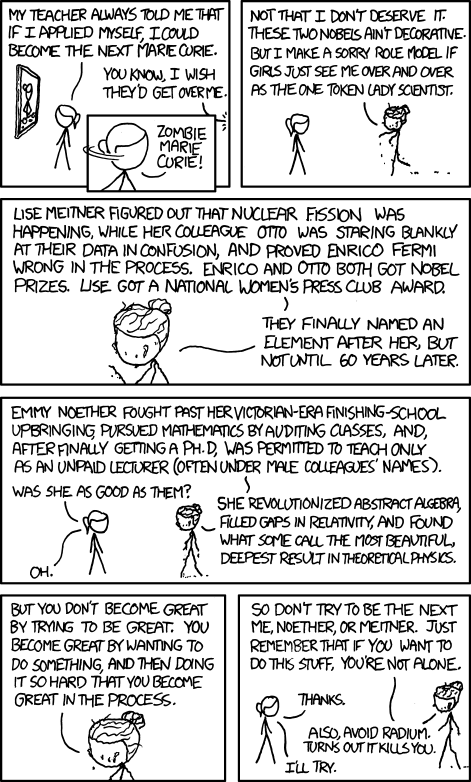
You Don't Become Great By Trying To Be Great

Today's XKCD has a nice message for girls aspiring to become scientists (see below). However, I would add that you don't have to be the next Marie Curie or Lise Meitner or Emmy Noether to be a successful scientist, for that matter. After all, there are plenty of mediocre male scientists out there, too...