Showing posts with label discrimination. Show all posts

Thursday, November 18, 2021

Crosspost: None of the 2021 science Nobel laureates are women – here’s why men still dominate STEM award winning

Written By Mary K. Feeney for The Conversation
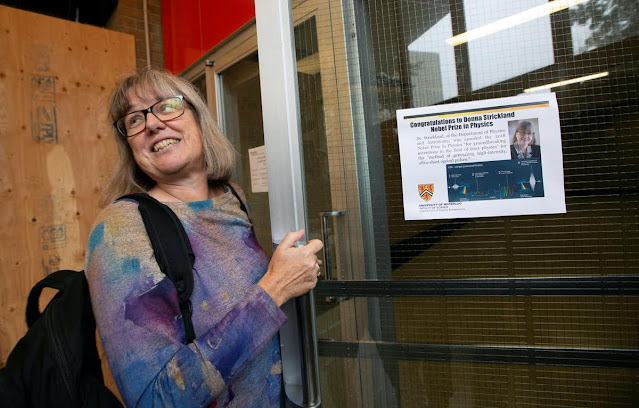
Dr. Donna Strickland, winner of the 2018 Nobel Prize in physics, glances over her shoulder before entering her laboratory at the University of Waterloo.

All of the 2021 Nobel Prizes in science were awarded to men.

That’s a return to business as usual after a couple of good years for female laureates. In 2020, Emmanuelle Charpentier and Jennifer Doudna won the chemistry prize for their work on the CRISPR gene editing system, and Andrea Ghez shared in the physics prize for her discovery of a supermassive black hole.

2019 was another year of all male laureates, after biochemical engineer Frances Arnold won in 2018 for chemistry and Donna Strickland received the 2018 Nobel Prize in physics.

Strickland and Ghez were only the third and fourth female physicists to get a Nobel, following Marie Curie in 1903 and Maria Goeppert-Mayer 60 years later. When asked how that felt, Strickland noted that at first it was surprising to realize so few women had won the award: “But, I mean, I do live in a world of mostly men, so seeing mostly men doesn’t really ever surprise me either.”

The rarity of female Nobel laureates raises questions about women’s exclusion from education and careers in science and the undervaluing of women’s contributions on science teams. Women researchers have come a long way over the past century, but there’s overwhelming evidence that women remain underrepresented in the STEM fields of science, technology, engineering and math.

Studies have shown that those women who persist in these careers face explicit and implicit barriers to advancement. Bias is most intense in fields that are dominated by men, where women lack a critical mass of representation and are often viewed as tokens or outsiders. This bias is even more intense for transgender women and non-binary individuals.

As things are getting better in terms of equal representation, what still holds women back in the lab, in leadership and as award winners?

Read the rest of the article to learn more about the discrimination women experience throughout their careers in STEM, from getting and undergraduate degree to winning a Nobel Prize.

Thursday, July 29, 2021

Crosspost: Bullying and harassment are rife in astronomy, poll suggests

Written By: Phillip Ball for Nature

Bar chart displaying the results of a survey on experiences of bullying and harassment in the Royal Astronomical Society community. Credit: Royal Astronomical Society

Bullying and harassment are rife in astronomy and geophysics in Britain and perhaps other regions, according to the results of a survey conducted last year by the Royal Astronomical Society (RAS) in London. Among 661 researchers polled, more than half of whom were in the United Kingdom, 44% said they had experienced issues in the previous two years.

“The results from the survey are very concerning indeed, and we must act to change this unacceptable situation,” says RAS president Emma Bunce, an astrophysicist at the University of Leicester, UK.

RAS diversity officer Aine O’Brien, who conducted the survey with RAS education, outreach and diversity officer Sheila Kanani, says, “We knew from anecdotal data and other evidence that there was likely to be a sector-wide problem, and I wasn’t super shocked by the trends of the findings — but I was certainly shocked by the extent.”

Read the rest of the article here at: https://doi.org/10.1038/d41586-021-02024-5.

For more references on discrimination in STEM, check out these two, great papers:
Race and Racism in the Geosciences and Double jeopardy in astronomy and planetary science: Women of color face greater risks of gendered and racial harassment

Friday, May 17, 2019

AASWomen Newsletter for May 17, 2019

AAS Committee on the Status of Women AAS Committee on the Status of Women
Issue of May 17, 2019
eds: Nicolle Zellner, Heather Flewelling, Cristina Thomas, Maria Patterson, and JoEllen McBride

[AAS has migrated their email system to Microsoft Exchange, so please check your spam folder if you did not receive the newsletter this week. It is no longer possible to subscribe or unsubscribe to the AASWomen newsletter by means of Google Groups, and we continue to work on developing new instructions. Please follow us on social media for updates and bear with us as we work out all the kinks. Twitter: @AAS_Women, Facebook: https://bit.ly/2PkU9of

Director Lori Glaze; Image Credit: NASA, from item 4
This week's issues:

1. Cross-post: Summary from the WiPS Networking event at LPSC 2019

2. Reflections on Ethics at the AAS

3. Modern Women in STEM Book Project

4. Women are now in charge of NASA's science missions

5. NASA’s initiative to put a woman on the Moon is named Artemis, after Apollo’s twin sister

6. Women in Kyrgyzstan are fighting sexism by joining the space race

7. How the creators of a database are stamping out all-male panels

8. Calling attention to gender bias dramatically changes course evaluations

9. Commentary: The problematic media portrayals of women in science

10. Women gifted in math are still less likely than men to pursue it

11. Lawsuit Alleges Age, Race, Sex Discrimination At Mount Sinai Med School

12. 'I Don’t Want to Stay in a Country That Doesn’t Want Me As Badly as I Want It'

13. Job Opportunities

14. How to Submit to the AASWomen Newsletter

15. How to Subscribe or Unsubscribe to the AASWomen Newsletter

16. Access to Past Issues of the AASWomen Newsletter

Tuesday, January 31, 2017

Responses to the Executive Order on Immigration and Visas

Protests against the  EO.
Outside SCOTUS, DC,  Jan. 30th.
Photo courtesy of Hannah Wakeford.
Attached below are recent statements, petitions, etc. from the scientific community in response to the executive order (EO) signed by President Trump on January 27th, suspending all immigration rights to the United States for citizens from seven countries  (Iran, Iraq, Syria, Sudan, Yemen, Libya, and Somalia) for 90 days. Images throughout this blog are not attached to original pieces, but were taken by professional astronomers and planetary scientists acting in their personal interests.

On a personal note, I am appalled by these recent actions, including this EO, and the impacts they have on our science and on this great nation.  I will continue to support those working on the front lines of this issue, like the American Civil Liberties Union, and want to pledge my full support to my colleagues, both here in the United States and abroad.

---

1. AAS Urges President to Rescind Order on Visas & Immigration


The American Astronomical Society (AAS) has joined with 150 other scientific and engineering societies, national associations, and universities to send a letter to President Donald J. Trump¹ objecting to his January 27th executive order on visas and immigration. It expresses deep concern that the restrictions the new policy imposes “will have a negative impact on the ability of scientists and engineers in industry and academia to enter, or leave from and return to, the United States. This will reduce US science and engineering output to the detriment of America and Americans.”

Wednesday, September 21, 2016

Help SGMA Assess Institutional Gender Identity and Expression Policies


At the American Astronomical Society (AAS) Diversity Summit last fall, its Committee for Sexual-Orientation and Gender Minorities in Astronomy (SGMA) decided to take on the project of improving institutional policies regarding gender identity and expression across the field of astronomy. We are starting that project with a request to readers of the Women in Astronomy blog to let us know the policies at their institution. I have set up a web survey to accept your answers. No personal information will be recorded.

Monday, August 22, 2016

The Price of Stories

Do you believe that racial discrimination and harassment occur in your department? Do you believe that sexual harassment has impacted the careers of its victims? Do you believe the climate in your department is safe for our LGBTQIA colleagues and students?

Your belief is irrelevant. We have facts at our disposal. Yet we extort a high price from those who experience harassment and assault in our community. 

Monday, May 5, 2014

Ain't I a woman? At the intersection of gender, race and sexuality

Today's guest post is by Dr. Chanda Prescod-Weinstein, a Martin Luther King, Jr. Postdoctoral Fellow at the MIT Department of Physics. She specializes in theoretical cosmology and has an interest in formal issues in field theory and relativity. She also serves as an informal academic advisor for most of the very few underrepresented minority women physics majors at M.I.T.

In 1851, former slave Sojourner Truth asked white feminists, "Ain't I a woman?" when they refused to let her speak at a women's conference because she was Black. One might hope that in 158 years, that speech wouldn't seem so essential and relevant. But at the 2009 Women in Astronomy conference, my first foray into non-race oriented equal opportunity efforts, we were told the news was good: women had made significant gains and equality was on its way. There was no substantive mention of race beyond Peggy McIntosh's talk. But I knew the truth. I have been looking at the NSF and AIP statistics myself for years, and I knew that the news was not good for Black, Latina, and Native American women. Those numbers hadn't changed too significantly in three decades. How could they possibly be telling us that the news was good?

As a queer Black (cis)woman, I live at the intersection of multiple minority statuses. More of my time than I would like has been sucked up in trying to fend off the marginalization that society's structures foist upon anyone who has even one of these identities. More of my time than I would like has been spent thinking about a way out of those structures and trying to convince others to help.

And here's one thing I want out of: the phrase "women and minorities," a phrase I used to use a lot myself. As part of the effort to push for equal opportunities in STEM, I  used it repeatedly for over a decade, thinking that I was advocating not just for strangers but also for myself. At some point however, hearing other people use it began to grate on me. A lot.

Wednesday, September 25, 2013

Sexism the Other Way Round

Today’s guest blogger is Gerrit Verschuur. Gerrit is a semi-retired radio astronomer who continues to study interstellar neutral hydrogen structure. He is the author of eight popular astronomy books and co-author or editor of three text books. He has also found the time to get his name on over a dozen patents. He claims that his primary accomplishment is that he is married to Joan Schmelz (me!).

Organizations, People and Strategies in Astronomy (OPSA, Vols. 1 & 2) presents a compilations of 49 chapters designed to reveal the way astronomy is practiced all over the globe. Or, to frame this in words used by its editor, it is a continuation of a former series in which scientists and non-scientists describe their experience on ’non-purely scientific matters, many of them of fundamental importance for the efficient conduct of our activities.’ While fascinating material, it is not a target for a book review for CSWA. What is interesting is what it does not do.  

First, it is striking that 41 chapters have lead authors that are men, or 84%, not surprising perhaps given the international nature of these two volumes. More interesting, from the point of the Women in Astronomy readership, is the lack of any chapters dealing with the issues central to the work of CSWA; harassment, prejudice, glass ceilings, leaky pipelines, and the subtleties of unconscious bias. In fairness, one chapter summarizing data from the UK shows that while 34% of post-graduate astronomy students are female, only 7% share the highest academic level of professor. Another chapter discusses the plight of African-American minorities in the field. But there is nothing that could remotely be described as chapters on the barriers faced by women in astronomy, worldwide. This caused me to send an email enquiring about this oversight to the editor in France.

Wednesday, September 4, 2013

On reverse discrimination


Ed Bertschinger recently wrote an about his recent encounter with a response to the charge of “reverse discrimination.” It really struck a chord for me because I used to be “that guy” who would point to reverse discrimination as part of my general (uninformed) stance against affirmative action. More recently I’ve learned how wrong I was to take such a position. I'd like to take this space to explain my new way of thinking.

First, think about why discrimination exists and how it works in practice. Discrimination is a tool used by those in power to consolidate and preserve power by excluding others based on arbitrary distinctions such as race, sexual orientation or gender. By designating a portion of the population as “lesser” and “separate,” groups in power can very effectively reduce the size of the competitive pool, making it easy to e.g., win funding and get jobs. This can be done explicitly, but fortunately it’s rare these days. 

More often than not discrimination takes the form of an institutionalized structure left over from the past with little incentive for people who benefit from it to change, or implemented (poorly) in pursuit of other goals. However, implementing these arbitrary delineations for the benefit of the few requires an important ingredient, namely power. Thus for reverse discrimination to occur from, say, women toward men, we’d need an institutional structure with a powerful female faction who have the power to suppress male involvement.

Friday, August 9, 2013

Reverse discrimination?

This week I gave a talk about physics education that included a substantial discussion of the benefits of diversity in creating a successful university program.  I was presenting in a different country, where the culture is patriarchal although respectful of minorities.  Very few of the faculty or students in this physics audience were women.

At the end of the talk, a young man asked, "Why are you trying to recruit women?  Isn't that reverse discrimination?"  I smiled, glad to have an elephant in the room revealed.  Fortunately, I had been thinking about his question for a while, as it has come up in other settings.

I answered no, I didn't consider it reverse discrimination, it was merely rectifying an imbalance caused by discouragement and implicit bias.  He then asserted that perhaps women didn't want to pursue science careers and were making other choices.

I replied that the women I had spoken with definitely wanted to pursue science careers, and I concluded that no, I was definitely not practicing reverse discrimination.

It was a short exchange, I resisted the temptation to launch into a wider discussion about cultural stereotypes, bias, etc.  (Know one's audience -- that approach would likely have been ineffective in this country.)  This kind of question can be frustrating, but it also represents an excellent opportunity to present facts and to show the many benefits of improving the climate in our departments and workplaces.  We will never change the hearts and minds of everyone, but there are young men in such audiences who may become allies, and young women who will appreciate the encouragement.  At the very least, speaking out sets a good example for department leadership to do likewise.  It's also a good thing for men to be speaking on this issue, as it makes the charge of reverse discrimination less plausible to other men.

Tuesday, May 21, 2013

ADVICE: Dealing with Discrimination and Harassment

This is the third in our new series of ADVICE posts as CSWA tries to ensure that information gathered over the years remains available to the current generation of students, postdocs, and faculty. This month, we try to deal with discrimination and harassment:

From: Joan Schmelz and Patricia Knezek [jschmelz_at_memphis.edu; knezek_at_noao.edu]

The good news for women in astronomy is that incidents of overt sexual discrimination and sexual harassment have declined dramatically in recent years. The bad news is that there are still problems, especially for grad students and post docs. Sometimes we don't realize that these problems are still out there until something happens to us or to someone we know personally.

As members of CSWA, young women sometimes seek us out to ask for advice or just talk about problems. We do our best to help, but we are not trained professionals. We thought many heads can be better than two, so we asked for advice from readers of AASWOMEN on two particular issues. We would also like to encourage readers to broaden the topic to other issues. No doubt some of you have developed good responses and advice, and we would like to widely distribute this information in order to benefit all. Rather than betray confidences or reveal personal details for the two issues we are raising here, we have chosen instead to combine similar incidents that have happened to each of us and volunteer to be the guinea pigs.