Showing posts with label Black women in STEM. Show all posts

Thursday, February 12, 2026

Highlighting Stories of Black Women In Science This Month

As we celebrate Black History Month this February, we've gathered stories and interviews of Black women in science. Read on!

Image by ekavesh from Pixabay

In Stories From Black Physicists in Our Collection, the AIP collected interviews from members and presented them this February in a series of not-to-be-missed articles.

Read about Lynnae C. Quick, a Senior Planetary Scientist at The Johns Hopkins University Applied Physics Laboratory (APL). Quick previously worked at NASA Goddard Space Flight Center  before joining the Applied Physics Lab. Currently, she focuses on modeling volcanic processes on the terrestrial planets and the icy moons of the outer solar system. Read Quick's story, and find her AIP Oral History Interviews at AIP.org. 

Director of Johnson Space Center Vanessa E. Wyche oversees a broad swath of programs, from Mission Control Center, International Space Station, Orion, and Gateway programs. Wyche has held many leadership positions within NASA. Check out this Fireside Chat with Wyche from ExploreMars.org, where Wyche outlines the roadmap to returning humans to the Moon and more on Johnson Space Center's programs. 


Join Vanessa Wyche, NASA's Acting Associate Administrator, in an exclusive fireside chat at the 2025 Humans to the Moon and Mars Summit (H2M2), held at George Washington University in Washington, D.C. Moderated by J.R. Edwards, President of Explore Mars, Inc.

Scientific American interviewed Aomawa Shields in 2023 at the release of her memoir Life On Other Planets. Find the interview Only 26 Black Women Have Ever Become Astrophysicists in the U.S. Here's One Story. Shields also founded Rising Stargirls to encourage girls of all colors to learn and discover more about space. You can watch SheShields' TEDx talk "How We'll Find Life on Other Planets" on YouTube, among other videos. Shields brings an acting background to her work, giving her a unique, multifaceted approach to science. 


Aomawa Shields, How We'll Find Life On Other Planets, TedEx. 

From the Women in Astronomy blog archives, (re)read this crosspost by Dr. Jedidah Isler: On Planck's Law, Blackbodies, and the Physics of Diversity, first published in the June 2014 issue of Status. 

Happy Black History Month. We celebrate all of the contributions Black women have made in astronomy and physics and look forward to even more to celebrate. 

Thursday, February 27, 2025

Spotlight on Dr. Beth Brown

As we hit the end of February, let’s revisit one of astronomy’s brightest stars who left us too early. 

Beth Brown was born February 4, 1969. She grew up in Roanoke, Virginia watching reruns of Star Trek and was enthralled with Star Wars, and both fueled her love for the stars. In high school she visited an observatory, where she viewed the Ring Nebula through a telescope. That school trip impacted her deeply, and after graduation, Brown decided to pursue astronomy.

She chose Howard University as an astrophysics major, dreaming of one day becoming an astronaut. While an undergrad, she learned her dislike of tight spaces (like those in a space shuttle) and that being near-sighted might not be the best attributes for an astronaut. Brown still pursued astrophysics, though, and graduated summa cum laude in 1991. While still an undergrad, she interned twice for NASA at Goddard Space Flight Center.

Brown pursued her graduate degrees at the University of Michigan, earning both her Masters and her doctoral degrees there. She became the first Black woman to earn a PhD in astronomy from the university. While studying astronomy, Brown also participated in science communication, teaching students and the general public about astronomy through the local planetarium and developing a short course at the university for non-astronomy majors to learn about the subject.

Photo: NASA

After obtaining her PhD, Dr. Brown returned to NASA, first as a post-doctoral research associate focused on elliptical galaxies, using both the ROSAT X-ray satellite and Chandra X-ray observatory to gather data. In her career at NASA, Dr. Brown worked at Goddard Space Flight Center and the X-Ray Astrophysics Laboratory. She also taught classes at Howard University on physics and astronomy as part of a NASA administrator fellowship.

Dr. Brown had just accepted a new position at GSFC as the Assistant Director for Science Communications and Higher Education, a job that combined her love for teaching and communicating about astronomy. Unfortunately, she didn’t have the chance to fulfill that role. Dr. Brown suffered a pulmonary embolism in October of 2008 which led to her unexpected death at the age of 39.

The Dr. Beth A. Brown Science Foundation was founded to remember and honor Dr. Brown by awarding scholarships to students studying physics or astronomy. The foundation awards scholarships to graduating high school seniors who are attending a university and majoring in either subject, as well as current students at Howard University and the University of Michigan.

The American Astronomical Society remembers Dr. Brown through the Beth Brown Memorial Award. In conjunction with the National Society of Black Physicists, the awards are given to an undergraduate and a graduate student who presents their research to the NSBP in poster format, and one student who presents in an oral format. Those selected receive a year of membership in AAS and registration to an AAS event with reimbursement for expenses. Members of the Committee on the Status of Minorities in Astronomy (CSMA) are often involved in the selection process through the NSBP. 

Though Dr. Brown’s time in astronomy was cut short, she made deep and lasting impacts everywhere she went. Astro 127, or Naked Eye Astronomy, is still taught at the University of Michigan, allowing students to experience the joy of learning about the most common astronomical objects that can be observed with the naked eye.

Photo: NASA
Through her work, teaching, and outreach, she inspired young people to look to the stars, just as she did that first time she peered through a telescope and felt the stars calling her.


Thursday, February 13, 2025

Cross-post: Defying the Stereotype of Black Resilience

Cross-post: Defying the Stereotype of Black Resilience


(Original article written by Jyoti Madhusoodanana for Nature.com, May 30, 2024)


Kaela S. Singleton has pushed back against Black stereotypes again and again as she pursued her PhD in neuroscience and then made a career shift to nonprofit leadership. Singleton faced common assumptions and myths about Black students in academia. In 2020, she co-founded Black in Neuro, a community for Black researchers in neuroscience and their allies. This network provides mentorship and professional development for Black researchers in the field.


Image Credit: Kaela S. Singlton at kss-phd.com.

Singleton also finds herself confronting racism and has found ways to engage others about it, even when it makes both parties uncomfortable.  “A lot of times, it comes down to just having conversations and being direct with people,” Singleton says in her Nature.com interview. She also discusses the myths of Black resilience and changing her mind about her career direction after receiving her PhD. 

Read Singleton’s full interview Defying the stereotype of Black resilience at nature.com.


Learn more about the history of Black History Month at ASALH - The Founders of Black History Month


Find out more about what drives Kaela Singleton, read her bio, and view copies of her successful applications (free resources for others to view) at Kaela S. Singleton, PhD.


Thursday, July 18, 2024

Celebrating Apollo-era Women

NASA’s Johnson Space Center in Houston will rename “Building 12,” on Friday, July 19, the eve of the 55th anniversary of the Apollo 11 Moon landing, in honor of "hidden figure" computer Dorothy Vaughan, who is acknowledged as NASA’s first African-American managerOther women of Apollo will also be recognized with activities marking their achievements.
A portrait of Dorothy Vaughan.
Credit: NASA

At 9 a.m. CDT, NASA Johnson Director Vanessa Wyche will begin with a discussion about the importance of Vaughan and the women of Apollo’s contributions to the agency’s lunar landing program and their significance to today’s Artemis campaign. Other highlights include a “Women in Human Spaceflight” panel discussion moderated by Debbie Korth, the agency’s Orion Program deputy manager. 


Read more at


Further reading:

Thursday, April 18, 2024

Women at NASA Support Human Spaceflight

By Nicolle Zellner

NASA logo


On April 12, the United Nations celebrated the International Day of Human Spaceflight in honor of Yuri Gagarin, a Soviet citizen. who conducted the first human space flight. This historic event opened the way for space exploration for the benefit of all humanity.

NASA has been the leader of human spaceflight in the United States, and women at all of the NASA centers and facilities have worked - for decades - to support those efforts. Here are just a few of them.

Teresa Kinney, NASA's first female chief engineer at the agency's Kennedy Space Center (KSC), is one of the managers working to put the Gateway lunar space station together in orbit around the Moon later in the 2020s. She says, ""If everybody thinks alike, you're not thinking about the problem correctly."

Read more at

https://www.space.com/nasa-1st-female-chief-engineer-gateway-moon

Kari Alvarado, is the lead management analyst and Dryden Aeronautical Test Range (DATR) asset manager at NASA’s Armstrong Flight Research Center in Edwards, CA. Her advice? Never compare yourself to others. Only compare yourself to you and your own potential."

Read more at

https://www.nasa.gov/centers-and-facilities/armstrong/womens-history-month-meet-kari-alvarado/

Gwendolyn Wheatle currently serves as the Administrative Assistant for the Office of STEM Engagement at NASA’s Langley Research Center in Hampton, VA. What started as a temporary, three-week clerical position supporting the Office of the Chief Scientist has blossomed into a 38-year career at NASA. She reminds us that you don’t have to have a degree in engineering or science to hold a position at NASA - no matter your degree, background, or experience, there is a place for you.

Read more at

https://www.nasa.gov/centers-and-facilities/langley/langley-celebrates-womens-history-month-gwendolyn-wheatle/


Learn more! Women are making history at NASA every day, as the agency continues to drive innovation and push the envelope. Learn more at https://www.nasa.gov/women-at-nasa/.


Thursday, February 15, 2024

Cross-post: Meet the scientist protecting women of color from the wrong side of AI

[Eds. note: February 11 was the International Day of Women and Girls in Science.]


Dr. Joy Buolamwini during 2023 Massachusetts Conference For Women in Boston, on Dec. 14, 2023.
(Image Credit: Marla Aufmuth / Getty Images file)


By Daniela Pierre-Bravo, for msnbc.com

At 34, computer scientist and poet, Dr. Joy Buolamwini, has already made her mark as a pioneer in the rapidly developing field of artificial intelligence.

She’s advised President Biden and Big Tech on the benefits and dangers of AI, was named one of Time’s "100 Most Influential people in AI," has worked on documentaries about the subject, and she recently released a book about her personal journey in the space: “Unmasking AI: My Mission to Protect What is Human in a World of Machines.”

Her research as an AI scientist came into focus during her time as a graduate student at MIT: addressing the downfalls in machine learning (the building blocks of AI systems).

At the time, Dr. Buolamwini was working on a face detection technology for an art installation she was building. She noticed the software program was having trouble detecting her skin color. It wasn’t until she decided to place a white mask on her face that it finally started to work properly.

Read more at

Thursday, February 8, 2024

Celebrating Black in STEM - Part 1


women of color at NASA
NASA Pioneers and Innovators (Image Credit: NASA)


Since 1976, every American president has officially designated February as Black History Month, a celebration of achievements by African Americans and a time to acknowledge and recognize their central role in American history. The annual event grew out of "Negro History Week", initiated by historian and civil rights leader Carter G. Woodson and other prominent African Americans. Around the world other countries also devote a month to celebrating Black history. Read more about the month's history here.

Organizations that support scientists in astronomy and physics have provided resources, guidance, and advice for advancing the careers of Black astronomers and physicists. Below is a partial list. 


Do you recommend others? Please add them in the comments section.

Thursday, July 7, 2022

Crosspost: Science must overcome its racist legacy: Nature’s guest editors speak

Nature editors Chad Womack, Elizabeth Wathuti, Ambroise Wonkam, and Melissa Nobles will be releasing a series of special issues on the intersection of racism and science. Credit: Gretchen Ertl and University of Cape Town. 
Science is a human endeavour that is fuelled by curiosity and a drive to better understand and shape our natural and material world. Science is also a shared experience, subject both to the best of what creativity and imagination have to offer and to humankind’s worst excesses. For centuries, European governments supported the enslavement of African populations and the subjugation of Indigenous people around the world. During that period, a scientific enterprise emerged that reinforced racist beliefs and cultures. Apartheid, colonization, forced labour, imperialism and slavery have left an indelible mark on science.

Although valiant and painful freedom struggles eventually led to decolonization, the impacts of those original racist beliefs continue to reverberate and have been reified in the institutional policies and attitudes that govern the ‘who’ and ‘how’ of individuals’ participation in the modern, global scientific enterprise. In our opinion, racist beliefs have contributed to a lack of diversity, equity and inclusion, and the marginalization of Indigenous and African diasporic communities in science on a national and global scale.

Science and racism share a history because scientists, science’s institutions and influential supporters of science either directly or indirectly supported core racist beliefs: the idea that race is a determinant of human traits and capacities (such as the ability to build civilizations); and the idea that racial differences make white people superior. Although the most egregious forms of racism are unlawful, racism persists in science and affects diverse communities worldwide. Following the murder of George Floyd in 2020 and the expansion of the Black Lives Matter movement into science, Nature was among those institutions that pledged to listen, learn and change. In an Editorial1, it said, “The enterprise of science has been — and remains — complicit in systemic racism, and it must strive harder to correct those injustices and amplify marginalized voices.”

Read the rest of the editorial here and look out for the first of Nature's series and science and racism at the end of this year.

Thursday, February 17, 2022

Crosspost: 5 Pioneering Women of Color in STEM You Might Never Have Heard Of (Plus a Quiz on Black Women in STEM!)

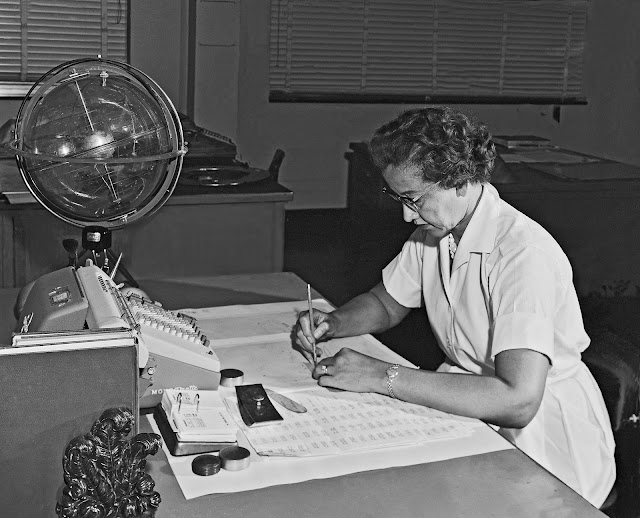
Talented mathematician, Katherine G. Johnson, works on complex orbital mechanics calculations at NASA Langley Research Center. Her work was pivotal to the success of the 1969 moon landing. Credit: Bob Nye/NASA
Science and technology have transformed our lives in unimaginable ways and, thanks to science, what's previously seems impossible can become a reality. Who would have thought a century ago, for example, that people on opposite sides of the world could communicate easily in real time with something so small it fits in a pocket? 

In the health sector, science has made huge strides in diagnosis, testing, and medication. It’s science that sent men (although no women yet) to the moon; that’s recognized and amplified the effects of climate change and solutions to help prevent it; that innovates disease- and weather-resistant crops; and so much more. 

Behind many of these incredible scientific discoveries are people who have put years of research, time, energy, and resources into improving lives. Amazing individuals focusing their efforts on making life better for the next person, the next community, and the next generation to come.

But when you think of a scientist, what do you picture? Is it an Albert Einstein-esque white man in a lab coat? Because you might be surprised to know that, from space travel to climate change, many of the huge scientific achievements of our age were made by women of color, women whose names and accomplishments have gone unnoticed for far too long. 

Meanwhile, the issue of gender inequality in science continues to be an obstacle for women and girls today. In fact, just 35% of science, technology, engineering, and mathematics (STEM) students in higher education are women. This is particularly alarming, as highlighted by UNESCO, because STEM careers are often referred to as "jobs of the future", those that drive innovation, social well-being, inclusive growth, and sustainable development. 

So in commemoration of International Day of Women and Girls in Science, on Feb. 11, we want to introduce you to five incredible women of color who have shaped (and are still shaping) the course of history through science. What’s more, you can also click here to take our quiz to find out more about the remarkable achievements of the women below. 

Read each of the profiles for these five incredible women of color in STEM—ranging from environmental science to physics—at: https://www.globalcitizen.org/en/content/women-of-color-in-STEM-to-know/ 

Thursday, September 23, 2021

Crosspost: Sian Proctor makes history with SpaceX's Inspiration4 as first-ever Black female spacecraft pilot

 Written by Chelsea Gohd for space.com 

Sian Proctor is making history as the first-ever Black female spacecraft pilot.

Proctor, a geoscientist, artist and science communicator, has been paving the way in the space sector for decades. Now, years after being a finalist in NASA's astronaut candidate program back in 2009, she is realizing her dream of becoming an astronaut as she launches to orbit with the Inspiration4 mission tonight (Sept. 15).

While the mission itself is making history as the first all-civilian mission to launch to orbit, Proctor is accomplishing a major first herself as the first Black female spacecraft pilot.

"I'm really grateful to be here and to have this opportunity," Proctor said Sept. 14 during a news conference with reporters. "There have been three Black female astronauts that have made it to space, and knowing that I'm going to be the fourth means that I have this opportunity to not only accomplish my dream, but also inspire the next generation of women of color and girls of color and really get them to think about reaching for the stars and what that means."

Read the rest of the article at https://www.space.com/sian-proctor-inspiration4-first-black-female-spacecraft-pilot to learn more about the history of Black women in space and Proctor's journey from science communication to civilian astronaut.