Thursday, December 4, 2025

Career Profile: Allyson Bieryla and the Astronomy Lab at Harvard University

The AAS Committee on the Status of Women in Astronomy has compiled dozens of interviews highlighting the diversity of career trajectories available to astronomers, planetary scientists, etc. The interviews share advice and lessons learned from individuals on those paths.

This article features Allyson Bieryla, manager of Harvard University’s Astronomy Lab and Telescope and astronomer at the Smithsonian Institute.
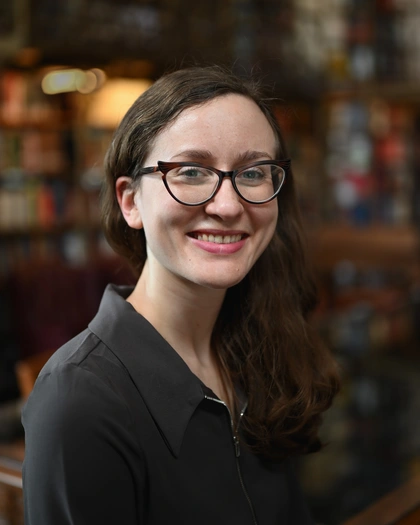
Allyson Bieryla, Astronomy Lab at Harvard and Astronomer at Harvard Smithsonian Center for Astrophysics.
Photo courtesy of Allyson Bieryla.
Allyson Bieryla only left her home state of Pennsylvania a handful of times while growing up outside of Scranton. She enjoyed school, particularly her math and science classes, and had great teachers, but she never had an astronomy class or the chance to peer through a telescope. When she visited her high school guidance counselor to discuss college options, she thought she would likely follow in the footsteps of many of her classmates and choose an in-state school.

Her guidance counselor had other ideas. “She convinced me to go out-of-state,” Bieryla said. “She had a University of Colorado Boulder poster. It looked pretty.” Bieryla chose to apply, and in March, she drove halfway across the country to tour the university. She arrived in the middle of a blizzard and couldn’t see the mountains. When she checked into the hotel and asked where they were, the clerk laughed and said, “Just wait.”

The next morning, Bieryla was rewarded with a beautiful view of snowcapped peaks. She fell in love with Boulder, the city and the university, for its eye-opening experiences. “Different people, different mentality,” she quipped. When faced with choosing a major, Bieryla knew it would involve math and science, her favorite subjects from high school, but beyond that, she had little direction. She started going down the list of career options in science and found astronomy right at the top. Could that be the right choice? “I just wanted a sign on what to do. I saw a shooting star—two, actually—probably a meteor shower.” Bieryla took those two stars as confirmation and chose astronomy, along with physics and fine arts. She also minored in geology. 

While she loved her classes, she didn’t have a mentor to guide her. She didn’t get into grad school right away after college. Instead, Bieryla worked at Southwest Research Institute. When funding ran out, she worked for a geophysics company and then applied for a position at the astronomy lab at Harvard. Bieryla was hired and found her perfect fit. 

The position has grown over the last eighteen years. Bieryla has done some of her own research on the side through the Smithsonian Institute, and she got her Master’s degree in software engineering. She is submitting her doctoral dissertation in astrophysics this year to the University of Southern Queensland. “While I’ve been in the field for twenty years, there are things I can’t do without the PhD.”
One of Bieryla’s roles at the astrophysics lab is Director of Graduate Studies. Within that role, she guides and mentors students in a way she never experienced. Outside of assisting students, she has a full plate of duties.

A typical day includes training grad students on how to run the labs offered at the astrophysics lab, overseeing telescope times allotted to students and teachers, and advising students in the General Astronomy Club. The club has weekly dinners, and students have the opportunity to attend the AAS conference each year. Bieryla also takes senior students on a trip every August. The students have visited Hawaii, Iceland, and Denmark, among others, and gotten to use professional telescopes. 

Bieryla also continues her own research on exoplanets. She also got involved with creating a tool to make viewing solar eclipses more accessible. In 2017, she helped design a tool that converts light to sound for the blind and low-vision impaired. In 2024, she ran workshops to teach people how to use the tools, and over 1,000 were 3D printed. “Our next version will convert color to sound,” Bieryla said.

Accessibility is a subject that Bieryla has given a lot of thought. “Like a lot of labs, [ours] was not accessible. We’re on the top floor.” Bieryla pushed to install a ramp for more accessibility. “It’s necessary for some people, but useful for everyone.” The ramp was a win for Bieryla, but she’s now thinking about the telescope itself. “Making sure the telescope is accessible is a whole different problem—small steps in the right direction.”

Through the years, as Bieryla has worked with students, she’s learned a few things she likes to pass on to them. 
  • Try different things, whether it’s an industry job or internship in the field, or a summer job with Major League Baseball. “It’s okay to not be in a traditional box.”
  • Seek out mentors. “Having great mentors is just as important (or more) than having a good research position.”
  • Peer mentorship is also great. “Seniors can help freshmen, grad students can help seniors.”
Finally, Bieryla encourages everyone in the field, especially in mentorship positions, to have conversations about different pathways. “Not everyone can go into academia. Old school mindsets are sometimes hard to shift.”

While Bieryla has her hands full with the astrophysics lab at Harvard, her own research, and her work with accessibility and solar eclipses, she also makes time for another passion. “I’m a big soccer fan. I was a player, and now follow the U.S. Women’s National Team.” She attends those games to see a different type of star, but astronomy continues to be her first love.