Issue of March 27, 2026
eds: Jeremy Bailin, Sethanne Howard, Ferah Munshi, Stella Kafka, and Ben Keller
[We hope you all are taking care of yourselves and each other. --eds.]
This week's issues:
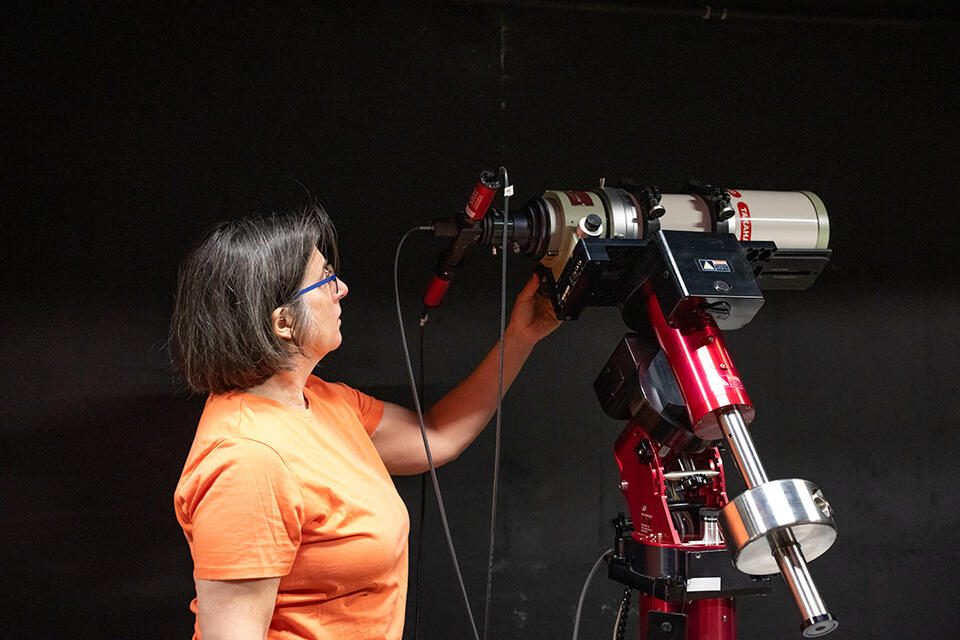
1. Career Interview Series: Deborah Skapik Leans Into Research Skills With Her Students
2. Laboratory Astrophysics Division 2026 Dissertation Prize to Julia Santos
3. The Harvard Computers, Women Computers in Science, and Precision Measurement
4. Women's Impact Award Nominations
5. "Leaky Pipeline" or systematic exclusion?
6. NIH grant terminations affected women scientists more than men
7. In Her Own Words: Black Women Scientists Reflect on Meaningful Accomplishments
8. Agnes Pockels’ pioneering work was unfairly dismissed by tropes about women’s domestic roles
9. NASA Astrophysics Small Explorer Announcement of Opportunity
10. How to Submit to the AASWOMEN newsletter
11. How to Subscribe or Unsubscribe to the AASWOMEN newsletter
12. Access to Past Issues
An online version of this newsletter will be available at http://womeninastronomy.blogspot.com/ at 3:00 PM ET every Friday.
Deborah Skapik traces her interest in space back to 1977, when a partial eclipse captured her interest. She built a shoebox diorama of the event on her own initiative. “I remember cutting out a circle on the side to put a flashlight. I even remember the color of the flashlight was this red plastic flashlight that my parents had, and putting that in the side of the box and hanging a styrofoam ball and making a shadow and just the visualization in three dimensions of what was going on.”
This wasn’t the only astronomy project Skapik tackled as a child interested in space. She also glued pastina—pasta shaped like stars—onto black construction paper and recreated the cosmos for herself. When Carl Sagan’s series Cosmos released in 1980, Skapik was mesmerized. She naturally gravitated to space and science, and felt fortunate to be in a public school system that encouraged STEM for all pupils. Her seventh grade science teacher allowed her the space to explore what it means to be a scientist as he led the class through multiple dissections that year. Skapik vividly remembers dissecting sharks outside and the smell as they dug into the process. “I didn't love that part of it, but the fact that we were so hands-on…he allowed me to explore and really do what felt like research science in seventh grade and use the tools of a scientist.”
Read more at
https://womeninastronomy.blogspot.com/2026/03/career-interview-series-deborah-skapik.html
Laboratory Astrophysics Division (LAD) is pleased to announce the recipient of its 2026 Dissertation Prize, given to an individual who has recently completed an outstanding theoretical or experimental doctoral dissertation in laboratory astrophysics. For the year 2026 the prize goes to Dr. Julia Santos for her thesis Transformation and sublimation of interstellar ices: insights from laboratory experiments and astronomical observations. Dr. Santos earned her PhD in Astrophysics, cum laude, from Leiden University in 2025, working with Prof. Ewine van Dishoeck and Prof. Harold Linnartz. She is currently a 51 Pegasi b Fellow at Harvard University.
Read more at
https://aas.org/posts/news/2026/03/lad-awards-2026-dissertation-prize-julia-santos
In the late 19th and early 20th centuries, "computers" were people, usually women, who did calculations by hand as part of scientific projects. Most famous to astronomers are the Harvard Computers who worked at Harvard College Observatory, including such luminaries as Henrietta Swan Leavitt and Annie Jump Cannon. These three articles provide an interesting background into historical computers, and their connection to women doing modern precision astronomical measurements like Susanna Deustua at NIST.
Read more at
https://www.saltwire.com/newfoundland-labrador/atlantic-skies-henrietta-swan-leavitt
By Falling Wells
The Women’s Impact Award recognises women who combine outstanding research with societal impact. It celebrates scientific excellence with purpose—led by women and actively contributing to a more equitable future.
The award is a joint initiative by the Falling Walls Foundation and the Elsevier Foundation and forms part of the Falling Walls Global Call for Science Breakthroughs. The 2026 Global Call for Science Breakthroughs 2026 is open. Applications and nominations are welcome.
Read more, and apply or nominate, at
https://falling-walls.com/about-summit/science-summit/womens-impact-award
A new themed issue of Advances in Archaeological Practice, published by Cambridge University Press on behalf of the Society for American Archaeology (SAA), argues that the long‑standing “leaky pipeline” metaphor obscures the real and active barriers faced by women, minority scholars, and LGBTQIA+ communities in archaeology.
Note that although the article is aimed specifically at archeaology, the analysis and recommendations within it are relatively universal within STEM and are relevant for women in astronomy.
Read more at
https://www.eurekalert.org/news-releases/1120637
Read the issue at
By Anil Oza
Academics have long referred to their field as a leaky pipeline — gradually bleeding researchers from marginalized communities as they progress through their careers.
A new paper, published Monday, suggests that grant terminations from the National Institutes of Health over the past year may have further punctured that pipeline. The paper, published in the Proceedings of the National Academy of Science, shows that women, particularly those early in their careers, were disproportionately affected by terminations, even though they receive less funding from the NIH in general.
Women lost a larger chunk of their grant funds than men — on average women had 57.9% of their grant terminated, while men had 48.2%. Among doctoral students and assistant professors, 60% of terminated grants were led by women.
Read more at
https://www.statnews.com/2026/03/23/nih-cuts-who-lost-funding-women-blacks-young-researchers/
Read the journal article at
https://www.pnas.org/doi/10.1073/pnas.2527755123
By Dorothy Tang
In celebration of Women’s History Month, I wanted to highlight some of the achievements of Black women in the sciences. Over the years, AIP has interviewed dozens of incredibly accomplished Black women scientists, and I was curious about what they considered to be their most meaningful research achievements and scholarly accolades. While looking through our oral history interview collection , I found three quotes on the subject in the transcripts of interviews by chemical engineer Paula Hammond, biomedical engineer Anjelica Gonzalez, and physicist Shirley Ann Jackson.
Read more at
By Alexis Pedrick, Sophia Levin, The Lost Women of Science Initiative & Mariel Carr
Agnes Pockels did pioneering work in surface science. Her invention, the Pockels trough, became the basis for an instrument that helped Katharine Burr Blodgett and Irving Langmuir make discoveries in material science that quietly shape our everyday world.
But the way we talk about Pockels’s life and work often falls back on familiar tropes about women’s domestic roles, along with assumptions about how science gets done and what it looked like to do science as a woman in the 19th century.
Reaed more and listen to the podcast at
By NASA
SMD's Astrophysics Division's (APD) Explorers Program continues to plan on releasing an Announcement of Opportunity (AO) entitled "2026 Astrophysics Small Explorer (SMEX)" during the 2nd Quarter of CY 2026. This CA provides an update on the AO Cost Cap. The AO Cost Cap will be increased to $190M in FY 2026 dollars (FY26$) from $170M in FY 2025 dollars (FY25$) as in the draft AO.
Along with answers to questions previously submitted by the Community, a copy of this email update also has been posted by the NASA Science Office for Mission Assessments (SOMA) to their 2026 Astrophysics SMEX Acquisition website and are available at
https://explorers.larc.nasa.gov/APSMEX26/SMEX/index.html
To submit an item to the AASWOMEN newsletter, including replies to topics, send email to aaswomen_at_lists.aas.org .
All material will be posted unless you tell us otherwise, including your email address.
When submitting a job posting for inclusion in the newsletter, please include a one-line description and a link to the full job posting.
Please remember to replace "_at_" in the e-mail address above.
Join AAS Women List through the online portal:
To Subscribe, go to https://aas.simplelists.com/aaswlist/subscribe/ and enter your name and email address, and click Subscribe. You will be sent an email with a link to click to confirm subscription.
To unsubscribe from AAS Women by email:
Go to https://aas.simplelists.com, in the "My account and unsubscriptions", type your email address. You will receive an email with a link to access your account, from there you can click the unsubscribe link for this mailing list.

No comments :
Post a Comment