The AAS Committee on the Status of Women in Astronomy maintains this blog to disseminate information relevant to astronomers who identify as women and share the perspectives of astronomers from varied backgrounds. If you have an idea for a blog post or topic, please submit a short pitch (less than 300 words).
The views expressed on this site are not necessarily the views of the CSWA, the AAS, its Board of Trustees, or its membership.
Showing posts with label black women in astronomy. Show all posts
Showing posts with label black women in astronomy. Show all posts
In our crosspost this week, radio astronomer Lexy Andati discusses exploring the universe and her mission to encourage women in science. The original article was by published in Nature and written by Abdullah Tsanni.
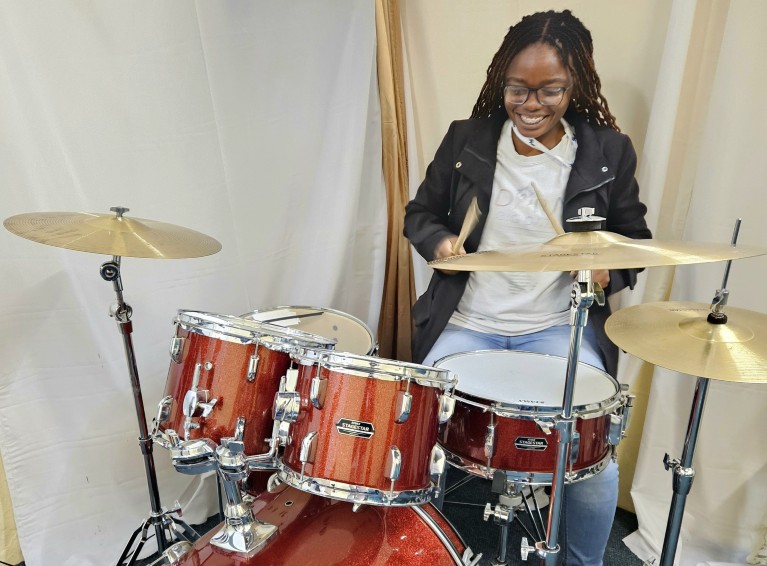
Lexy Andati playing drums. Credit: Urielle Kayumba. Photo from Nature.com
When radio astronomer Lexy Andati introduces herself, she beams with pride. As a postdoctoral research fellow with the South African Radio Astronomy Observatory (SARAO), she studies galaxies using some of the most powerful radio telescopes in the world.
Her journey in science has already earned her international recognition, including the coveted L’Oréal-UNESCO award for Women in Science.
In late August, at the 2025 Deep Learning Indaba - an annual meeting of researchers from Africa’s machine-learning community, that this year attracted over 1,000 attendees in Kigali, Rwanda - she was honoured again for her groundbreaking research.
Andati was announced as the winner of the Thamsanqua Kambule Award at the Indaba for her strong contributions to astronomy and strengthening Africa’s participation in the Square Kilometre Array (SKA) project. The award, for an outstanding PhD thesis in computational sciences from an African university, is named in honor of the South African mathematician and educator who was the first Black professor at the University of Witwatersrand.
But Andati tells Nature Africa that when she first began her PhD, she was terrified. “I was absolutely out of my depth,” she recalls. “But the same project that scared me has now brought me two awards”.
Read the rest of Lexy Andati's story at Nature.com.
As we hit the end of February, let’s revisit one of astronomy’s brightest stars who left us too early.
Beth Brown was born February 4, 1969. She grew up in Roanoke, Virginia watching reruns of Star Trek and was enthralled with Star Wars, and both fueled her love for the stars. In high school she visited an observatory, where she viewed the Ring Nebula through a telescope. That school trip impacted her deeply, and after graduation, Brown decided to pursue astronomy.
She chose Howard University as an astrophysics major, dreaming of one day becoming an astronaut. While an undergrad, she learned her dislike of tight spaces (like those in a space shuttle) and that being near-sighted might not be the best attributes for an astronaut. Brown still pursued astrophysics, though, and graduated summa cum laude in 1991. While still an undergrad, she interned twice for NASA at Goddard Space Flight Center.
Brown pursued her graduate degrees at the University of Michigan, earning both her Masters and her doctoral degrees there. She became the first Black woman to earn a PhD in astronomy from the university. While studying astronomy, Brown also participated in science communication, teaching students and the general public about astronomy through the local planetarium and developing a short course at the university for non-astronomy majors to learn about the subject.
Photo: NASA
After obtaining her PhD, Dr. Brown returned to NASA, first as a post-doctoral research associate focused on elliptical galaxies, using both the ROSAT X-ray satellite and Chandra X-ray observatory to gather data. In her career at NASA, Dr. Brown worked at Goddard Space Flight Center and the X-Ray Astrophysics Laboratory. She also taught classes at Howard University on physics and astronomy as part of a NASA administrator fellowship.
Dr. Brown had just accepted a new position at GSFC as the Assistant Director for Science Communications and Higher Education, a job that combined her love for teaching and communicating about astronomy. Unfortunately, she didn’t have the chance to fulfill that role. Dr. Brown suffered a pulmonary embolism in October of 2008 which led to her unexpected death at the age of 39.
The Dr. Beth A. Brown Science Foundation was founded to remember and honor Dr. Brown by awarding scholarships to students studying physics or astronomy. The foundation awards scholarships to graduating high school seniors who are attending a university and majoring in either subject, as well as current students at Howard University and the University of Michigan.
The American Astronomical Society remembers Dr. Brown through the Beth Brown Memorial Award. In conjunction with the National Society of Black Physicists, the awards are given to an undergraduate and a graduate student who presents their research to the NSBP in poster format, and one student who presents in an oral format. Those selected receive a year of membership in AAS and registration to an AAS event with reimbursement for expenses. Members of the Committee on the Status of Minorities in Astronomy (CSMA) are often involved in the selection process through the NSBP.
Though Dr. Brown’s time in astronomy was cut short, she made deep and lasting impacts everywhere she went. Astro 127, or Naked Eye Astronomy, is still taught at the University of Michigan, allowing students to experience the joy of learning about the most common astronomical objects that can be observed with the naked eye.
Photo: NASA
Through her work, teaching, and outreach, she inspired young people to look to the stars, just as she did that first time she peered through a telescope and felt the stars calling her.
In our popular Career Profile series, the AASCommittee on the Status of Women in Astronomy has compiled dozens of interviews highlighting the diversity of career trajectories available to astronomers, planetary scientists, and those in related fields. In a twist on this series, we video-interviewed students in astronomy and astrophysics to highlight their personal and academic career paths. The purpose of this series is three-fold. It aims not only to give a voice and exposure to those who are up and coming in the field but also to give feedback to the Astronomical community at large about the experiences of students who identify as women. The hope is that these interviews will not only share advice and lessons learned but will shed light on how to encourage and inspire more women, from various backgrounds and skill sets, to follow space trajectories, and reach towards the stars.
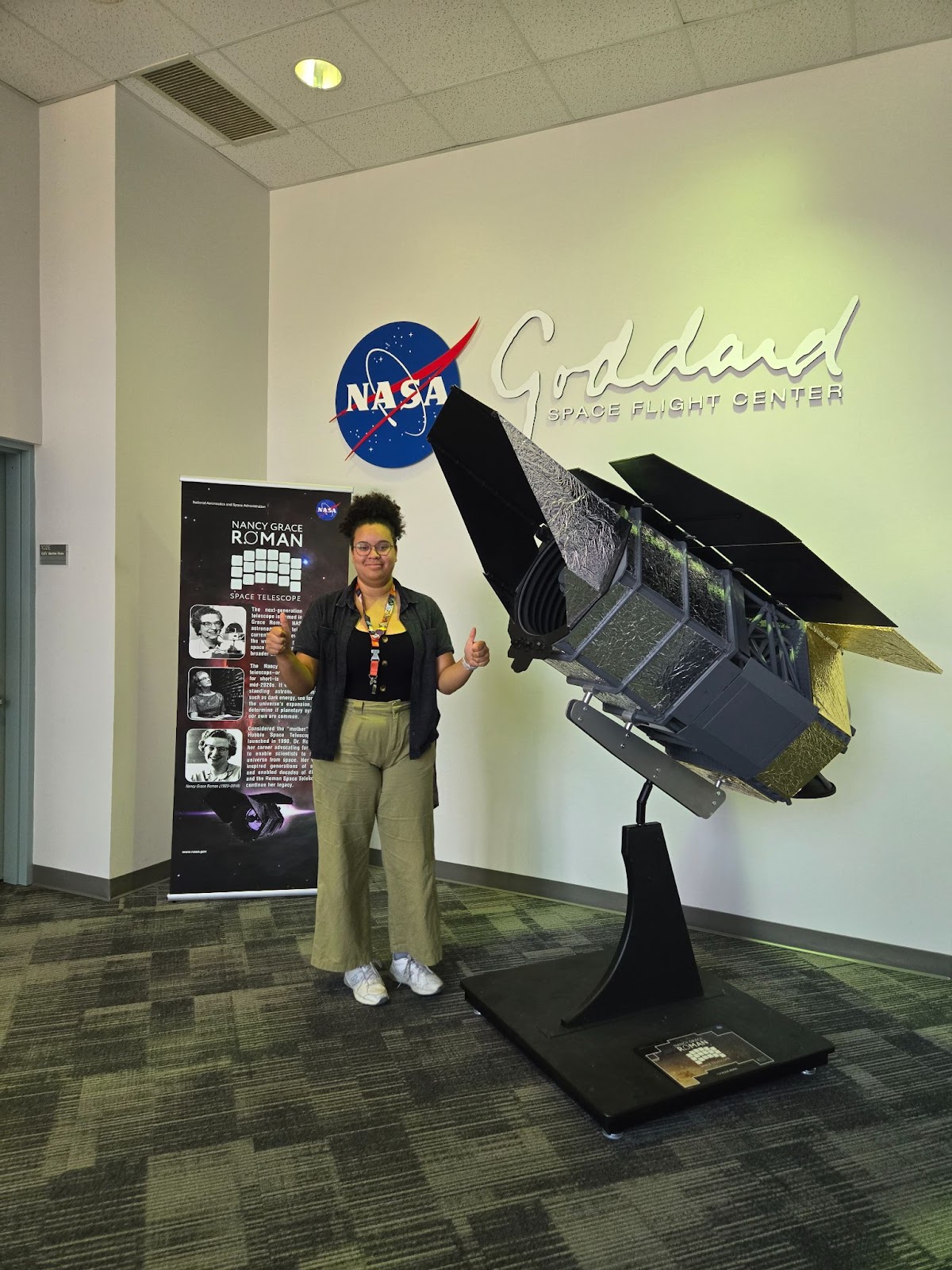
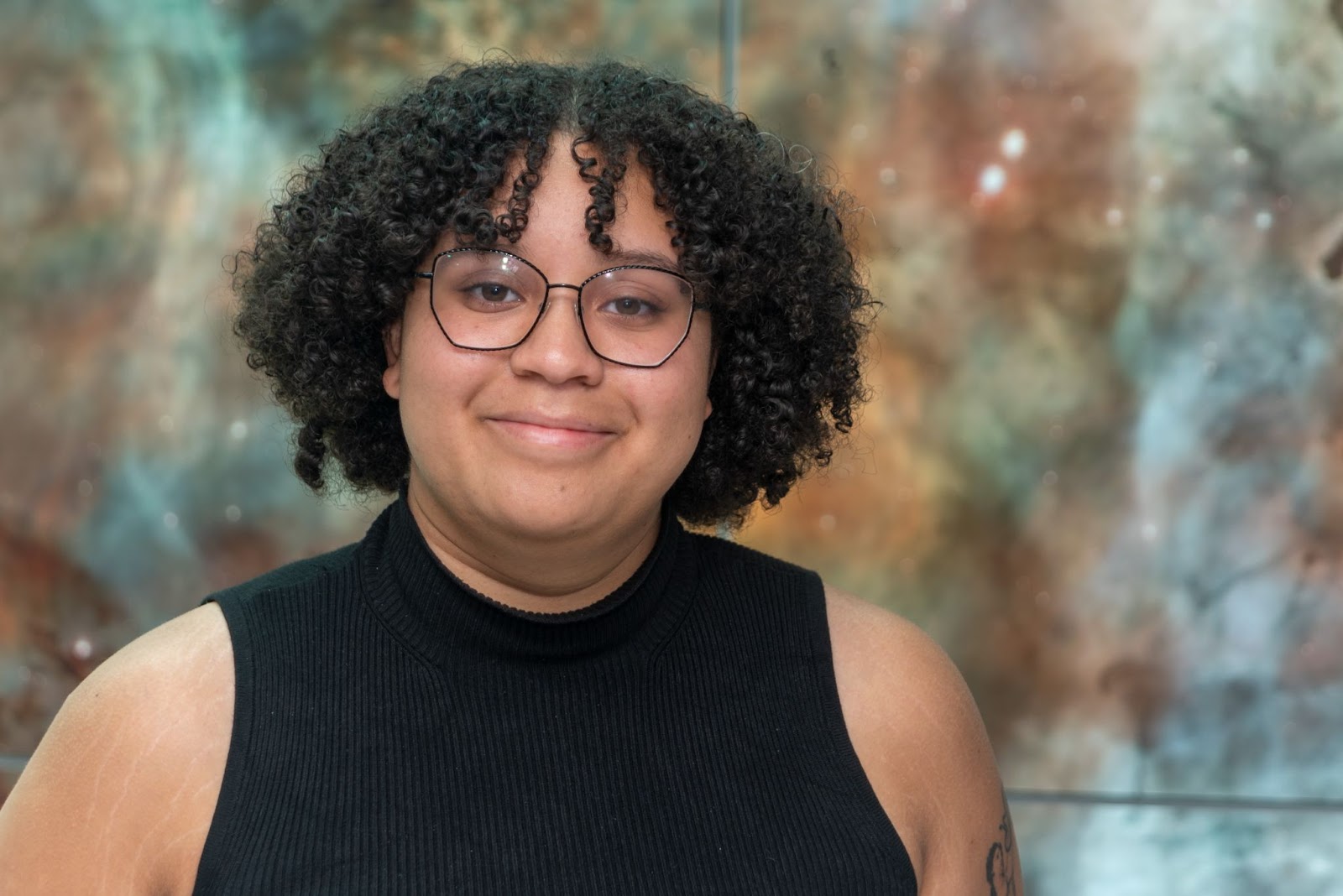
Below is our interview with Ellesse Lynum-Lozano, a senior undergraduate student at Embry-Riddle Aeronautical University, Daytona Beach Campus, as of Fall 2024. Raised in a military family, Ellesse had the chance to live in many places across the country while growing up, including Florida. It was here that Ellesse first found herself inspired by space via visits with her family to the Kennedy Space Center. Ellesse’s passion and enthusiasm have continued today, where Ellesse is now working towards a degree in Astronomy & Astrophysics with a minor in Computational Mathematics. This past summer, she interned at NASA Goddard Space Flight Center, where she worked on a project related to correcting detector effects on the new Roman Telescope, which is scheduled to launch by May 2027. She is also involved with research on the detection of binary stars. Ellesse believes that one of the keys to her success is not solely focusing on grades and taking things slow. The most important thing to her is maintaining her scientific passion while having fun. She finds this mindset helps propel her through any potential difficulties she faces. Outside of her studies, Ellesse is a collector of classic cult horror films and a consumer of all things science fiction. She enjoys traveling, especially to Colombia where her mother is from, reading, and crocheting sweaters for her hairless cats.
“…grades aren't everything. Being quick isn't everything. You don't need to be a young genius. I feel like most people that are in this field are just normal people. They have a lot of interests; they have a lot of passion and that's what got them the furthest. You don't need to be the smartest person in the office ‘cause everyone relies on everyone.” – Ellesse Lynum-Lozano
Transcript: Libby Fenstermacher and Ellesse Lynum-Lozano
Libby: Hi, everybody. Thanks for joining me today. My name is Libby Fenstermacher, and I'm here today with Ellesse, and she's here to talk with us about being a woman and a student in astronomy. So, thank you so much for being here today. Do you want to share a little bit about yourself and your background with us?
Ellesse: Yes. So just quickly, my name is Ellesse Lynum-Lozano. I'm an incoming senior at Embry-Riddle Aeronautical University. I'm majoring in astronomy and astrophysics. But my school isn't just about me. I'm from Orlando, FL. I was born and raised here, but I've been in a military family, so I moved around a lot. I've been from the East Coast to the Midwest, like all around the US. And just more about me is I'm an Afro-Latina. That's how I identify. I'm half African-American and half Colombian cause that's where my mom was from. So, that’s just a little bit about me.
Libby: Awesome. What inspired you to choose a path in astronomy slash astrophysics in the first place?
Ellesse: Yeah, I guess at first, it’s because I used to live in Florida. We have the John F Kennedy Space Center there, so it was always easy. I used to visit there when I was younger, and I remember I had this one trip. They had an astronomy exhibit and ever since then, I have been interested in learning more. And like my parents, they were very much like, you got to watch documentaries, you got to learn more. So, I would sit down, and I'd watch every astronomy space documentary there ever was. And then growing up, it'd just keep on growing. I had moments where I would leave and come back like, oh, astronomy is probably what I want to do. And by the time I got to middle school and high school, I started taking math courses and physics courses. And I was like, OK, this is probably what I want to do in the future. Astronomy is the way to go.
Libby: It hooked you. Got you in there. That's awesome. What about astronomy excites you?
Ellesse: I feel like astronomy, it's so big. It's a ginormous field. Like you can discover so many things. It's evolving. There are so many theories, so many sections of astronomy that you can always go into. It's not linear. It's not once you're in, you have to focus on one research project for the rest of your life. You can just move around, and skills apply to other things. I also think it's just cool. You get to learn about our universe, our world, the planets, how things began, and the building blocks of everything. There's so much to learn in so little time, so I'll never be bored. And yeah, it just allows me to be a part of something that's sort of bigger than myself. Because not everyone is going to discover something or be the person who discovers a black hole or be the person that discovers a new theory. It's just cool to be able to be involved in a generation that can be like, I helped lead to this. Maybe I didn't find it, but I helped do it.
Libby: Yeah, I feel the same way. That's why I'm here today with you. I just want to be part of all this future discovery. It's so exciting for our understanding of who we are and our place in the universe. I'm excited to see what you end up doing. What about astronomy do you find challenging and what have you done to overcome those challenges?
Ellesse: I think I already said math and physics. Astronomy requires so much background information, which is something I've learned. I guess more recently when I entered college, there's so much you need to learn to even prepare yourself to learn the bigger concepts. It's not all about cool stars and cool galaxies. You have to get into the math, get into the physics. And that was a huge sharing point. When I came to school, I was like, OK, I actually need to focus on learning these things. It might not always be interesting and exciting, but I feel like you sort of need to get through the more boring stuff, the more mundane stuff to get to the more exciting things. And I guess another challenge for me is I'm always the type of person where I like to focus on one thing, like this is what I want to do in the future. This is my goal. But I need to not limit myself. Cause with astronomy, just because you want to enter one field doesn't mean that's the field you're going to enter. Cause I could wake up one day and be like, I don't want to do this anymore. Like maybe I don't want to focus on stars. Maybe I want to move on to galaxies. Maybe I want to discover a different field. I just, you just, can't limit yourself. And that's a big, a big challenge for me. I don't need to focus on one thing. I can range out. Yeah, and it's just such a vast discipline. It's endless in what you can study, and that's what's exciting about it.
Libby: I’m excited for you. What do you think is a common misperception that people have about astronomy as a discipline and as an educational path?
Ellesse: Yeah, I know a huge misconception is it's all about sitting in an observatory, or at least what I thought when I was younger, sitting in an observatory. I'm out all night looking at stars and taking pictures and then going home the next day and starting over. That's barely what anyone does anymore. Like we don't go to observatories. That's usually a thing for the technicians. Everything's remoted in, everything's on your computers. And another one is coding. I had no idea astronomers did coding until I got to college. And I was like, oh, there's a whole new skill I have to learn now. And that was also a huge challenge for me because I feel like also because it's such a small field, not a lot of people are going around saying like, oh, you should go into computer science maybe to help you prepare beforehand. So that's a big part. And I know another misconception, especially with the educational path, is you have to go get your bachelor's in astronomy or you have to get a bachelor's in physics. I've met so many people who've gone in math. Or just computer science and they still go into astronomy. It's not one of those fields where you need to go for a specific degree. You could start anywhere. You could go to work and then join to be an astronomer. You don't need that PhD saying you're an astronomer to technically be one. So, there's a lot of different options.
Libby: That's some really, really solid advice. I'm going to quote you on that in in your in your little article. What are you currently working on right now? What projects?
Ellesse: Yeah, I'm currently at my internship here at NASA Goddard. I'm in Maryland at the moment. That's why I'm in a little different environment than I'm used to. And I'm just working on my project is mostly for like correcting detector effects that could affect like cosmology and results for like the expansion, constant, all these other interesting astronomy things for cosmology for the Roman Space Telescope and I know it's been a really a fun project so far, so I've been really excited about it. And then I know another project I'm sort of working on off and on because I'm here at the internship is I do research with one of my professors. So, it's mostly on binary star systems and we're just checking if it's a binary star. That's always fun to do. And I know outside of schooling and my projects, I know a big goal for me is I do want to do more outreach. I feel like it's really important for astronomers especially to do outreach because our field is so, everyone's in technical language, everyone's saying like scientific words. And so, the normal population who isn't like so focused on what we're doing won't understand why it's important. And so, I think it's really important that everyone can understand things and know how to maybe join the field.
Libby: Absolutely. Understanding our place in space is so important in terms of just understanding humanity as a whole. I mean, it's just anybody can be an astronomer, anybody can be inspired by space and just got to get out there and do it. What are your near future plans?
Ellesse: Oh, well, my near future plans are sort of just going. I'm very much “go with the flow”. So, I guess my biggest future plan is getting into grad school because I am becoming a senior, but I'm also sort of sporadic. Grad school is really important to me, but it's also maybe I want to take a break. So, I've been considering ‘postbac’ programs or just internships cause I know my philosophy is I don't need to go too fast. I think it's important that I'm learning, I'm having fun and I'm still interested in the field. I don't want to go so fast that I burn out by the end of the day. So, I just want to take things a little slower.
Libby: I am an adult learner myself and I personally found a lot of benefit from taking a little break. It ended up prolonging my journey and keeping me on the path in the long run. So, whatever you decide to do, it'll work out. What advice would you give to someone considering a trajectory similar to yours?
Ellesse: I would say going back on that, it's not a race against time. I know how I started with my trajectory is… I actually started college in high school 'cause in Washington where I was living at the time, they had this program called ‘Running Start’ and you could get your associate's by the time you graduated with your diploma, which is really fun and cool. But I now sometimes think maybe I should have just continued in high school because you sort of lose the aspect of just being a kid in college or being a high school student. It's not…you shouldn't be so hell-bent on education. And so, I think people, you just need to take it slow. It's not important that you need to be the one with the most research. You need to have the best grades. It's more important that you are able to still learn while having fun and being interested in it. And I think when other people look out and in and see that you're still really interested, you have so much passion for the field. It's not as important if you have straight As or if you have done like 10 research projects.
Libby: Absolutely. Did you receive any mentorship along your path? And if so, what is some of that advice that was given to you?
Ellesse: I receive a lot of mentorship from my professors cause I'm one of those students. I love talking to my professors and the advice that a close professor has given to me is to always talk to people. When I first entered my first year of college, I didn't do anything. I wasn't… I was focused on getting good grades. I would go to a club meeting once a month. I wasn't really talking to my professors. But it's so important that you make connections early on. And it's not just (that) I need to make connections to get a job with them. You want to make connections to (...) have people you can rely on, have people that can at the end of the day say like this person is really good at this. Or just having someone to give you advice. Cause if I never talked to my professors this year, I would have never found so many people I could rely on. Cause I go to them for everything. I go to them for life problems, not just academics. And cause there they're just senior. They have lived a longer life than me. So, I can always just rely on them for those things.
Libby: That's so important to have that community and that network. And have those people that are willing to support you. I'm glad that you found that at Embry-Riddle. That's wonderful.
Libby: What, if any, changes would you like to see for women in astronomy?
Ellesse: I think there's always a ton of changes. I know for me there's always this competitiveness that I need to be better than you. I need to do more than you. And I know a big problem with women in astronomy specifically, is sometimes women get barred out of these conversations or they're not involved in this research or they're not able to do as much. And I think there doesn't need to be any competitiveness like that. Like it's good to have a little bit cause we can, you know, more competitiveness, we can get more done. But, when there's so much, it just doesn't become a welcoming environment anymore. And that's another big problem, is that there are certain fields in astronomy. I know, and I've been warned that it's going to be hard to be able women to enter this field. Others have had more progression than others. But I know for like more theoretical or even like cosmology, some certain fields, it can be sort of wishy-washy, like maybe be careful, maybe be more cautious. And with that, I know I would love to see more support groups. Recently I've been seeing a lot more women in astronomy groups or helping mentorships for them. And I think it's cool if these certain environments can happen everywhere, like even in universities, there should be a women in astronomy type of program. So, we can encourage more development and see more changes.
Libby: Well, I would encourage you and anybody else watching this to check out the Committee for the Status of Women in Astronomy's page on the American Astronomical Society's website. And there's a ton of resources on there about mentorship and about all sorts of problems that women face in astronomy. So, I'd encourage you to check that out. It's a great resource. So, we're down to our last two questions here. Thanks again for being here today. This has been so informative and so inspiring.
Libby: And now we're going to go off the astronomy track and you're going to tell me what your favorite movie or TV show is.
Ellesse: I’m like a huge nerd, so of course my favorite movie is Interstellar. I wouldn't be an astronomy student without it being my favorite, but it isn't my only one. I know I love horror movies outside of astronomy. I have a huge passion. I collect horror movies VHS tapes, anything John Carpenter… give it to me. Or I know one of my favorite scary movies is The Shining or American Psycho. Those two are really good. And as for TV shows, I'm a huge I watch everything in my off time when I'm not in school. I love watching, whether it be reality TV or documentaries. I know like a really big TV show that everyone's going about is Game of Thrones. I’ve just started entering the Game of Thrones era. I've just started watching it. So, it's been really good so far.
Libby: Yes. Welcome. Welcome to Westeros. Are you? Are you into the Trek?
Ellesse: I am. I am, I am extremely into the Trek.
Libby: Me too. Me too. It's my home. If only if only we lived with the...I mean, I feel like NASA is our own version of Starfleet, frankly.
Ellesse: But it basically is. I think we're basically one of the fleets.
Libby: Yep, absolutely. Well, is there anything else you'd like to share with me today?
Ellesse: No. I guess just like overall for advice I've learned that I think is super important, that everyone needs to know is grades aren't everything. Being quick isn't everything. You don't need to be a young genius. I feel like most people that are in this field are just normal people. They have a lot of interests; they have a lot of passion and that's what got them the furthest. You don't need to be the smartest person in the office ‘cause everyone relies on everyone. Everyone gets advice from other people.
Libby: That's wonderful advice and I am so excited to see what you end up doing on your path. I'm going to be keeping tabs and looking for you in journals. But thanks again for being here this has been wonderful, and I can't wait to share your story. Have a great rest of your day.
Ellesse: Thank you. You, too! Thank you so much for having me.
The space scientist and broadcaster describes how she deals with racism, taps dyslexia’s hidden powers and inspires disadvantaged students to pursue science careers.
Credit: Steven May/Alamy (nature.com)
Maggie Aderin-Pocock is the most famous Black female scientist in the United Kingdom. She has co-hosted the BBC’s long-running astronomy television programme The Sky at Night since 2014, and earned a BAFTA nomination (from the British Academy of Film and Television Arts) for her work on the children’s programme Stargazing in 2016.
She studied at Imperial College London, obtaining a bachelor’s degree in physics in 1990 and a PhD in mechanical engineering in 1994. She has worked on many space-technology projects, notably on a number of satellites to monitor climate change and on NIRSpec, one of four scientific instruments on the James Webb Space Telescope (JWST) that allow it to survey extremely distant galaxies.
Over the past 20 years, Aderin-Pocock has also focused on science communication, encouraging under-represented groups to enter science, technology, engineering and mathematics (STEM) careers. So far, she has given talks to more than 500,000 people globally.
Since 1976, every American president has officially designated February as Black History Month, a celebration of achievements by African Americans and a time to acknowledge and recognize their central role in American history. The annual event grew out of "Negro History Week", initiated by historian and civil rights leader Carter G. Woodson and other prominent African Americans. Around the world other countries also devote a month to celebrating Black history. Read more about the month's history here.
Organizations that support scientists in astronomy and physics have provided resources, guidance, and advice for advancing the careers of Black astronomers and physicists. Below is a partial list.
Chanda Prescod-Weinstein still remembers how appalled her father was when she pointed to a stream of light spanning the sky and inquired, “What is that?”
“My dad just looked at me like, ‘What. . . is wrong with you?’” Prescod-Weinstein recalled with a laugh. “That’s the Milky Way,” he told her.
Neither one of them knew for sure during their camping trip among the giant sequoias nearly three decades ago that Prescod-Weinstein, then 14, would grow up to be a theoretical physicist specializing in early universe cosmology, though the teenager had already expressed an interest in the field. Spending her youth in light-polluted Los Angeles, however, had robbed Prescod-Weinstein of the opportunity to study the night sky, so it took driving hours out of the city to finally see the Milky Way.
Today, the teen who didn’t recognize her own galaxy is not only an expert on the cosmos but also a trailblazing scholar.
[Eds note: Free access is possible, and a subscription may be required.]
Photo: Ryan Lash/TED
WHEN AOMAWA SHIELDS temporarily left astronomy in the 1990s for a life in the theater, no one knew whether planets existed beyond our solar system. By the time she returned to academia 11 years later, hundreds of exoplanets had been discovered. Today, telescopes and detection methods have advanced so much that the discoveries number close to 6,000.
Shields, now an astrobiologist at UC Irvine, studies these distant worlds using computer models to evaluate their climates and assess whether they might be friendly to alien life. During this second stint in academia, she completed her PhD at age 39 and afterward gave birth to her daughter. She has been named a 2015 TED Fellow, she’s the recipient of multiple grants and awards from NASA and the National Science Foundation, and she’s the founder and director of Rising Stargirls, a program encouraging girls of all colors to learn about the universe through theater, writing, and visual arts.
In her new book out today, Life on Other Planets, she discusses her scientific work, as well as her own experiences as one of the few Black women in physics and astronomy and as a classically trained actor who completed her master of fine arts degree at UCLA.
Dr. Moiya McTier is the author of The Milky Way, an autobiography of our galaxy told from the perspective of the galaxy itself.
More than a decade ago, before getting swept into the maelstrom of high school, I went through a star-gazing phase. A Girl Scout summer camp program for astronomy was followed by nights on the deck of our sailboat, staring at the sky to identify constellations and other planets in our Solar System. One summer night while out on Lake Erie, the sky was so clear that the Milky Way was a vibrant white swathe splashed across the darkness.
In more recent years, my nighttime musings have been marred by the light pollution over Chicago. But I still headed out to watch the lunar eclipse this past May, and have been thrilled to meet with an astrophysicist neighbor and use his telescope to spot nebulae. No matter where I am in the world or in my life, the night sky is enchanting.
That’s something I share with Moiya McTier, a science communicator who brings her love of folklore and astrophysics to her new book, The Milky Way: An Autobiography of Our Galaxy. We talked about bringing fictional inspiration into complicated science, the dream of uniting science and the humanities, and all the ways that learning about the Milky Way can make us better humans.
Aboard the International Space Station, Expedition 67 Flight Engineer Jessica Watkins of NASA discussed life and work aboard the orbital outpost during an in-flight event September 7 with the Stanford University alumni magazine. Watkins is in the midst of a science mission living and working aboard the microgravity laboratory. The goal of the mission is to advance scientific knowledge and demonstrate new technologies for future human and robotic exploration missions as part of NASA’s Moon and Mars exploration approach, including lunar missions through NASA’s Artemis program.
Check out this incredible interview with Stanford University alum, martian geologist, and the first Black woman to participate in an ISS long-term space mission, Jessica Watkins!
The AAS Committee on the Status of Women in Astronomy and the AAS Employment Committee have compiled dozens of interviews highlighting the diversity of career trajectories available to astronomers, planetary scientists, etc. The interviews share advice and lessons learned from individuals on those paths.
Dr. Samaiyah Farid is a postdoctoral researcher in the astrophysics department at Yale University studying the Sun’s outer atmosphere, or corona. She earned both her bachelors and masters of science at Alabama Agricultural & Mechanical University, before graduating with her doctoral degree in astronomy and astrophysics at Vanderbilt University.
How did you first become interested in physics/astronomy?
I have been interested in astronomy since I was a kid! My first realization that I wanted to study astronomy was around 8 years old. I grew up in rural Alabama, so the night sky is very bright and almost overwhelming. I was just amazed with the vastness of space and had lots of questions about the universe. However at that time, I didn’t think studying astronomy could be a job, and the one thing I wanted more was not to be poor. It wasn't until high school physics that I discovered that I could study astrophysics for a living. In fact, until high school, I had never heard the term ‘astrophysics’. I always wondered why everyone wasn't busy figuring out the physical laws that govern the universe and thought I was the only one! Haha. It was a rural area.
Describe the first time you made a personal connection with the universe.
Once, while outside looking at the stars (something we did a lot), my older brother Jauhar said “when you look at the night sky you are looking back in time.” My mind was blown and I started a quest to understand it. I thought that if everyone could see the sky like this and spend time wondering about the universe, then there would be no war or injustice. Whenever I looked at the night sky, I felt like it was consuming me. I thought if I stared at it long enough I would atominize and be sucked up into the stars. Coincidentally, this feeling (and aliens) led to longstanding fear and avoidance of the night sky, but also a desire to understand the universe.
What has your career path been like since graduating with your PhD?
My experience as a postdoc has been interesting. First, I would have never guessed in a million years that I would be a postdoc at Yale. I feel very fortunate. I started during the pandemic so I have had a non-typical experience. The most important thing I have learned as a postdoc is not science related. I learned that how I feel about myself is reflected in my ability to do research, write papers, and present my work. Imposter syndrome is often discussed but what is not discussed is how much it affects your self-esteem and internal value. I have always felt out of place, even as a kid. But, never finding your ‘tribe’ in a field that is a large part of your identity, is very isolating and can be detrimental to your sense of self. I didn't realize how much work it takes to overcome the trauma of out of control imposter syndrome. As a postdoc, I have the resources to find a therapist that understands my perspective. That has been very helpful. For many people, your goal as a postdoc should be to publish as many papers as possible. That mindset was further damaging my mental health and affecting my ability to be a good parent. So now, I try to focus on being healthier and taking small but consistent steps towards my research and writing goals. It's a slower process, but a healthier one. Science and learning in general feels very intimate for me, so I have always had a hard time separating ‘myself’ from my accomplishments in science. Learning to separate my self-worth from my accomplishments or lack thereof is something that I am currently working on.
What have been particularly valuable skills for your current job that you gained from completing your PhD?
Graduate school was really useful for honing skills that help conduct research like computer programming, organizational tactics, focusing tactics, and writing tools. However, the ‘skill’ I cherish the most is the being OK with asking a million questions, even if they are stupid, and my advisor, Dr. Kathy Reeves, did not get frustrated or bored or impatient or make me feel like a burden (maybe they did but they never said so). I really appreciate my research advisors and mentors for giving me that space. It has always been difficult to sit through a lecture that discusses amazing ideas, then have to just go home with so much in my head. So getting comfortable with that part of myself was probably my biggest ‘skill’. It also taught me a lot about the type of mentor I would like to be. I screwed up so much as a grad student. I fell behind in classes, missed paper submission deadlines, struggled with childcare, even took time away to take care of my mom. I was a mess. Through all of that my mentors and instructors were patient and kind - well most of them. I thought that I would be sent packing any day, at any time, but somehow I was never kicked out!
So one skill I will try to implement as a mentor is to help students see past the ‘moment’. There will be many hard moments in graduate school when you may feel like it is the end and you need to quit, go home and sell eggs by the side of the road. But my advisors, instructors, and peer mentors helped me get through those moments and learn that there is a solution to every problem. Neither of these skills are directly related to coursework, but I think internal battles are much more difficult. One skill I wish I could have learned as a grad student is to ask for help! I am still working on that now. The coursework was challenging and it always took me a really long time (usually much longer than the assigned time), so it would have been better to go to the instructors and classmates for help, and to ask for help often. I have fairly intense anxiety so working in groups makes it hard for me to focus. So, asking for one-on-one help would have helped me manage coursework better.
One more skill that I learned as a grad student and still use now, is starting your day with positive, motivating, phrases and lectures. I began listening to self-help speakers like Les Brown when I was finishing my research. It was really helpful. The hardest part of my day was usually walking into the building and into my office. Once I was into my work I could block out the world, but my anxiety getting to my office was intense. My older sister introduced me to motivating lectures and it helped drown out the ‘bees’ and helped me get through the door. I still listen to a mix of positive affirmations, Tupac, and Kanye on the way to work.
How did you end up working in your field?
Serendipity. Fate. The ancestors. It's a winding story. As a freshman I wanted to study black holes and how particles behave in extreme environments. Of course, part of that reason was so I could figure out how to build a time machine and teleporter, but also because I wanted to understand the most fundamental laws of the universe. At that time, in 1998/99, blackholes were still just theory. I will never forget my professor telling me it was a waste of time being interested in black holes. I internalized everything, so of course, what that meant to me was that I was a waste of time. I was a bit lost after that, but still secretly interested in extremes of the universe. I transferred to Alabama A&M University and planned to just get through undergrad so I could go study with Kip Thorne. Ha ha! A completely unrealistic goal. As an undergrad I went on a number of summer REUs. One summer was at Berkeley Lab with Dr. Hakeem Oluseyi. My job was to test part of a CCD (charge-coupled device) that would fly on a mission called SuperNova Explorer studying Type 1A supernovae and the acceleration of the universe. This experience reignited my interest in astrophysics. Coincidentally, when I was preparing to graduate, Alabama A&M started a graduate program in Space Science and Dr. Oluseyi joined as an adjunct, so I stayed on for graduate school to work with him. At that time, he was interested in solar physics, specifically polar plumes, so that became my focus. I was even able to travel to Ghana to collect data during a total solar eclipse! A little later, Dr. Amy Winebarger, also a solar physicist, joined A&M and became my primary advisor. I’ve been in solar physics ever since! It's not blackholes, but I think it's better! I get to look at mind-blowing solar data everyday!
What are some of the challenges and rewards of working in your field?
There are soooo many rewards! Thinking about science, talking to other people about science, teaching people about science, traveling to see total solar eclipses, analyzing cool data, learning new things, figuring out hard problems, thinking of new ways to answer big questions, etc… all for free! In fact, I get paid to do it!!!
There are also many challenges. I have struggled every step of the way with one challenge or another. Writing code, meeting deadlines, writing papers, etc., those things are very challenging. However, the biggest challenges have been the social and emotional aspects of science. Feeling like and/or being treated like you are not a normal human from planet Earth has by far been the biggest challenge. Feeling like you don’t belong, that you are always being examined under a microscope; feeling like you will never measure up and that you are illegitimate are the most difficult challenges. Being the only Black person and/or Black woman in a sea of white people and not knowing why is difficult. Trying to understand why no one thought that it was weird that there were no Black or brown people at physics conferences or universities. Did people not think about it or did they think Black and brown people didn’t like science? Being told in one way or another that I don't belong is difficult. It turns out that research is tedious but nothing compared to the social challenges. There have been so many times I wanted to leave science and raise chickens, but I know that I wouldn't be satisfied….also I kinda hate chickens.
How do you manage all of the different demands on your time?
I am a single parent, so it has been difficult to balance science-life and home-life. It is really great that my current position is very flexible so that I can work around any personal responsibilities. One big perk of being in science is that often the jobs are flexible. However, I can't say that I have figured out how to balance work and life. My social life has suffered, my professional life has suffered, and my family has suffered, but I am grateful because it could be a lot worse.
If you weren’t in your current field, what would you be doing?
I have no idea. I have only ever wanted to study astrophysics, ponder the mysteries of the universe, and ‘save the world’. If I had another job, I am sure that I would still study astrophysics as a hobby. Right now, I would love to work with a think tank to address and solve big Earth-based social problems. However, I would still like to be a solar physicist in some capacity.
Tell us about a favorite moment so far in your career.
Observing total solar eclipses are the top experiences of my career. In theory, I know that we are on a big rock, flying through the infinite universe, but during solar eclipses, I can feel it! It's awesome and terrifying at the same time!
Do you have any advice for students just starting their career in science?
Just keep swimming. Many times in life the path is not clear. You may have no idea how you will pass your courses, or afford grad school, or find a job, or raise your child. But keep at it anyway. Even if you don't feel like you are worthy. Do it anyway. One day, you might look around and see that you have grown and accomplished much more than you ever imagined. It's hard enough to know yourself, don't worry about figuring out the motivations of other people. This is your life, this is your time, so take your time. Spend less time on A’s and accomplishments and more time on asking yourself who you are, why you are, and why you feel the way you feel. Therapy is awesome. Be kind, even when you don't have to be. Figure out your fundamental motivation and that will help you overcome obstacles. Face your fears. Everyone else is afraid too. The single most important thing I have learned is that you can't get it wrong, but you only have one life so just be. Finally, if you just can't seem to get yourself together no matter how hard you try, or how bad you want to, talk to your doctor about Wellbutrin. It sounds like a commercial but antidepressants have really helped me.
Describe your approach to job hunting, any networking resources you use, and any other advice/resources for early career professionals looking for positions in your field.
I have been unusually lucky and blessed. My advice is to try to be true to yourself. Try to do the right thing. Be kind to everyone. Most of the best opportunities I have been given were through networking, so your relationship with people matters. For a long time my advice was, ‘Go! Never say no to an opportunity’, but I am not sure that is good advice anymore. My advice would be to go where you are wanted, not tolerated. Take care of yourself. Apply. Apply. Apply anyway. Look for jobs that bring you JOY, never for what you will get from the job (money, status, etc.). Don't listen to naysayers. The most important resource is people, so go to conferences and meet people as much as possible.
What advice do you have for achieving work-life balance (including having a family)?
I have not figured this out. I am lost and have no good advice. My experience has always been similar to a see-saw. If I am finally focused and doing great work, my daughter will be miserable. If my daughter is happy, I am not getting any work done and I feel horrible about it. The only advice is to try to detach your self-worth from your ‘accomplishments’ because you need to save that mental energy for home. I also try to remember that I have the rest of my life to ponder the universe, so if I get fired (which I feel like is always a possibility) that will be okay. But if I screw up my child, that is not okay. Also, I have no personal life but that is okay too. My advice would be to not be like me. Establish a good support system and use it often.