Showing posts with label STEM equity. Show all posts

Thursday, January 13, 2022

Crosspost: Advancing equity, diversity, and inclusion: a how-to guide

Written By Dr. Rowan M. Thomson, Canada Research Chair, physics professor, and assistant dean at Carleton University for Physics Today
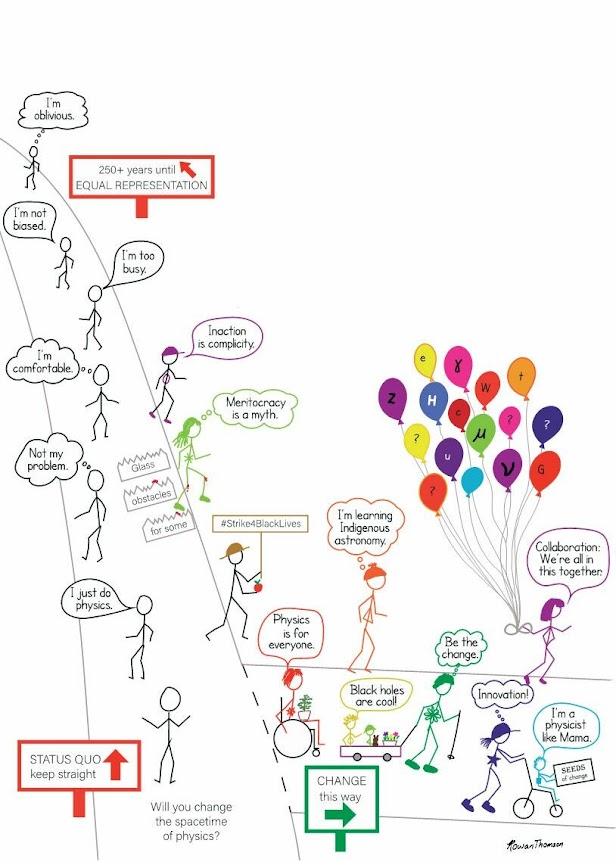
Dr. Thomson's vision for the future of physics as a field that includes, accommodates, and values everyone, regardless of the gender identity, race, or disability status. Credit: Physics Today

Looking around the lunchroom on my first day at my first job in physics—as a summer student in a Canadian national laboratory—I was shocked to see that almost all the scientists present were white men! I loved that job and was thrilled to be paid to do physics, but I was disappointed in the lack of diversity at the lab. I expected that things would get better as I continued in my career. Surely, I thought, the diversity of the general population would begin to be reflected in physics. But 20 years later, my optimistic expectation has proven naive. The lack of diversity in physics is still striking. Moreover, the issues in the field go beyond representation. Insidious inequities, pernicious discrimination, and systemic barriers continue to prevent the inclusion of everyone in physics.

The numbers confirm that many groups are underrepresented in physics: Data from a recent NSF report demonstrate that among recent PhDs awarded in physics, Black, Hispanic, and Indigenous people, women, and individuals with disabilities are underrepresented by factors of about two to five.1 The representation of individuals in physics identifying as lesbian, gay, bisexual, transgender, queer, intersex, asexual, and additional identities (LGBTQIA+) has received less attention, but those groups are certainly underrepresented too.2,3 And representation gaps seem set to persist for a long time. To take just one example, currently only 13% of senior authors of articles in physics are women. That number is rising by only 0.1% per year—at that rate, it will take 258 years to come within 5% of gender parity!4
What factors lead to those disparities in representation? What are the challenges faced by equity-deserving groups? Why should physicists be motivated to effect change? What can physicists do to help the field improve? This article is a call to action for all physicists to work together on concrete and sustained efforts to advance equity, diversity, and inclusion through awareness, collaboration, and engagement.

Check out the rest of the article to learn more about Dr. Thomson's inspired plan for helping physicists at every career level make the field of physics more inclusive:

Thursday, December 9, 2021

Crosspost: Record number of first-time observers get Hubble telescope time

Written By: Dalmeet Sing Chawla for Nature
Credit: Space Telescope Science Institute

An unprecedented number of first-time investigators have secured viewing time on NASA’s Hubble Space Telescope in the years since the agency overhauled the application process to reduce systemic biases.

In 2018, NASA changed the way it evaluates requests for observing time on Hubble by introducing a ‘double-blind’ system, in which neither the applicants nor the reviewers assessing their proposals know each other’s identities. All the agency’s other telescopes followed suit the next year.

The move was intended to reduce gender and other biases, including discrimination against scientists who are at small research institutions, or who haven’t received NASA grants before. “The goal of submitting an anonymized proposal isn’t to completely eradicate any evidence of who’s submitting, but rather to have that not be the focus of discussion,” says Lou Strolger, an observatory scientist at the Space Telescope Science Institute (STScI) in Baltimore, Maryland, which manages Hubble.

Check out the rest of the article at: https://www.nature.com/articles/d41586-021-03538-8

Tuesday, November 23, 2021

Crosspost: Madagascar STEM Non-profit Completes a Successful OAD Proj

From the International Astronomical Union's Office of Astronomy for Development


A team of female scientists from Ikala STEM (Women in STEM – Madagascar) implemented LAMPS (
Leveraging Local Astronomy to Promote STEM)a project to directly address the inequality between urban and rural Madagascar in accessing quality STEM education and to showcase the relevance of science in everyday life. Originally planned to be held in the AVN-host city of Arivonimamo, this Office of Astronomy for Development-funded project was adapted to a two-stage STEM education hybrid event, a one-week online activity (e-LAMPS) and school visits by LAMPS volunteers, due to the COVID-19 pandemic.

e-LAMPS online program
e-LAMPS was held in June 2021 under the theme “Science in our daily life” or “STEM, incontournable dans notre quotidien” in French. Primarily targeted at middle and high school learners as well as tertiary students, e-LAMPS was designed to substitute the planned in-person STEM Fair (cancelled due to the pandemic). The event consisted of online quizzes, games, talks etc, targeting Malagasy middle and high school learners all over the country. The Ikala STEM Facebook page and website as well TV (TVM, Dream’in, TV Plus Madagascar) and radio (Fivoarana in Arivonimamo, RNM reaching around the country) stations, printed newspapers (e.g. L’Express de Madagascar) and posters were used to ensure maximum reach for e-LAMPS. Seven STEM-focused NGOs partnered with Ikala STEM during this virtual component of the project. More than 100 high school learners participated in the e-Quiz Contest and at least 15,000 people were reached virtually throughout the event.


Read the rest of the article and learn more about the the IAU OAD's work in Madagascar here: https://www.astro4dev.org/2021/11/02/madagascar-stem-non-profit-completes-a-successful-oad-project/ 

Thursday, August 12, 2021

Crosspost: Mallory Molina awarded Ford Fellowship for astrophysics research, diversity efforts

 Written By Rachel Hergett for MSU News Service

Credit: Adrian Sanchez-Gonzalez for MSU

Mallory Molina, who studies black holes in dwarf galaxies at Montana State University, was awarded a 2021 Ford Foundation Postdoctoral Fellowship in June.

In addition to recognizing the academic achievements of the awardees, the competitive Ford Foundation Fellowship Program — administered by the National Academies of Sciences, Engineering and Medicine — is grounded in a mission to increase diversity on college campuses.

“The Ford expects you to not only do research but to increase the diversity in higher academia, using the diverse human experience to enrich the academic experience,” Molina said. “It speaks to how both my research and my equity and inclusion efforts are valuable. That means a lot to me. Equity and inclusion work has always been a very strong component of who I am as a researcher.”

Molina is one of 26 postdoctoral Ford Fellows for 2021 and the first postdoctoral fellow at MSU. The fellowship includes a $50,000 stipend and an invitation to attend the Conference of Ford Fellows in October. It will support Molina’s ongoing inclusion initiatives and fund a year of astrophysics research with Amy Reines in the Department of Physics in MSU’s College of Letters and Science.

“Mallory is exactly the kind of person we need as a leader in academia,” Reines said. “In addition to being a top-quality researcher making important discoveries, they also work hard toward making physics and astronomy more inclusive.”

Molina knew they wanted to be an astronomer at age 4, when a visit to NASA’s Johnson Space Center in Houston opened their mind to myriad questions about the universe. But early in their academic career, Molina considered abandoning the dream.

“It wasn’t because I didn’t like astronomy,” Molina said. “It was because I felt isolated and alone.”

As a Mexican American, Molina was met with negative comments and cultural bias from peers as an undergraduate student at Ohio State University. The young university student craved a supportive community within the field, people to engage in conversations about the things they were learning and share in the struggles.

Molina was discouraged and the situation didn’t improve in graduate school. The Sloane scholar was contemplating dropping out of Pennsylvania State University when they reached out to their academic inspiration: their father, David, who grew up in Mexico City and is now chair of the economics department at the University of North Texas. Molina’s father pushed them to find other solutions, both for themself and students who come after.  

“If someone leaves because they don’t like astronomy, fine,” Molina said. “But it’s not fine if they leave because they think no one cares.”

Read more about Dr. Molina's work creating equitable spaces for future astronomers and her incredible research on supermassive black holes at the link below:


Tuesday, May 11, 2021

Crosspost: Black women’s experiences in STEM inspire an annual workshop

By Bryné Hadnott

When LaNell Williams arrived at Harvard University in 2017 to begin a graduate program in physics, several of her peers told her she had been admitted only because she was a Black woman—her 3.9 GPA, NSF Graduate Research Fellowship, and two coauthored scientific papers notwithstanding. During an open house for the incoming class, she asked her fellow students why they thought no other underrepresented racial minority woman had been admitted to the physics department that year. “We [women of color] hear many different things in those conversations, one of them being that we’re not interested in physics, which isn’t true,” Williams says. “Or that some of us don’t have the pedigree, which is also not true. And then the last thing is that we don’t apply—and in some cases that is true.”


Photo courtesy of LaNell Williams

In Williams’s experience, however, many women of color had both the grades and the aptitude for physics, but they were discouraged from applying to graduate programs by their professors, advisers, and classmates. “I wanted to prove them wrong,” she says of her peers at Harvard. She was determined to show just how many talented candidates there really are. “I wanted to say to those women that you are as good as, if not better than, some of the people who might be applying to graduate school,” Williams explains.

In 2019 Williams founded the Women+ of Color (WOC+) Project, an annual three-day workshop that encourages women and gender-nonconforming people of color to pursue advanced STEM degrees and provides resources on how to apply for and succeed in graduate school. The WOC+ Project has gone on to win the Materials Today Agent of Change Award. Now, Williams, graduate students L. Miché Aaron and Ayanna Jones, and several other graduate student volunteers are working to expand the workshop’s scope to support women of color throughout their academic careers.

Read the rest of the article at: https://physicstoday.scitation.org/do/10.1063/PT.6.5.20210510a/full/